Solana Yield Landscape: Q2 2026 Overview
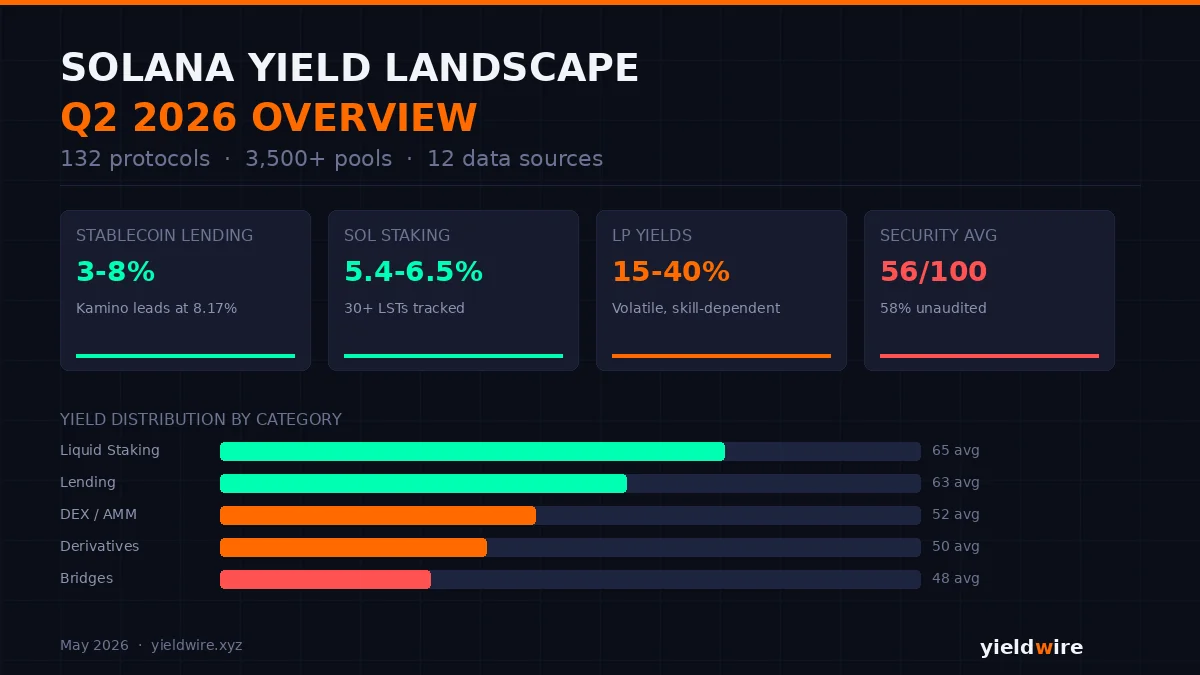
Stablecoin lending yields hit 8%, SOL staking holds steady near 6%, and LP returns stay volatile. Here's what Q2 2026 looks like across 132 protocols and 3,500+ pools on Solana.
The Big Picture
Solana DeFi is maturing. Fast.
Q2 2026 has been a quarter of consolidation rather than explosion. Lending yields are stabilizing into a predictable 3-8% band for stablecoins. SOL staking sits comfortably at 5.4-6.5%. LP yields remain the wild card, anywhere from 15% to 40%+ on major pairs, with enough volatility to keep things interesting.
We track 132 protocols and 3,500+ pools across 12 categories on yieldwire. This is what the data says about where yields stand right now, what's compressing, and where the opportunities moved.
Stablecoin Lending: The New Baseline
Stablecoin lending on Solana has become the closest thing to a "savings account" in DeFi. The rates are real, they're competitive with TradFi, and the spread between protocols tells you a lot about how each one manages risk.
| Protocol | Asset | APY | TVL | Risk Score | Grade |
|---|---|---|---|---|---|
| Kamino Lend | USDC | 8.17% | $1.5B | 79 | B |
| Lulo (aggregated) | USDC | 7.84% | $87M | 63 | C |
| Jupiter Lend | USDC | 3.70% | $874M | 75 | B |
| Save (ex-Solend) | USDC | ~3.5% | $77M | 67 | C |
| marginfi | USDC | ~4.2% | $38M | 71 | B |
Kamino dominates with a $1.5B TVL and the highest USDC rate among major protocols. Jupiter Lend, despite being the second-largest lending platform, pays roughly half of Kamino's rate on the same USDC. Same asset, same chain, completely different risk profiles and utilization dynamics.
The spread between Kamino (8.17%) and Jupiter (3.70%) isn't random. It reflects utilization rates, borrowing demand, and each protocol's reserve factor design. Higher utilization means higher rates for depositors, but also means your withdrawals might queue during peak demand.
For context: the US 10-Year Treasury yields roughly 4.3-4.6% right now. Solana stablecoin lending at 7-8% offers a meaningful premium, though with smart contract risk that treasuries don't carry.
Lulo sits in an interesting position as a yield aggregator. It routes deposits across multiple lending protocols to optimize returns. The 7.84% rate reflects this aggregation, but adds a layer of smart contract exposure on top of whatever underlying protocol your funds end up in. Our deep dive on yield aggregators covers how this works.
SOL Staking: Steady, Predictable, Differentiated
Liquid staking tokens (LSTs) are the most predictable yield source on Solana. The rates cluster between 5% and 6.5%, driven by network inflation and MEV tips. But the spread within that range is wider than most people realize.
| LST | APY | TVL | Key Differentiator |
|---|---|---|---|
| dSOL | ~6.5% | ~$64M | Smaller, fewer integrations |
| jupSOL | ~6.2% | $814M | Validator selection by Jupiter |
| jitoSOL | ~5.7% | $895M | MEV tip redistribution |
| mSOL | ~5.1% | $278M | Oldest, most liquid, most integrated |
The pattern is clear: smaller LSTs tend to offer higher yields, larger ones trade yield for liquidity and composability. jupSOL at 6.2% earns more than jitoSOL at 5.7%, but jitoSOL has deeper DeFi integrations across Kamino, Orca, and Raydium. mSOL pays the least at 5.1% but has been running since 2021 with the deepest liquidity pool.
dSOL quietly yields 6.5%, the highest among tracked LSTs. The tradeoff: fewer protocol integrations and lower TVL, which means less battle-testing. Our LST comparison breaks this down further.
Sanctum's validator LST infrastructure now supports 30+ liquid staking tokens on Solana. Most of the long tail is small, niche, or validator-specific. But the diversity means there's more room to optimize than the top-3 headlines suggest.
LP Yields: High Reward, High Skill
Liquidity provision remains the highest-yielding category on Solana, and the most demanding. Major pair LP yields run 15-40%, but the variance is enormous and the risks are proportional.
| Pool | Protocol | APY | TVL | Risk Level |
|---|---|---|---|---|
| SOL-USDC | Raydium | ~25% | $48M | High (IL + directional) |
| SOL-USDT | Raydium | ~22% | $15M | High |
| RAY-USDC | Raydium | ~18% | $12M | High |
| SOL-USDC | Orca (0.04%) | 15-35% | $30M+ | High (concentrated) |
| USDC-USDT | Orca (0.01%) | 8-18% | $15M+ | Low-Medium |
Two dynamics stand out this quarter.
First, concentrated liquidity pools on Orca and Meteora are pulling more TVL from traditional AMMs. Active LPs who manage their price ranges well can earn multiples of what a passive full-range position delivers. But "managing well" means monitoring positions daily, rebalancing when price moves, and accepting amplified impermanent loss when you get the range wrong.
Second, stablecoin LP is emerging as a middle ground. USDC-USDT pools on Orca's 0.01% tier generate 8-18% with minimal IL risk, since both assets track $1. That's better than most lending rates, with marginally more complexity.
Perps LP: The Quiet Contender
Perpetual exchange LP vaults don't get the attention they deserve. Protocols like Flash Trade and Jupiter Perpetual Exchange offer LP positions where you're essentially acting as the house against leveraged traders.
Flash Trade's FLP vault runs roughly 15% APY on ~$10M TVL. LPs earn 70-90% of all trading fees. Jupiter Perpetual Exchange is much larger at $691M TVL but carries a different risk profile as a derivatives platform.
The risk here isn't impermanent loss. It's trader PnL. If traders on the platform are net profitable, the LP vault takes the loss. Historically, the house tends to win over longer time horizons, but short-term drawdowns happen and can be sharp.
RWA: Early Innings
Real-world asset tokenization on Solana is growing but still nascent. Fewer than five protocols have meaningful TVL, and the category as a whole is dominated by a handful of institutional players.
BlackRock's BUIDL fund sits at $232M TVL on Solana. Ondo has ~$180M across its yield products. These are essentially tokenized treasury bills and money market funds, yielding roughly in line with their TradFi equivalents.
The RWA category scores an average 58/100 on our security methodology. The primary risk isn't smart contract exploits... it's centralization. These products depend on custodians, legal structures, and issuer solvency in ways that pure DeFi protocols don't.
For now, RWA on Solana is more about institutional positioning than retail yield optimization. The rates aren't competitive with DeFi-native options, but the risk profile is fundamentally different.
Security: The Uncomfortable Numbers
We scored 132 Solana DeFi protocols on a 0-100 scale using our six-factor model. The results are sobering.
The ecosystem average is 56.1 out of 100. Only 19 protocols score above 70 (Grade B). Zero protocols score above 85 (Grade A). 58% of protocols have no publicly listed audits on DeFiLlama.
| Grade | Range | Protocols | % |
|---|---|---|---|
| A | 85-100 | 0 | 0% |
| B | 70-84 | 19 | 14% |
| C | 55-69 | 60 | 45% |
| D | 40-54 | 46 | 35% |
| F | 0-39 | 7 | 5% |
Three protocols carry active HACK flags: Drift (two entries, $285M exploit in April 2026, attributed to DPRK) and Loopscale ($5.8M exploit, also April 2026, just two weeks after launch). One protocol, Serum, is flagged ZOMBIE after the FTX collapse froze its development.
Of the top 10 Solana DeFi protocols by TVL, only one has a publicly documented timelock: Jupiter Lend with a 12-hour delay. The rest either have no timelock or don't document one publicly.
This doesn't mean every unaudited protocol is unsafe. But it means the burden of due diligence falls on the user. Our security scores are designed to make that process faster, not to replace it.
What's Compressing, What's Not
Three trends define Q2:
Lending yields are narrowing. The 3-8% band for stablecoin lending has been stable for weeks. As more capital flows into lending protocols, utilization rates moderate and yields compress toward the lower end. Kamino's 8%+ is the outlier, sustained by high borrowing demand.
SOL staking yields are flat. The 5.4-6.5% range hasn't moved significantly this quarter. Network inflation is predictable, MEV tips add a variable component but don't swing the numbers dramatically. This is working as designed.
LP yields remain volatile. Unlike lending and staking, LP returns are driven by trading volume and price movement. A big SOL rally or sell-off can double or halve LP returns in a day. The 15-40% range is wide for a reason.
Where the Alpha Moved
The easiest yield opportunities are well-known and increasingly crowded. The interesting pockets in Q2 are in the edges:
Stablecoin LP on concentrated liquidity. USDC-USDT positions on Orca's 0.01% tier offer 8-18% with negligible IL. More complex than simple lending, but the yield premium is real for anyone comfortable with the mechanics.
Smaller LSTs. dSOL at 6.5% and jupSOL at 6.2% consistently outperform the more popular mSOL and jitoSOL. The tradeoff is liquidity depth and integration count. Fine for a portion of a portfolio, risky as an all-in position.
Perps LP. Flash Trade's FLP vault at ~15% is a distinct risk profile from anything else on the list. No IL, no directional exposure to any single token. Just net trader PnL risk. Worth understanding even if you don't deposit.
The Risk-Adjusted View
Yield alone tells an incomplete story. A 25% LP return means nothing if the protocol scores 40 on security with zero audits. A 5% staking yield on a Grade B protocol might be the smarter allocation.
Use the risk filter to set minimum security scores alongside your yield targets. The pool comparator lets you stack up to three positions side by side with full risk breakdowns. And the yield calculator helps you model what your actual returns look like over time, with compounding.
The data updates hourly. The yields change daily. The risk scores evolve as protocols mature, get audited, or get exploited. Q2 2026 is a quarter where risk-adjusted selection matters more than chasing the highest number.
All 132 protocols and 3,500+ pools are live on yieldwire.xyz/yields.
This is informational content, not financial advice. DeFi carries risk of loss, including total loss of deposited funds. Always do your own research.
Track all Solana yields in real time
Compare APYs across lending, LP, and liquid staking protocols on the YieldWire dashboard.
Open Dashboard →