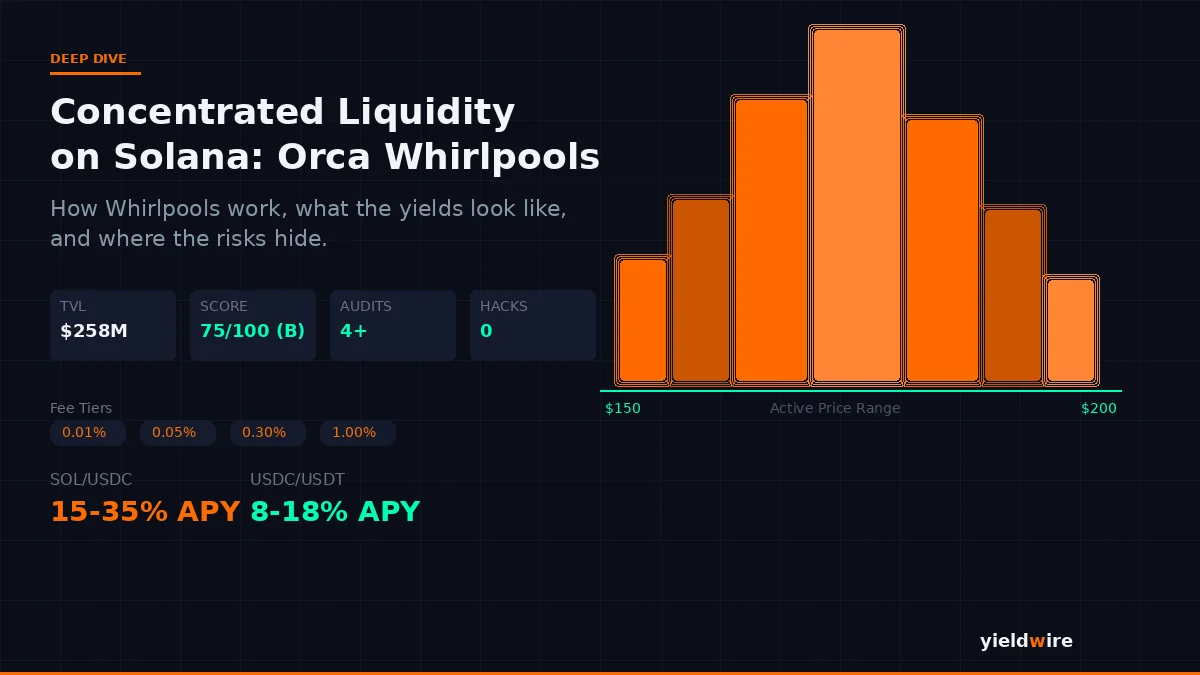
Concentrated Liquidity on Solana: Orca Whirlpools Deep Dive
Orca's Whirlpools run $258M in TVL with zero hacks in four years. Here's how concentrated liquidity works, what the real yields look like, and where the risks hide.
Why Orca Matters Right Now
Orca is the third-largest DEX on Solana by TVL, sitting at roughly $258M. It runs behind Raydium ($1B+) and Meteora in raw numbers, but it holds a distinction no other major Solana DEX can claim: zero security incidents in over four years of operation.
That track record matters when you're providing liquidity. Raydium lost $4.4M in a December 2022 exploit. Meteora has had its own growing pains. Orca has been clean since launch.
The engine behind Orca's liquidity is Whirlpools, their concentrated liquidity AMM. If you've used Uniswap v3 on Ethereum, the concept is familiar. But the implementation details, fee structures, and risk profile are different enough to warrant a closer look.
How Whirlpools Work
Traditional AMMs spread your liquidity across every possible price, from zero to infinity. If you deposit $10,000 into a SOL/USDC pool, most of that capital sits idle at price points where trades never happen.
Concentrated liquidity fixes this. You pick a price range, say $150 to $200 for SOL, and your entire deposit works within that window. Every swap that executes in your range generates fees for you. Capital outside the range? Zero fees.
The math is straightforward: concentrating liquidity into a tighter range means more of your capital earns fees per trade. Orca estimates that well-positioned LPs can earn up to 15x more fees compared to a full-range position in the same pool. The SOL/USDC 0.04% tier typically generates 15-35% APY for positions that stay in range.
The catch is equally straightforward. If the price moves outside your range, you stop earning entirely. Your position also becomes 100% denominated in the cheaper token. Set a tight range and get it wrong, and you're holding a bag of the losing asset with zero fees to show for it.
Fee Tiers and When to Use Each
Orca offers four fee tiers per trading pair. Each tier has a different tick spacing, which controls how precisely you can set your price range.
| Fee Tier | Tick Spacing | Best For | Typical Pairs |
|---|---|---|---|
| 0.01% | Finest | Stablecoins, pegged assets | USDC/USDT |
| 0.05% | Fine | Low-volatility, correlated pairs | mSOL/SOL, jitoSOL/SOL |
| 0.30% | Standard | Most trading pairs | SOL/USDC, ORCA/USDC |
| 1.00% | Wide | High-volatility, exotic pairs | Memecoins, low-liquidity tokens |
The 0.04% tier (sometimes listed as 0.05% depending on the source) handles the bulk of SOL/USDC volume. Stablecoin pairs sit in the 0.01% tier where the tight tick spacing makes sense because USDC/USDT rarely moves beyond 0.5%.
For exotic or volatile pairs, the 1% tier compensates LPs for the higher risk of impermanent loss and lower trade frequency.
Choosing the wrong tier is a common mistake. A SOL/USDC position in the 1% tier will earn significantly less than the same capital in the 0.04% tier, because traders route through the cheapest available liquidity first.
The Real Yields
Let's talk numbers. These are approximate ranges based on current market conditions, not guarantees.
| Pool | Fee Tier | Typical APY Range | TVL | Notes |
|---|---|---|---|---|
| SOL/USDC | 0.04% | 15-35% | $30M+ | Highest volume pair on Orca |
| USDC/USDT | 0.01% | 8-18% | $15M+ | Tight range, low IL risk |
| jitoSOL/SOL | 0.05% | 5-12% | $10M+ | Correlated pair, low IL |
| ORCA/USDC | 0.30% | 20-50%+ | $5M+ | Higher volatility, wider spreads |
A few things to note. These APYs assume your position stays in range. The moment price moves outside your bounds, yield drops to zero. Active management or wider ranges reduce this risk but also dilute returns.
The stablecoin pairs are the closest thing to "safe" LP yield. USDC/USDT at 0.01% gives you 8-18% with minimal impermanent loss risk, since both assets track $1. That's meaningfully better than lending USDC at 3-8% on protocols like Kamino or Jupiter, but with more smart contract exposure.
The SOL/USDC pair is where the real action happens. 15-35% APY sounds great, but the position is directional. If SOL drops 30%, your concentrated range might be entirely out of bounds, and you're sitting on 100% SOL with no fee income. That's the trade-off: higher yield, higher skill requirement.
How Orca Compares to Other Solana CLMMs
Orca isn't the only concentrated liquidity game on Solana. Meteora's DLMM and Raydium's CLMM pools compete for the same capital.
| Feature | Orca Whirlpools | Meteora DLMM | Raydium CLMM |
|---|---|---|---|
| TVL | ~$258M | ~$287M | ~$1B+ |
| Security Score | 75 (B) | 49 (D) | 63 (C) |
| Audits | 4+ | 0 (DeFiLlama) | 0* (DeFiLlama) |
| Hack History | None | None | $4.4M (Dec 2022) |
| Fee Model | Fixed tiers | Dynamic fees | Fixed tiers |
| Position Type | NFT-based | Bin-based | NFT-based |
The security score gap is significant. Orca scores 75/100 (Grade B) on yieldwire's security methodology, the highest of any DEX on Solana. Four confirmed audits. Clean track record. Open-source contracts on GitHub.
Meteora's DLMM scores 49/100 (Grade D) with no publicly listed audits on DeFiLlama. That doesn't mean the code is bad, but it means less external verification. Raydium sits at 63 (Grade C) with a hack in its history.
For risk-adjusted returns, Orca has the strongest profile among Solana CLMMs. The trade-off is liquidity depth: Raydium has 4x the TVL, which means better execution on large swaps and potentially more consistent fee generation for LPs.
Positions as NFTs
Every Whirlpool position is represented as an NFT on-chain. This is more than a cosmetic choice. It means your LP position is:
Transferable. You can sell or move a position without closing it. If you've built a well-performing range, that has value beyond the underlying tokens.
Composable. Other DeFi protocols can build on top of Whirlpool positions. Liquidity managers like Kamino Liquidity (which scores 76/100 on yieldwire) use Whirlpool NFTs to run automated rebalancing strategies, essentially managing your range for you.
Transparent. Anyone can inspect exactly what price range a position covers, what fees it's earned, and what tokens it holds. No black boxes.
The Kamino Connection
If managing your own concentrated liquidity range sounds like too much work, that's a common reaction. Active LP management is genuinely demanding. You need to monitor price, rebalance ranges, and react to volatility.
Kamino Liquidity sits on top of Orca Whirlpools (and Raydium) as an automated liquidity manager. You deposit tokens, Kamino's vaults handle the range selection and rebalancing.
The cost: an additional smart contract layer between you and the pool, which adds exposure. The benefit: professional-grade management without the 24/7 attention. Kamino Liquidity holds ~$167M in TVL with a 76/100 security score.
If you want Whirlpool yields without the manual work, Kamino is the most battle-tested option. But understand the layered risk: Orca's contracts + Kamino's contracts + whatever underlying pool you're in.
Risk Profile: What Can Go Wrong
Orca scores well, but concentrated liquidity has inherent risks that no security audit eliminates.
Impermanent loss is amplified. Concentrated positions act like leveraged exposure to price movement. A 20% price move on a tight range can result in significantly more IL than the same move on a full-range position. Our IL guide covers the mechanics.
Range management is active work. Set it and forget it doesn't apply here. If SOL rallies from $170 to $220 and your range was $150-$200, you stopped earning at $200 and now hold 100% USDC. You need to close, reopen at a new range, and pay transaction costs.
Smart contract risk. Four audits help, but no code is guaranteed bug-free. Orca's contracts are open source, which allows community review. The $258M TVL means the code has been stress-tested by real capital, which is meaningful but not absolute.
Liquidity fragmentation. With four fee tiers per pair, liquidity can split across multiple pools. Lower liquidity per pool means higher slippage for traders and potentially lower fee generation for LPs.
Oracle independence. Whirlpools don't rely on external price oracles. The price is determined by actual trades in the pool. This eliminates oracle manipulation risk but means the pool price can deviate from the market during low-liquidity periods.
Who Should Use Whirlpools
Whirlpools aren't for everyone. Here's a quick framework.
Good fit: You understand IL and are comfortable managing positions actively. You want higher yield than lending and are willing to accept directional risk. You value security and want the most audited DEX on Solana.
Not a fit: You want passive, set-and-forget yield. You're new to DeFi and still learning the basics. You can't monitor positions at least daily.
Middle ground: Use Kamino Liquidity on top of Whirlpools. You get automated management with Orca's underlying security, at the cost of an extra trust layer.
Bottom Line
Orca Whirlpools are the most security-conscious concentrated liquidity option on Solana. Grade B on yieldwire, 4+ audits, zero hacks. The yields are real, 15-35% on SOL/USDC, 8-18% on stablecoins, but they demand active management and carry amplified IL risk.
If you're choosing between Solana CLMMs on a risk-adjusted basis, Orca is the strongest pick. If you need maximum liquidity depth and can tolerate a weaker security profile, Raydium has more TVL.
The data updates hourly on yieldwire's yields page. Compare Orca pools against every other protocol on Solana, risk-scored and side by side.
Use the yield calculator to model scenarios before you commit capital. And always check our security scores before depositing into any protocol.
This is informational content, not financial advice. DeFi carries risk of loss. Always do your own research.
Track all Solana yields in real time
Compare APYs across lending, LP, and liquid staking protocols on the YieldWire dashboard.
Open Dashboard →