Meteora DLMM: Concentrated Liquidity Yields on Solana
Meteora's DLMM bins changed how LPs earn on Solana. $287M TVL, dynamic fees, zero slippage within bins. But concentrated liquidity cuts both ways. Here's the full yield and risk breakdown.
Meteora Became Solana's LP Protocol
Meteora didn't start as the biggest liquidity protocol on Solana. It got there by solving a problem most AMMs ignored: capital efficiency for LPs.
Traditional AMMs spread your liquidity across an infinite price range. If you deposit $10,000 into a SOL/USDC pool, maybe $500 of that actually sits near the current price where trades happen. The rest just waits. You earn fees on a fraction of your capital.
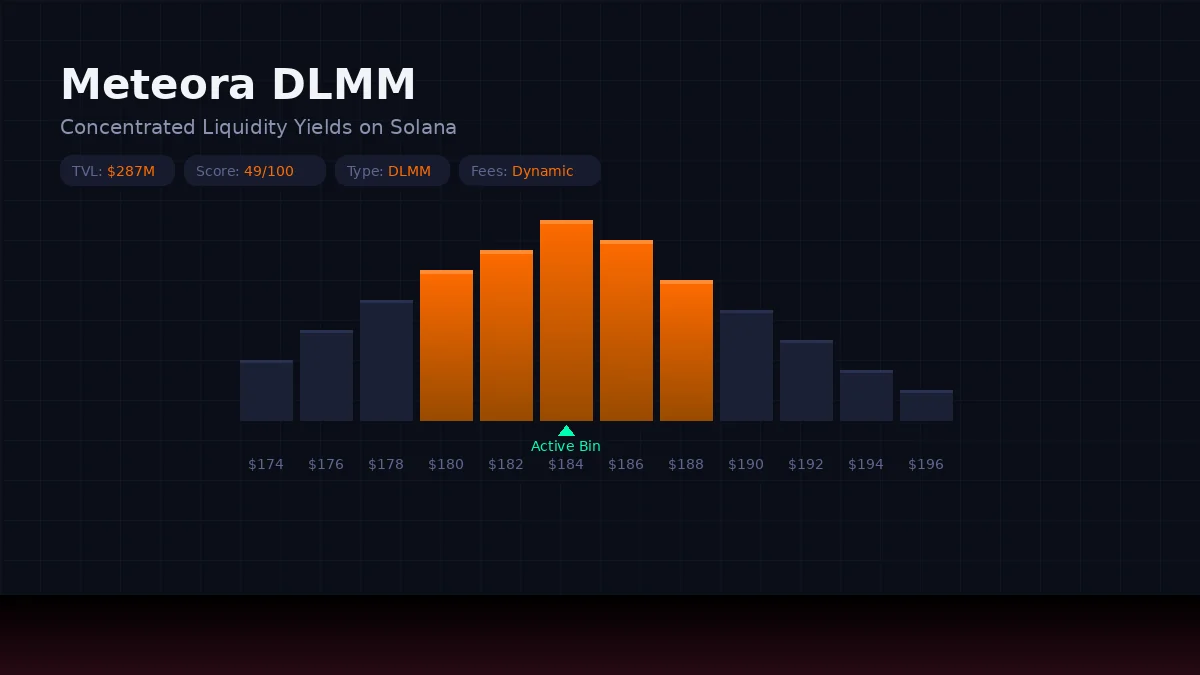
Meteora's DLMM (Dynamic Liquidity Market Maker) changed that. It organizes liquidity into discrete price bins, each representing a specific price point. You choose which bins your capital occupies. Trades happen inside these bins with zero slippage. When the price moves, the active bin shifts.
The result: 4-5x higher fee generation per dollar of liquidity compared to standard AMMs. That sounds great until you realize the same concentration that amplifies your fees also amplifies your losses when price moves against you.
This post breaks down how Meteora's DLMM actually works, what the yields look like right now, and what risk you're taking to earn them.
How DLMM Bins Work
Think of bins as small containers, each holding liquidity at one specific price. If SOL trades at $180, the active bin is the one centered around $180. Every swap that stays inside that bin executes with zero slippage.
When a large trade pushes the price past one bin, it "crosses" into the next bin. The protocol moves to that bin as the new active one. Fees from each trade go to the LPs who provided liquidity in the bins that got used.
You don't have to provide liquidity across all bins. You pick a range. Tighter range means more of your capital is active (higher fees), but the price is more likely to move outside your range (you stop earning and start losing to impermanent loss). Wider range means lower fees but less IL risk.
Meteora offers preset distribution strategies to help:
Spot. Concentrates liquidity around the current price. Highest fee potential, highest IL risk. Best for stable pairs or short-term positions you'll actively manage.
Curve. Bell curve distribution, heavier in the middle and lighter at the edges. Balanced approach. Good default for volatile pairs.
Bid-Ask. Concentrates liquidity on both sides of the current price, lighter in the middle. Works for pairs you expect to oscillate within a range.
Dynamic Fees: The DLMM Advantage
Most DEXs charge a flat fee per swap. Orca Whirlpools, for example, let you pick from fixed tiers (0.01%, 0.05%, 0.30%, 1.00%).
Meteora's DLMM adjusts fees in real time based on market volatility. When volatility spikes, fees increase automatically. When markets are calm, fees drop to stay competitive and attract volume.
Why this matters for LPs: during volatile periods, you're compensated more for the impermanent loss you're absorbing. Fixed-fee AMMs pay you the same 0.30% whether the market is flat or crashing. Meteora's dynamic fees try to match compensation to risk.
The base fee for most DLMM pools sits between 0.10% and 0.80%, with volatility multipliers that can push effective fees higher during market moves.
The Yield Picture: May 2026
Meteora runs three main product types, each with different yield profiles:
DLMM Pools
These are the concentrated liquidity pools. The headline numbers:
| Pool | Approximate APY | TVL | Risk Level |
|---|---|---|---|
| SOL-USDC | 20-60% | $15-30M | High (IL) |
| SOL-USDT | 15-45% | $5-15M | High (IL) |
| JitoSOL-SOL | 5-15% | $5-10M | Lower (correlated pair) |
| BONK-SOL | 30-100%+ | Variable | Very High |
| Stablecoin pairs | 5-20% | $2-8M | Lower |
APY ranges are wide because they depend entirely on your bin range, trading volume that week, and price movement. A tight-range SOL-USDC position could earn 60% APY in a high-volume week and lose money the next week if SOL gaps past your range.
The honest answer: DLMM yields are not passive income. They're active LP management returns. If you're not monitoring and rebalancing your position at least weekly, you'll underperform. For correlated pairs (JitoSOL-SOL, mSOL-SOL), the IL risk drops dramatically and a more passive approach works.
Dynamic AMM (DAMM v2)
Meteora's constant-product pools with an upgrade: idle assets sitting in the pool get automatically lent to lending protocols (Kamino, MarginFi, Save) for additional yield.
Trading fees: 0.25-0.30% per swap. Lending yield: variable, typically 2-5% additional APY.
This is the "set and forget" option on Meteora. No bin management, no active rebalancing. You provide liquidity, earn trading fees plus lending yield. The trade-off: lower returns than well-managed DLMM positions, but also lower IL risk since liquidity isn't concentrated.
Dynamic Vaults
Single-sided deposits routed to lending protocols. Similar concept to Lulo's aggregation. You deposit an asset, the vault routes it to whichever lending market pays the most.
Current vault TVL sits around $47M. APY depends on the deposited asset and lending market conditions.
Meteora vs Orca: The Concentrated Liquidity Comparison
Both protocols offer concentrated liquidity on Solana. The differences matter for your yield strategy:
| Feature | Meteora DLMM | Orca Whirlpools |
|---|---|---|
| Fee model | Dynamic (adjusts to volatility) | Fixed tiers (0.01-1.00%) |
| Liquidity structure | Discrete bins | Continuous tick ranges |
| Zero slippage | Within bins, yes | No (continuous curve) |
| Management complexity | Higher | Moderate |
| Best for | Active LPs, volatile pairs | Passive LPs, stable pairs |
| Security score (yieldwire) | 49/100 (D) | 75/100 (B) |
| TVL (DLMM/Whirlpools) | ~$287M | ~$258M |
The security score gap is significant. Orca has 4+ audits on record, a long track record, and well-documented infrastructure. Meteora DLMM shows 0 audits in DeFiLlama's records, though separate audits by Zellic and Bramah Systems exist for the DLMM contracts, and Neodyme audited the Dynamic AMM and vault contracts.
Meteora's 49/100 (Grade D) score reflects that gap. It doesn't mean the protocol is unsafe, but it means the public audit trail isn't as robust as Orca's. For risk-conscious LPs, that matters.
Yield-wise, well-managed Meteora DLMM positions can outperform Orca Whirlpools because dynamic fees compensate LPs better during volatility. But "well-managed" is doing a lot of work in that sentence. Passive positions on Orca tend to produce more predictable returns.
The IL Problem: Real Numbers
Impermanent loss is the cost of concentrated liquidity. Here's what it looks like in practice.
Say you provide SOL-USDC liquidity in a narrow bin range around $180. SOL moves to $200 (an 11% move). Your position is now 100% USDC because the price moved above your range. You earned fees while the price was in your bins, but you missed the SOL upside.
If you'd just held SOL, you'd be up 11%. Your LP position earned maybe 2-3% in fees over that period. Net result: you underperformed holding by 8-9%.
The math works differently for correlated pairs. JitoSOL-SOL barely diverges in price (JitoSOL slowly appreciates relative to SOL due to staking yield). A concentrated position on that pair earns trading fees with minimal IL. That's why correlated pair DLMM pools are popular among LPs who want Meteora's fee structure without the directional risk.
Risk Assessment
Meteora's risk profile on yieldwire breaks down across three products:
| Product | Score | Grade | Key Risks |
|---|---|---|---|
| Meteora DLMM | 49/100 | D | IL, audit trail, smart contract complexity |
| Meteora Vaults | 63/100 | C | Compounded exposure (like aggregators) |
| Meteora DAMM v2 | 46/100 | D | IL + lending protocol risk |
The DLMM score is pulled down by two factors: the limited public audit record and the inherent complexity of bin-based liquidity. More complex contracts mean more attack surface.
Meteora does have an Immunefi bug bounty with a $500K max payout for critical bugs. The protocol uses Realms SafeSnap for governance decisions. A front-end vulnerability was patched in December 2025, which, while concerning, also shows active security monitoring.
The bottom line: Meteora is a sophisticated protocol with genuine innovation. But sophistication and safety aren't the same thing. The audit gap compared to Orca and Raydium is real. LPs should size their positions accordingly.
When Meteora DLMM Makes Sense
Good fit:
Active LPs who monitor positions daily. You understand bin management, rebalancing, and IL math. You're looking for higher fee yields on volatile pairs and accept the management overhead. You want dynamic fees that adjust to volatility.
Poor fit:
Passive depositors who want to set and forget. You're looking for stable, predictable yield. You prioritize security score and audit coverage above all else. Your position size makes the management time cost-ineffective.
The middle ground:
Meteora's DAMM v2 pools or Dynamic Vaults offer a more passive experience. Lower yields than DLMM, but no bin management required. The vault products score higher on security (63/100) because the complexity is lower.
For correlated pairs (JitoSOL-SOL, mSOL-SOL), DLMM can work even for less active LPs. The IL risk is minimal, and you benefit from the dynamic fee structure without needing to rebalance constantly.
Tools for Meteora LPs
Before opening a position, use these:
yieldwire Yield Calculator. Model your expected returns at different APY levels, compounding frequencies, and time horizons. Try it.
yieldwire Risk Filter. Filter all Solana pools by minimum security score, minimum APY, and minimum TVL. Useful for finding Meteora pools that meet your risk threshold. Use the filter.
Compare pools. Stack any three Meteora pools (or mix with Orca/Raydium) side by side. APY, TVL, risk score, base vs reward yield. Compare now.
Bottom Line
Meteora DLMM is the highest-yield LP option on Solana if you know what you're doing. The bin-based system, dynamic fees, and zero-slippage mechanics are genuine innovations that outperform traditional AMMs on capital efficiency.
The catch: concentrated liquidity is a skilled game. Active management isn't optional. IL eats your returns if you set a range and walk away. And the security profile (49/100, Grade D) means you're trusting newer, less-audited infrastructure compared to Orca or Raydium.
For experienced LPs willing to actively manage positions, Meteora offers the best fee-to-capital ratio on Solana. For everyone else, the Dynamic Vaults or Orca Whirlpools offer more predictable returns with a stronger security foundation.
All Meteora pools are tracked and risk-scored on yieldwire, updated hourly: yieldwire.xyz/yields
Explore all Solana yields · Security scores · Follow @yieldwirexyz
This article is for informational purposes only. It is not financial advice. Yield rates are variable and past performance does not guarantee future returns.
Track all Solana yields in real time
Compare APYs across lending, LP, and liquid staking protocols on the YieldWire dashboard.
Open Dashboard →