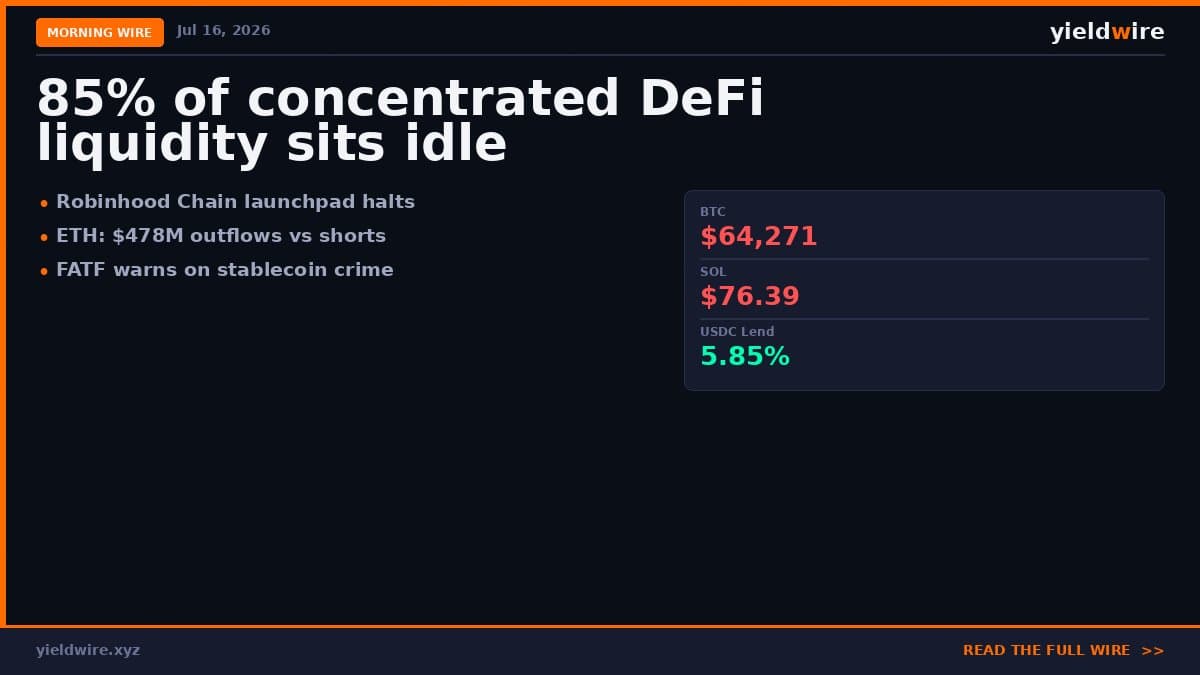
The Wire — July 16, 2026
A Dune study commissioned by 1inch finds 85% of concentrated DeFi liquidity sits idle, leaving $150M in fees on the table, as a Robinhood Chain launchpad halts and ETH outflows collide with smart-money shorts.
The Wire — July 16, 2026
Dune study finds 85% of concentrated DeFi liquidity sits idle, $150M in fees foregone Research from Dune, commissioned by 1inch, found that about 85% of capital in concentrated liquidity pools sits outside the active price range at any given moment, earning nothing while it waits. The study puts the cost of that idle capital at roughly $150 million in annual fees left on the table across the market. Concentrated liquidity was supposed to be the efficiency upgrade over old constant-product AMMs, letting providers focus capital where trades actually happen. In practice most of that capital is parked out of range, so the headline APY a pool advertises is spread across far more money than is doing the work. This is the gap we point at constantly: an LP yield quoted on deployed capital is not the yield your full deposit earns. Source: The Block, published July 16. Compare LP and lending yields →
Robinhood Chain memecoin launchpad Vlad.fun halts over "internal integrity" issue Vlad.fun, a memecoin launchpad on Robinhood Chain, suspended its platform after disclosing what it called a "serious internal integrity issue" involving members of its own team. The project did not detail the alleged misconduct, and funds and token status were left unclear at the time of the halt. It is the second stress signal from the Robinhood Chain ecosystem in a week, after reports of tokens vanishing from buyer wallets. New chains attract launchpads fast because listing friction is low, but low friction cuts both ways, and team-level failures land on users before any code is audited. For anyone chasing early yield or airdrop activity on a young SVM chain, counterparty and operator risk is the part no APY compensates for. Source: Cointelegraph, published July 16. How we score protocol risk →
Bitcoin's aged coins go quiet, and $69,000 becomes the line to watch Galaxy Research data shared by analyst Alex Thorn shows coins aged one year or more moving on-chain in 2026 at less than half of 2025's pace, a sharp slowdown after two years of near-record movement among older supply. Thorn reads it as evidence that Bitcoin's "Great Distribution", the wave of dormant coins that changed hands during the rally, has largely run its course. The caveat is real, since on-chain movement alone does not prove those coins reached new owners, though the chart excludes exchange and custodial churn to sharpen the signal. Bitcoin traded near $64,271, down about 1.7% on the day, leaving $69,000 as the level that would test whether newer holders hold firm. Source: CryptoSlate, published July 16.
Ethereum posts $478M in outflows as smart money leans short Nansen data shows about $478 million in net ETH exchange outflows over the past week, running roughly five times the average pace, the kind of supply-side move that usually reads as accumulation. The same dataset complicates the story. Top-PnL wallets sold a net $64 million over seven days, and on Hyperliquid perpetual futures the cohorts the market treats as informed, so-called smart traders and whale accounts, held $38 million and $21 million net short respectively. So the coins are leaving exchanges while the sharpest traders position for a fall, a split that rarely stays unresolved for long. Ether traded near $1,882, down about 2.8%. Source: CryptoSlate, citing Nansen, published July 16.
FATF warns crypto AML enforcement is lagging as stablecoin crime grows The Financial Action Task Force said criminal networks are increasingly routing funds through stablecoins and even issuing their own proprietary tokens to evade asset freezes, while national regulators struggle to enforce existing anti-money-laundering rules on crypto. The global standard-setter framed enforcement, not rulemaking, as the weak link. The read-through for DeFi is that dollar-stablecoin liquidity, the base layer nearly every on-chain yield is built on, stays under a widening compliance lens. Tighter enforcement tends to push activity toward assets and venues that can show provenance, which over time favors audited protocols over anonymous ones. Source: Cointelegraph, published July 16.
ARK disputes a16z's "TradFi wants blockchain, not DeFi" thesis ARK Invest's director of research pushed back on a16z crypto's argument that traditional finance will adopt permissioned blockchain rails rather than open decentralized finance, saying institutions will increasingly rely on DeFi itself. The disagreement is more than a talking point. One camp sees banks building walled tokenization stacks they control, the other sees regulated capital plugging into public lending and liquidity markets for the yield and depth those markets already have. Which thesis wins decides whether onchain yields become an institutional product or stay a crypto-native one. For now the money is split, and the deepest USDC markets on Solana and Ethereum are the proving ground. Source: Cointelegraph, published July 16.
Numbers
- BTC: $64,271 (-1.7%)
- SOL: $76.39 (-3.0%)
- ETH: $1,882 (-2.8%)
- Solana DeFi TVL: $4.87B
- Top USDC yield (Solana): Kamino Lend at 5.85% ($8M TVL); deepest book Jupiter Lend at 4.27% ($429M TVL)
Explore all Solana yields → · Risk scores → · Follow @yieldwirexyz
Track all Solana yields in real time
Compare APYs across lending, LP, and liquid staking protocols on the YieldWire dashboard.
Open Dashboard →