The Wire — July 10, 2026
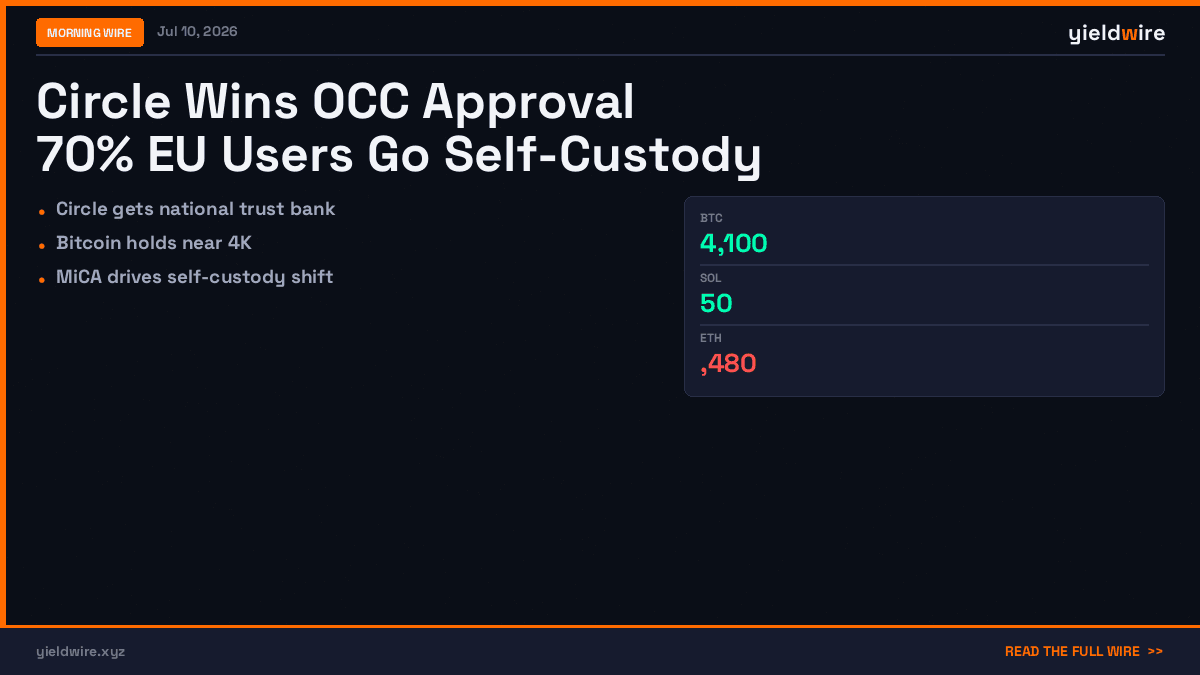
Circle wins final OCC approval for a national trust bank as bitcoin holds near $64,000 and 70% of exiting EU users move to self-custody after MiCA.
The Wire — July 10, 2026
Circle wins final OCC approval to open a national trust bank Circle received final approval from the US Office of the Comptroller of the Currency to establish First National Digital Currency Bank, which will operate as Circle National Trust. It is the first time a major stablecoin issuer has cleared the full federal trust-bank process, moving USDC custody under national banking supervision rather than a patchwork of state charters. Circle filed the application in June 2025 and won conditional approval last December, so the final nod closes a year-long regulatory path. The company said reserve management for USDC will come in a later phase. CRCL stock jumped roughly 10% in premarket trading to about $69.50. This matters for anyone parking capital in dollar-pegged assets, because USDC is the base layer of most Solana DeFi yield, and federally supervised custody is a direct answer to the counterparty questions that have shadowed stablecoins since 2022. Source: CoinDesk and The Block, published July 10. Top stablecoin yields →
Bitcoin holds near $64,000 as crypto shrugs off equity weakness Bitcoin traded around $64,192, up about 2.6% on the day, as crypto pushed higher even while equities wobbled and altcoin optimism built into the weekend. Solana added 1.5% to roughly $78.88 and ether led the majors with a 3.3% gain. The $60,000 to $70,000 band has now become the third most-traded price range in bitcoin's history, a sign of how long this consolidation has run rather than a breakout signal. Standard Chartered kept its $100,000 end-2026 bitcoin target, framing the recent Strategy selloff as a communication problem rather than a solvency one. For yield hunters, a range-bound bitcoin usually means steadier funding rates and calmer collateral values, which tends to support lending APYs over leverage-driven ones. Source: CoinDesk and The Block, published July 10.
Binance says 70% of exiting EU users moved to self-custody after MiCA Binance co-CEO Richard Teng said that after the exchange suspended some EU services around the MiCA deadline, about 70% of withdrawing European users moved their assets to self-custody, with only 30% going to MiCA-licensed platforms. If the figure holds, it is an awkward data point for regulators who framed MiCA as a way to route users toward supervised venues. It also underlines a structural shift: when centralized access tightens, a large share of users go on-chain directly rather than to another licensed intermediary. Self-custody users are exactly the audience that interacts with lending markets, LSTs and vaults without a custodian in between, which is where transparent risk scoring earns its keep. Source: The Block, published July 10. How we score risk before rate →
Ledger researchers disclose a Tangem hardware wallet flaw Ledger's security team disclosed a laser fault-injection attack that can reset a Tangem card's password by bypassing a recovery-state check in the firmware. The attack requires physical access and specialized equipment, and Tangem said the real-world risk to everyday users is virtually non-existent. The disclosure still matters because it lands in the middle of a self-custody surge, and hardware wallets are the tool most of those new self-custody users are reaching for. The lesson is not that cards are unsafe but that "cold storage" is a spectrum, and the threat model for a laser-equipped attacker with your physical card is very different from the everyday one. Source: The Block, published July 10. How we score protocol risk →
Polymarket files to bring regulated margin trading to US customers Polymarket filed applications with US regulators to offer margin trading to American customers, a step that would let traders take leveraged positions on its prediction markets under a supervised framework. Rival Kalshi already secured US approval for margin back in March, so this is Polymarket catching up on a feature that reshapes how much capital can sit behind a single bet. Prediction markets have become one of the most-watched corners of onchain-adjacent finance, and adding leverage raises both the volume and the risk that comes with it. For DeFi watchers, the read-through is regulatory: US approval of margined prediction trading is another sign of how far the supervised perimeter is expanding. Source: CoinDesk and The Block, published July 10.
OKX, MetaMask and Matter Labs back an "internet court" for AI agents GenLayer Foundation launched Internet Court, a system designed to settle disputes between autonomous AI agents without human involvement, and drew backing from 26 crypto and AI firms including OKX, MetaMask, Matter Labs and BNB Chain. The setup lets agents write contracts with defined terms, and when they cannot agree on an outcome, a staked network of AI evaluators reviews the evidence and issues a verdict in minutes. It is early and speculative, but it points at where onchain infrastructure is heading as agents start hiring and paying each other for tasks. For a data brand, the interesting part is the settlement layer: agent-to-agent commerce needs neutral dispute resolution, and several of the biggest wallets and exchanges are betting it belongs on a blockchain. Source: CoinDesk, published July 10.
Numbers
- BTC: $64,192 (+2.6%)
- SOL: $78.88 (+1.5%)
- ETH: $1,797 (+3.3%)
- Solana DeFi TVL: $5.00B
- Top USDC yield (Solana): Kamino Lend at 6.18%
Explore all Solana yields → · Risk scores → · Follow @yieldwirexyz
Track all Solana yields in real time
Compare APYs across lending, LP, and liquid staking protocols on the YieldWire dashboard.
Open Dashboard →