Solana Staking ETFs: What They Mean for DeFi Yields
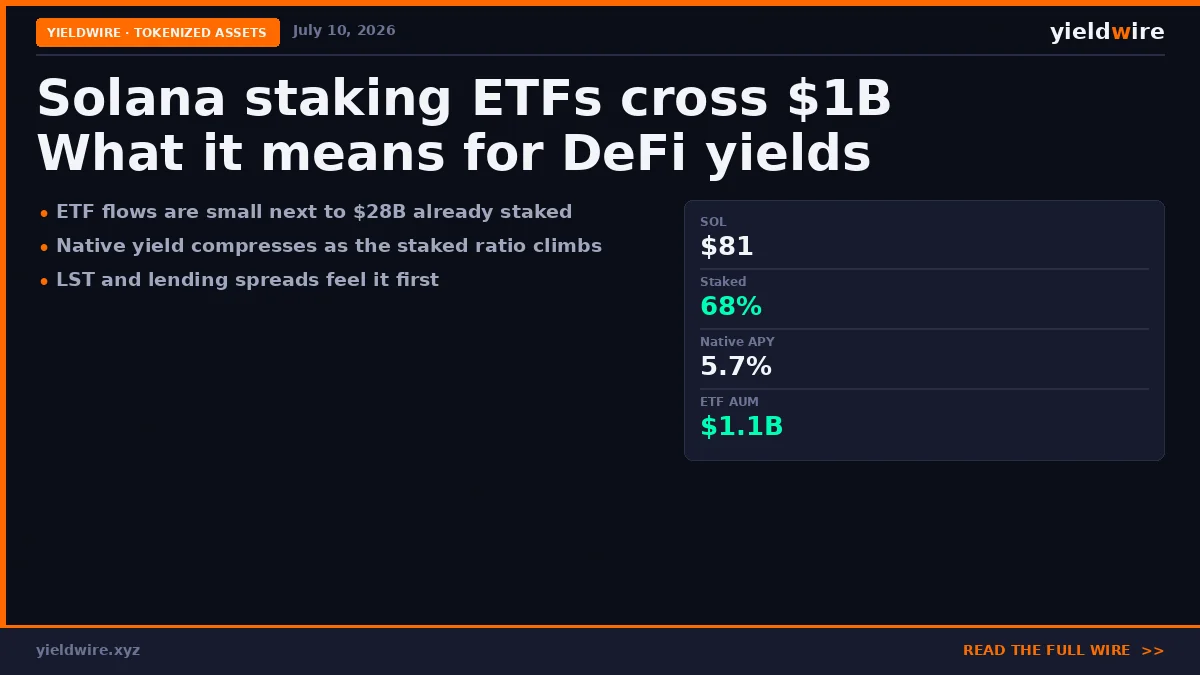
Solana staking ETFs crossed $1B in combined assets. That is small next to the $28B already staked on-chain, but the flows still pull on validator economics, LST yields, and the SOL lending rates DeFi runs on. Here is the transmission chain, with real numbers.
The number everyone quotes, and the one that matters
US Solana ETFs crossed $1B in combined assets this summer. Thirteen funds, roughly $1.13B between them, with Morgan Stanley the latest name to register a spot product. That is the number in every headline.
Here is the number that decides whether it moves your yields: 430 million SOL, worth close to $28B at a $81 spot price, is already staked on-chain. That is about 68% of eligible supply. The entire ETF complex is under 4% of what validators already secure.
So the honest starting point is this. ETF inflows are not, by themselves, large enough to reprice Solana staking yield. The compression you have watched all year, native yield sliding toward 5.7%, is driven by the staked ratio and the inflation schedule, not by a billion dollars of new fund demand. But ETFs still matter for DeFi, because of where they route SOL and what they compete with. The flows are small. The plumbing they plug into is not.
What a Solana staking ETF actually does
A spot Solana ETF holds SOL. A staking ETF holds SOL and stakes it, then passes the rewards to shareholders, usually as a monthly cash payout. The first US product, REX-Osprey's SSK, listed in July 2025 and set the template: direct SOL exposure plus native staking yield in a wrapper a brokerage account can hold.
The mechanics differ by issuer, and the differences show up in what you actually earn.
| Fund | Ticker | SOL staked | Yield handling | Fee note |
|---|---|---|---|---|
| REX-Osprey SOL + Staking | SSK | Yes, on-chain | Monthly cash payout | First US staking ETF |
| Bitwise Solana Staking | BSOL | 100% | Accrues to NAV | 6% staking fee, waived on first $1B |
| VanEck Solana | VSOL | Yes | Accrues to NAV | 0.28% on staked assets, intro waiver |
| Grayscale Solana Staking | GSOL | Yes | Accrues to NAV | Up to 23% aggregate staking fee |
Read the fee column carefully. Bitwise's BSOL showed a net staking reward rate near 6.0% in late May 2026 against a gross rate around 6.4%. The gap is the fee, and it is small only while the waiver holds. Grayscale's prospectus permits an aggregate staking fee as high as 23% once its own waiver ends. An ETF that markets "Solana's 7 to 9% staking yield" and then keeps a fifth of it is not handing you the on-chain rate. It is handing you the on-chain rate minus a management layer.
That fee drag is the first reason this topic touches DeFi. It sets the bar that on-chain products are measured against.
Step one: ETFs stake, and the staked ratio climbs
Every SOL an ETF stakes is SOL added to the network's stake pool. Solana yield is close to a mechanical function of that pool. Rewards come from a fixed inflation schedule, currently around 4.5% annually and falling 15% a year toward a 1.5% floor, split across everyone staking. More stake chasing the same emissions means a smaller slice each.
At 68% staked, Solana is already high by proof-of-stake standards. Ethereum sits closer to 28%. Each new cohort of stakers, ETFs included, nudges the ratio up and the yield down. The ETF contribution alone is marginal today. But it runs in the same direction as every other force on yield, and it does not reverse. Funds stake and hold. They are not tactical.
There is a second-order effect worth naming. Validator count fell to roughly 721 from a peak above 2,500, while stake kept growing. ETF mandates concentrate stake with a handful of institutional-grade validators and custodians, which is efficient for the fund and a mild centralizing pressure on the network. For a yield tracker this is a risk signal, not a yield signal, and it is exactly the kind of thing our security scoring is built to surface.
Step two: the squeeze on LST yields
This is where ETF demand reaches DeFi directly. A staking ETF and a liquid staking token are competing products. Both take your SOL, stake it, and return the reward. The LST just does it on-chain and hands you a receipt token, jitoSOL or an mSOL or a Sanctum LST, that you can then use as collateral.
Liquid staking is not a niche on Solana. The LST sector holds about 56.8M SOL, roughly 13% of all staked tokens, and liquid staking is the single largest DeFi category on the chain at over 30% of total value locked. When an ETF stakes, it competes for the same base reward the LST depends on. Same inflation pool, same compression.
So the yield stack, top to bottom, looks like this today.
| Layer | Approximate yield | Who gets it |
|---|---|---|
| Gross native staking | ≈ 6.4% | Direct validators |
| LST holder (net of commission) | ≈ 5.5 to 6% | On-chain, keeps liquidity |
| Staking ETF (net of fee, waived) | ≈ 6% | Brokerage account |
| Staking ETF (net of fee, full) | 5% and below | Brokerage account |
The LST's structural edge is not a higher headline number. It is that the receipt token stays productive. You can hold jitoSOL and post it as collateral in a lending market the same afternoon. An ETF share sits in a brokerage account and does one thing. That difference is the whole DeFi case, and it gets sharper as ETF fee waivers expire.
Step three: the lending rate feedback loop
Here is the part most coverage misses. Institutional demand for staked SOL feeds back into DeFi borrowing rates through the leverage loop.
The trade is familiar to anyone who has run a looping strategy. Deposit an LST, borrow SOL against it, stake the borrowed SOL into more LST, repeat. It works whenever the staking yield clears the SOL borrow rate. Every ETF and every new staker that compresses the base yield narrows that spread. When native yield drifts from 7% toward 5.7%, the looping trade that penciled out at a 3% borrow rate stops working, leverage unwinds, and SOL borrow demand on lending markets falls with it.
Run it the other way and the same logic holds. Heavy ETF accumulation tightens circulating SOL, which can firm up SOL borrow rates on venues like Kamino and Jupiter Lend even as staking yield compresses. Lending is the category most exposed to this crosscurrent, and it carries real liquidation and oracle risk on top, which is why it scores mid-band in our dataset while liquid staking sits higher. The upshot for anyone lending or borrowing SOL: your rate is now partly a function of flows into products that never touch a wallet.
What to actually watch
The ETF headline is a demand story. The DeFi consequence is a spread story. Three things decide how it plays out.
The staked ratio is the master variable. Above 70% and climbing, native yield keeps compressing and every downstream spread tightens with it. Governance is the wildcard: SIMD-0550 and similar proposals would roughly double Solana's disinflation rate, pulling the 1.5% inflation floor forward from about 5.7 years away to under 3, which accelerates every yield decline in this piece. And fee waivers are a clock. As BSOL, VSOL, and GSOL exhaust their introductory waivers, the net yield an ETF delivers drops toward and below what an on-chain LST returns, which strengthens the case for keeping SOL productive in DeFi rather than parked in a fund.
None of this is a reason to chase or avoid any single product. It is a reason to watch the spread between what SOL earns staked and what it costs to borrow, because that spread is where ETF flows, LST yields, and lending rates all meet. We track the live version of every number in this post on the yields page, and you can model a looping or lending position against current rates with the calculator.
The ETFs are a $1B story sitting on top of a $28B one. Small mover, real signal. The money that moves your yields is still on-chain. For now.
Not financial advice. Yields, fees, and staking rates cited reflect data available in early July 2026 and change continuously. Every yield carries protocol, smart contract, and market risk.
Track all Solana yields in real time
Compare APYs across lending, LP, and liquid staking protocols on the YieldWire dashboard.
Open Dashboard →