The Wire PM — June 21, 2026
AI audit tools are pushing the cost of a basic smart contract review toward zero, even as the weekend's exploits showed the losses that code review alone cannot stop
The Wire PM — June 21, 2026
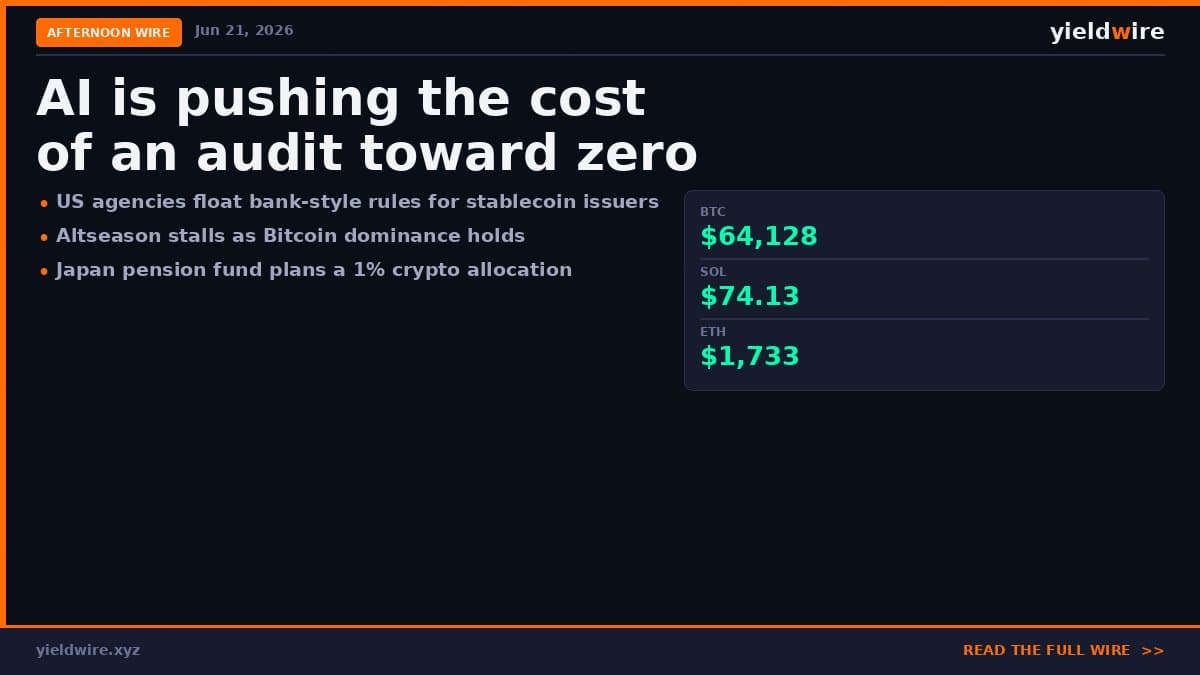
AI Is Pushing the Cost of a Smart Contract Audit Toward Zero A new class of AI security tools is collapsing the economics of code review, with one expert telling CoinDesk that models like Anthropic's Mythos push the price of a basic audit "toward zero." Work that used to take weeks and a five-figure budget can now run in minutes, which means projects that never could afford a professional review can get one, and the ones that could can move from a single point-in-time audit to continuous monitoring with suggested fixes. The catch is the same one this weekend made expensive: AI finds coding flaws, but most of crypto's biggest losses come from social engineering, compromised keys, and operational gaps, not from a bug a scanner would catch. The Axelar bridge drain and the jaredfromsubway exploit both turned on logic and approvals, not on a missed line of Solidity, which is why our security scores weigh multisig, timelocks, and track record alongside audit count. (CoinDesk)
Three US Agencies Want Stablecoin Issuers to Look Like Banks The Treasury, the OCC, and the FDIC have floated rules that would push stablecoin issuers into bank-style supervision. Treasury wants full anti-money-laundering and sanctions programs, the OCC wants a weekly confidential report plus quarterly financials from every issuer, and the FDIC is weighing how deposit-insurance logic applies to reserves. For the largest issuers this is mostly a compliance cost they already carry. For smaller players it is a moat, raising the barrier to entry and tilting the market toward a few well-capitalized names, which matters for anyone earning yield on a stablecoin whose issuer profile is now a regulatory variable, not just a peg. (CryptoSlate)
Capital Keeps Pooling in Bitcoin, and Altseason Stays Stuck Bitcoin dominance is holding above a key support level, and traders read that as BTC continuing to absorb capital that in past cycles would have rotated into altcoins. The takeaway is that the broad altseason many allocators are positioned for keeps getting pushed out. Solana was the exception today, up about 3.4% to $74.13 while BTC and ETH barely moved, but a single green day inside a strong-dominance tape is not rotation. For yield, it reinforces the same read as the morning: carry that does not depend on a risk-on rotation, like staking, holds up better than levered directional plays through a market that refuses to broaden. (Cointelegraph)
A Japanese Pension Fund Plans a 1% Crypto Allocation A corporate pension fund covering roughly 1,200 small and mid-sized Japanese businesses plans to put about 1% of its assets into crypto, according to Nikkei. The number is small, but the signal is not: it is patient, regulated capital treating digital assets as a portfolio line rather than a trade. Allocations like this tend to favor the most liquid, most auditable end of the market, which is the same end where transparent yield data and risk scoring do the most work. (Cointelegraph)
Numbers (Updated)
- BTC: $64,128 (+0.55%)
- SOL: $74.13 (+3.39%)
- ETH: $1,733.35 (+0.48%)
- Solana DeFi TVL: $4.95B
- Top USDC yield (Solana): Jupiter Lend near 4.73% APY
Explore all Solana yields → · Morning edition → · Follow @yieldwirexyz
Track all Solana yields in real time
Compare APYs across lending, LP, and liquid staking protocols on the YieldWire dashboard.
Open Dashboard →