The Wire — June 21, 2026
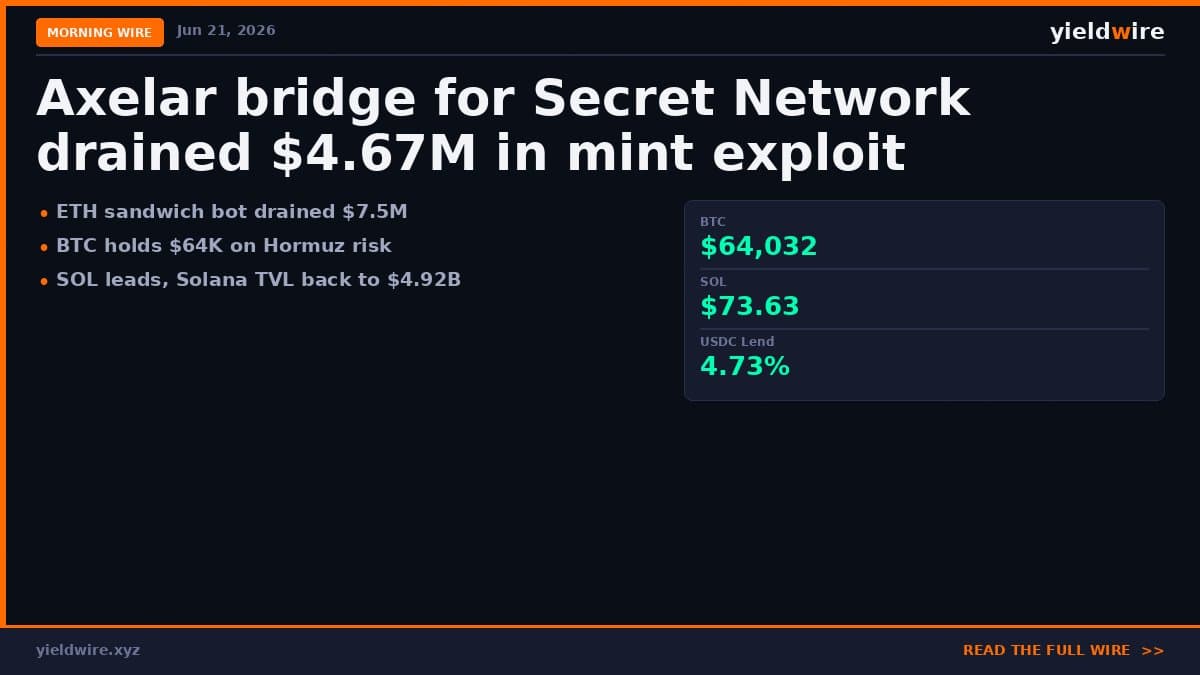
An Axelar bridge for Secret Network was drained of $4.67M in an infinite-mint exploit that sat unnoticed for seven days, one of two DeFi security failures over the weekend
The Wire — June 21, 2026
An Axelar Bridge for Secret Network Lost $4.67M to an Infinite-Mint Bug That Hid for Seven Days A custom token contract bridging Secret Network and Axelar minted wrapped assets without checking which channel an inbound transfer actually came from, and an attacker used that gap to forge deposits and mint saTokens backed by nothing. The June 10 theft sat undetected for a week, until a failed cross-chain transfer on June 17 exposed that the Axelar escrow account had already been emptied of roughly $4.67 million. The mechanics are worth reading closely: the attacker spun up a single-validator Cosmos chain, opened a channel to the bridge, and self-relayed packets carrying token denominations that matched the contract's allow-list, so the contract could not tell forged deposits from real ones. The root cause was a rework that adapted the contract from an escrow model to a mint model, dropping the two functions that would have validated a transfer's source, and Axelar did not request an external audit of the integration. Axelar's emergency committee disabled the Secret connections and said its core protocol was never touched. About $672,000 still sits in the attacker's wallet, and Secret says Axelar declined a request to freeze it. For anyone parking capital in wrapped or bridged assets, this is the exact failure mode our security scores are built to flag before funds move. (The Block)
Ethereum's Biggest Sandwich Bot Got Sandwiched for $7.5M The notorious MEV bot jaredfromsubway.eth, tied to roughly 70% of sandwich attacks on Ethereum, was drained of more than $7.5 million, and the attacker did it without a contract bug or a phishing lure. Over several weeks they fed the bot fake tokens and liquidity pools that mimicked WETH, USDC and USDT, baiting it into approving malicious helper contracts through its own automated trading logic, then used those standing approvals to pull funds and route part of the haul through Tornado Cash. Sandwich attacks cost Ethereum traders an estimated $60 million a year, so there is a certain symmetry to watching the most prolific offender turned into the victim. The lesson for yield is that machine-speed, pattern-based systems are only as safe as the approvals they hand out, and blanket token approvals remain one of the quietest risks in DeFi. (CoinDesk)
Bitcoin Holds Near $64K as a Renewed Hormuz Threat Clouds Ceasefire Talks Bitcoin firmed over the weekend after Friday's sell-off, hovering around $64,000 and leaving prices roughly flat for the week. The tape is being driven by geopolitics rather than crypto-specific flow: US-Iran ceasefire talks are opening in Switzerland even as Tehran renews its threat to close the Strait of Hormuz, the shipping chokepoint whose status swings oil prices and broad risk appetite. Ether, solana and tron all posted weekly gains while the macro picture stayed unresolved. For yield allocators the read is unchanged from last week, that a macro-led tape compresses collateral values fast and the steadiest carry on chain keeps coming from staking rather than levered lending. (CoinDesk)
Schwab and Cboe Plan S&P 500 Binary Options as TradFi Crowds the Prediction-Market Race Charles Schwab is working with Cboe to launch yes-or-no binary options on the S&P 500, according to the Wall Street Journal, a move that drops event-contract structure into one of the largest US retail brokerages. The framing matters for crypto because prediction markets like Kalshi and Polymarket have been a rare growth story with real onchain settlement, and a Schwab-Cboe product points at TradFi importing the same binary payoff into listed, regulated options. Whether that pulls volume toward or away from crypto-native venues is the open question, but the direction of travel is clear: the line between a prediction market and an exchange-listed option is getting thinner. (The Block)
Solana Leads the Majors as DeFi TVL Recovers Toward $4.92B SOL was the strongest major into Sunday, up about 4% to $73.63 while BTC and ETH posted smaller moves, and the bounce showed up onchain as Solana DeFi TVL climbed back toward $4.92 billion. The yield side of the chain stayed calm through the recovery: Jupiter Lend tops USDC supply at 4.73% on roughly $408 million, while staking carry holds near 5.63% on JitoSOL across about $722 million. That spread between lending and staking is the same one worth tracking through any macro week, because the staking return does not depend on borrower demand the way lending rates do. The full pool-by-pool picture lives on our SOL yields page. (DeFiLlama, CoinGecko)
Numbers
- BTC: $64,032 (+1.12%)
- SOL: $73.63 (+3.97%)
- ETH: $1,722.82 (+0.44%)
- Solana DeFi TVL: $4.92B
- Top USDC yield (Solana): Jupiter Lend at 4.73% APY
Explore all Solana yields → · Risk scores → · Follow @yieldwirexyz
Track all Solana yields in real time
Compare APYs across lending, LP, and liquid staking protocols on the YieldWire dashboard.
Open Dashboard →