PumpSwap on Solana: From Memecoins to AMM, Security Concerns
PumpSwap is the native AMM for pump.fun, with about $253M in TVL and more than $16B in 30-day DEX volume. That scale makes it impossible to ignore, but LP yield on PumpSwap is not the same thing as lending yield or staking yield. It is fee income from extremely volatile memecoin pools, wrapped in migration, liquidity, contract, and governance risk.
The Short Version
PumpSwap is the AMM that sits under pump.fun. When a pump.fun token finishes its bonding curve, liquidity migrates into PumpSwap and the token starts trading like a normal AMM pair. That turns pump.fun from a launchpad into a full trading venue, and it keeps more of the token lifecycle inside one product.
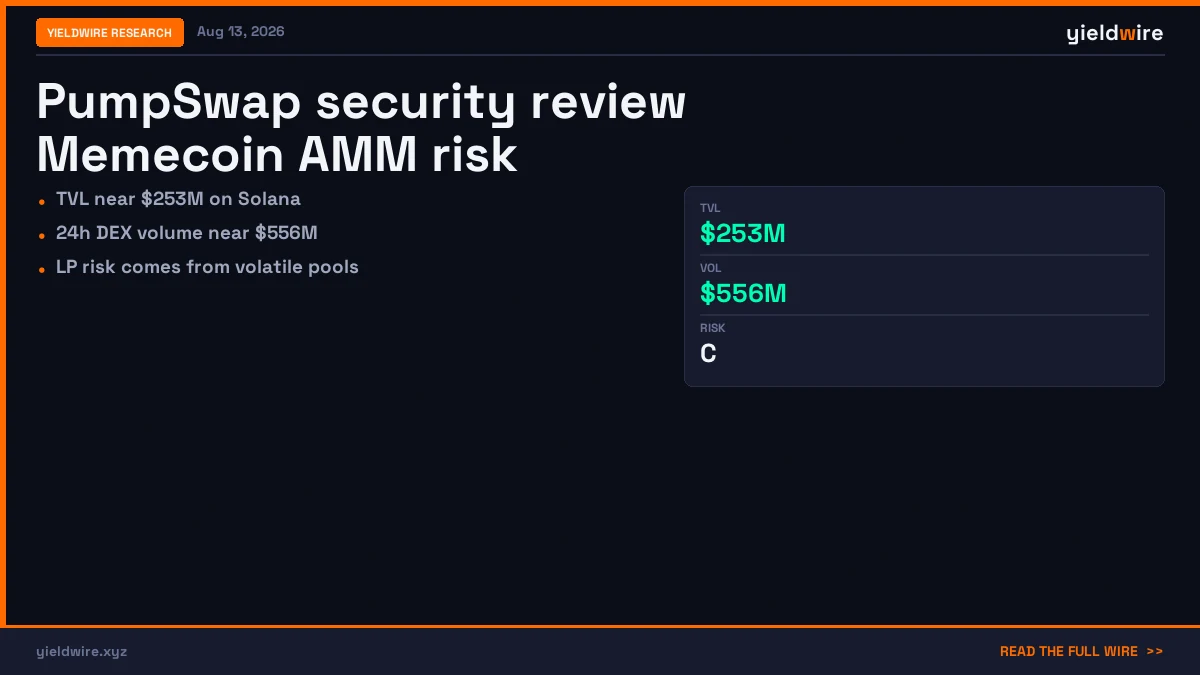
The scale is real. DeFiLlama currently lists PumpSwap at about $253M in TVL, roughly $556M of 24-hour DEX volume, $3.70B over seven days, and $16.88B over 30 days. It is one of the biggest liquidity surfaces on Solana by activity.
The risk profile is also real. PumpSwap yield is not the same as a USDC lending rate or a liquid staking return. It is mostly LP fee income from trading memecoins, which means the depositor is being paid for inventory risk, volatility, flow toxicity, and the chance that a pool goes one-way. A high fee number can be rational. It can also be compensation for holding the wrong side of a dying token.
This review covers what PumpSwap is, where the yield comes from, what the migration design changes, and which security questions matter before treating it as an income venue.
What PumpSwap Actually Does
pump.fun started with a simple launch mechanic: create a token, trade it on a bonding curve, and let early demand set the path. PumpSwap extends that flow. According to pump.fun's public program documentation, once a coin reaches the required threshold, liquidity from the bonding curve migrates to PumpSwap, an AMM on Solana, and the LP tokens received from the pool are burned.
That last detail matters. Burning LP tokens is meant to reduce the chance that the initial liquidity can simply be pulled by the creator after migration. It does not make the token safe. It only addresses one narrow form of liquidity removal in the migration path.
Once the token is on PumpSwap, the pool behaves like a DEX pool. Traders pay swap fees, LPs hold both sides of the pair, and prices move according to flow. The AMM inherits the same broad risks as other Solana DEX venues, plus a few risks that come from the pump.fun funnel itself.
The product difference is distribution. PumpSwap does not need to fight for every new pool from scratch. Tokens graduate from pump.fun directly into its trading venue. That creates a strong liquidity funnel, but it also means the average asset quality can be very different from a DEX where pools are seeded around mature assets like SOL, USDC, JitoSOL, or mSOL.
The Data Snapshot
Current DeFiLlama data gives the rough scale:
| Metric | PumpSwap reading |
|---|---|
| TVL | About $253M |
| 24-hour DEX volume | About $556M |
| 7-day DEX volume | About $3.70B |
| 30-day DEX volume | About $16.88B |
| 24-hour fees | About $2.45M |
| 30-day fees | About $57.35M |
| DeFiLlama audits field | 0 |
The volume number is the main reason PumpSwap matters for yield analysis. Fees follow volume. A pool with heavy flow can look attractive to LPs even if the underlying token has no cash flow, no stable treasury, and no long-term demand.
That is why the first question should not be "what is the APY?" The better question is "what risk am I being paid to warehouse?"
For a lending market, the answer might be borrower credit risk, oracle risk, liquidation risk, and smart contract risk. For a staking token, it might be validator performance, slashing assumptions, and liquidity discount. For PumpSwap, it is mostly market-making risk in highly reflexive assets.
Where The Yield Comes From
LP yield on PumpSwap comes from swap fees. There is no external borrower paying an interest rate. There is no staking validator producing protocol emissions. There is no real-world asset coupon. LPs earn because traders cross the spread and pay the AMM fee.
That distinction changes the whole analysis.
In a USDC lending pool, a depositor can ask whether the rate is backed by real borrow demand. In a PumpSwap pool, an LP has to ask whether the fee income is enough to compensate for holding a token that can drop 70 percent before the fees matter.
High volume is good for fee income, but not automatically good for LP returns. Volume can come from healthy two-way trading. It can also come from panic exits, sniper flow, bot churn, or a one-sided repricing event. If most traders are selling the token into the pool, the LP ends up with more of the token and less SOL or USDC. The fee line can look strong while the inventory value bleeds.
This is the core PumpSwap yield trap: the pool can be busy, and the LP can still lose money.
The Migration Design Helps, But It Is Not A Security Score
The pump.fun to PumpSwap migration solves a real friction point. Before native migration, graduated tokens often depended on external venues. Native migration keeps the user journey tighter and can reduce the time between bonding curve completion and secondary market trading.
The docs also say the LP tokens received from the PumpSwap pool are burned. That is a useful mechanism because it limits one obvious rug vector around migrated liquidity. A creator cannot treat the initial migrated LP position like a normal withdrawable LP token if those LP tokens are burned as part of the process.
But burning LP tokens is not the same as full protocol safety.
It does not tell you whether the AMM program has been independently audited. DeFiLlama's protocol page currently reports audits: 0 for PumpSwap. That does not prove the code is unsafe, but it does mean yieldwire cannot give the same smart contract confidence signal it would give to a protocol with multiple public audits and a mature bug bounty.
It does not tell you whether the token itself has sane mint authority, freeze authority, distribution, holder concentration, or metadata risk. A PumpSwap pool can be mechanically valid while the traded token is still poor quality.
It does not protect LPs from price collapse. LP token burning protects initial liquidity mechanics. It does not create floor value for the asset.
For a security score, that means PumpSwap needs to be judged at two levels: the AMM and the individual pool. The venue can be large and useful while many pools remain unsuitable for conservative yield.
The Main Risks For LPs
The first risk is inventory risk. LPs are not neutral. They hold a mix of the token and the quote asset. If the token rises sharply, LPs may underperform simply holding it. If it falls sharply, LPs accumulate more of the weaker asset. Fees are the compensation, not a guarantee.
The second risk is pool quality. PumpSwap's funnel is optimized for new tokens, and many new tokens have short lifespans. Some pools will have real community demand. Many will not. A venue-level TVL number does not make every pool investable.
The third risk is toxic flow. Solana memecoin markets are fast, bot-heavy, and latency-sensitive. LPs can become the passive counterparty to traders with better execution, better information, or faster routing. The more a pool attracts professional flow, the more the LP has to understand adverse selection.
The fourth risk is contract and admin transparency. The public pump.fun docs identify program addresses and configuration accounts for the launch program, which is useful, but a conservative LP still wants a clear audit trail, upgrade authority clarity, fee recipient clarity, and ongoing monitoring. If those pieces are missing or hard to verify, the risk score should reflect that.
The fifth risk is fee illusion. A pool can show a high fee rate because trading exploded during a mania window. That does not mean the same fee rate will persist for the next seven days. It also does not mean LPs captured those fees net of inventory losses.
How PumpSwap Differs From Traditional Solana DEX Yield
Compared with Orca, Raydium, or Meteora, PumpSwap is less about concentrated liquidity strategy and more about owning the lifecycle of new-token flow. That makes it powerful, but it also makes the average LP decision more speculative.
On a mature SOL-USDC or JitoSOL-SOL pool, the LP can model volatility, correlation, depth, and fee history with some confidence. On a PumpSwap memecoin pool, the asset may be days old. Holder distribution can change by the hour. Liquidity can vanish from trader attention long before the pool technically disappears.
That does not make PumpSwap bad. It makes it a different category.
For traders, PumpSwap is infrastructure. For creators, it is distribution. For LPs, it is paid exposure to memecoin order flow. Those are not the same thing.
The safest way to read PumpSwap yield is to separate venue risk from pool risk:
| Layer | What to check |
|---|---|
| Venue | Program maturity, audits, upgrade controls, fee routing, operational history |
| Pool | Token age, holder concentration, mint and freeze authorities, quote asset, depth, volume quality |
| LP position | Expected fees, inventory exposure, exit liquidity, slippage, time horizon |
If any one layer is weak, the APY should be discounted heavily.
A Practical Checklist Before Providing Liquidity
Start with the quote asset. A SOL pair and a USDC pair do not carry the same risk. In a SOL pair, both sides can move against dollars. In a USDC pair, the quote side is more stable, but the memecoin side can still dominate the position after a drawdown.
Check token controls. If mint authority or freeze authority is still active, the pool has a different risk profile from a token with cleaner controls. Holder concentration matters too. A few wallets can create a lot of apparent volume before exiting into LPs.
Look at fee durability, not one-day fees. A 24-hour spike can be useful information, but it should not drive position sizing by itself. Compare it with seven-day and 30-day activity, and ask whether the volume is broad or concentrated around a single hype cycle.
Check exit depth. A pool may look profitable on entry and expensive on exit. If your position is large relative to pool depth, your realized return depends on slippage as much as fees.
Finally, compare the opportunity against lower-complexity yield. If the goal is conservative income, PumpSwap usually should not compete with the safest stablecoin lending pools or liquid staking routes on the yieldwire yields dashboard. If the goal is active fee farming with high volatility, then PumpSwap can belong in the toolkit, but the position size should reflect that.
The yieldwire View
PumpSwap is one of the most important pieces of Solana trading infrastructure because it captures the memecoin lifecycle from launch to AMM trading. The numbers are large enough that serious DeFi users should track it. Ignoring it would miss a major source of fees and flow.
But yield is only useful when the risk is named correctly. PumpSwap LP returns are not fixed income, not lending yield, and not staking rewards. They are market-making compensation in volatile pools. That can be attractive for active users who understand the trade. It is dangerous when presented as passive APY.
Our base view is simple: PumpSwap is a high-activity, high-volatility venue. The AMM deserves monitoring at the protocol level, but every pool needs its own review before capital goes in. Venue scale can raise confidence in execution and liquidity. It cannot turn a weak token into a safe yield asset.
Use PumpSwap when the fee opportunity is explicit, the pool risk is understood, and the exit path is clear. Do not use it as a substitute for stablecoin lending, liquid staking, or risk-managed yield unless the position is sized like a speculative LP trade.
This is analysis, not financial advice. PumpSwap TVL, fees, volume, pool composition, token controls, and LP returns change constantly. Always verify live data and contract state before committing capital.
Track all Solana yields in real time
Compare APYs across lending, LP, and liquid staking protocols on the YieldWire dashboard.
Open Dashboard →