
JitoSOL vs mSOL vs bSOL: Which Liquid Staking Token Wins?
Comparing the top three Solana liquid staking tokens — JitoSOL, mSOL, and bSOL. We analyze APY, security, adoption, liquidity, and DeFi composability to find the best LST for your strategy.
Why Liquid Staking Matters on Solana
Liquid staking is one of the most important primitives in Solana DeFi. Instead of locking your SOL with a validator and losing access to it, liquid staking gives you a token that represents your staked SOL — one that earns staking rewards while remaining fully usable across DeFi.
In 2026, over 40% of all staked SOL goes through liquid staking protocols. The three dominant LSTs on Solana are JitoSOL, mSOL (Marinade), and bSOL (BlazeStake). Each takes a different approach to validator selection, yield optimization, and ecosystem integration.
Let's compare them head to head.
APY Comparison
| LST | Base Staking APY | MEV/Bonus | Effective APY | Fee |
|---|---|---|---|---|
| JitoSOL (Jito) | ~7.2% | +1-1.5% MEV tips | 8-9% | 4% of rewards |
| mSOL (Marinade) | ~7.2% | Minimal MEV | 7.5-8% | 6% of rewards |
| bSOL (BlazeStake) | ~7.2% | BLZE incentives | 7.5-8% + BLZE | 0% protocol fee |
JitoSOL: The Yield Leader
JitoSOL consistently delivers the highest effective APY among Solana LSTs. The edge comes from MEV (Maximal Extractable Value) tips. Jito runs a modified validator client that captures MEV tips from transaction ordering and redistributes them to JitoSOL holders.
In practical terms, this means JitoSOL earns everything that regular staking earns, plus an additional 1-1.5% from MEV redistribution. As Solana's trading volume and DeFi activity grow, so does the MEV captured by Jito validators.
mSOL: The Reliable Standard
Marinade's mSOL was one of the first Solana LSTs and remains one of the most trusted. The yield is competitive at 7.5-8% APY, though it lacks Jito's MEV edge. Marinade's fee is higher at 6% of rewards, which slightly reduces net yield compared to JitoSOL.
bSOL: Zero Fees Plus Token Incentives
BlazeStake takes a different approach: zero protocol fees. All staking rewards flow directly to bSOL holders. While the base APY is similar to mSOL, the absence of fees means slightly more of the yield reaches you. On top of that, BlazeStake distributes BLZE governance tokens to bSOL holders, adding supplementary yield (though BLZE token value fluctuates).
Bottom line on APY: JitoSOL wins on pure yield thanks to MEV redistribution. bSOL is competitive on fee-adjusted basis. mSOL sits in the middle.
Security and Trust
JitoSOL
- Audited by Halborn, Neodyme, and others
- Open-source validator client (Jito-Solana)
- Largest LST by TVL — over $2B+ in staked SOL
- Custom validator client risk — Jito validators run a modified Solana client, which introduces a small additional attack surface compared to the standard client. However, the Jito client has been running reliably for over two years with no incidents.
mSOL
- Multiple audits (Neodyme, Ackee Blockchain)
- Longest track record among Solana LSTs — operational since 2021
- Native Stake Authority model — uses standard Solana staking, no custom client needed
- Battle-tested through multiple market cycles including the 2022 bear market
bSOL
- Audited by Ackee Blockchain
- Standard staking infrastructure — no custom validator client
- Smaller team and community compared to Jito and Marinade
- DAO-governed with transparent validator selection
Bottom line on security: mSOL has the longest track record and most conservative architecture. JitoSOL has the largest TVL (more at stake means more scrutiny) but carries marginal additional risk from its custom validator client. bSOL is well-audited but smaller in scale.
Adoption and Liquidity
Liquidity matters. If you can't swap your LST back to SOL quickly and cheaply, the "liquid" part of liquid staking loses its meaning.
| Metric | JitoSOL | mSOL | bSOL |
|---|---|---|---|
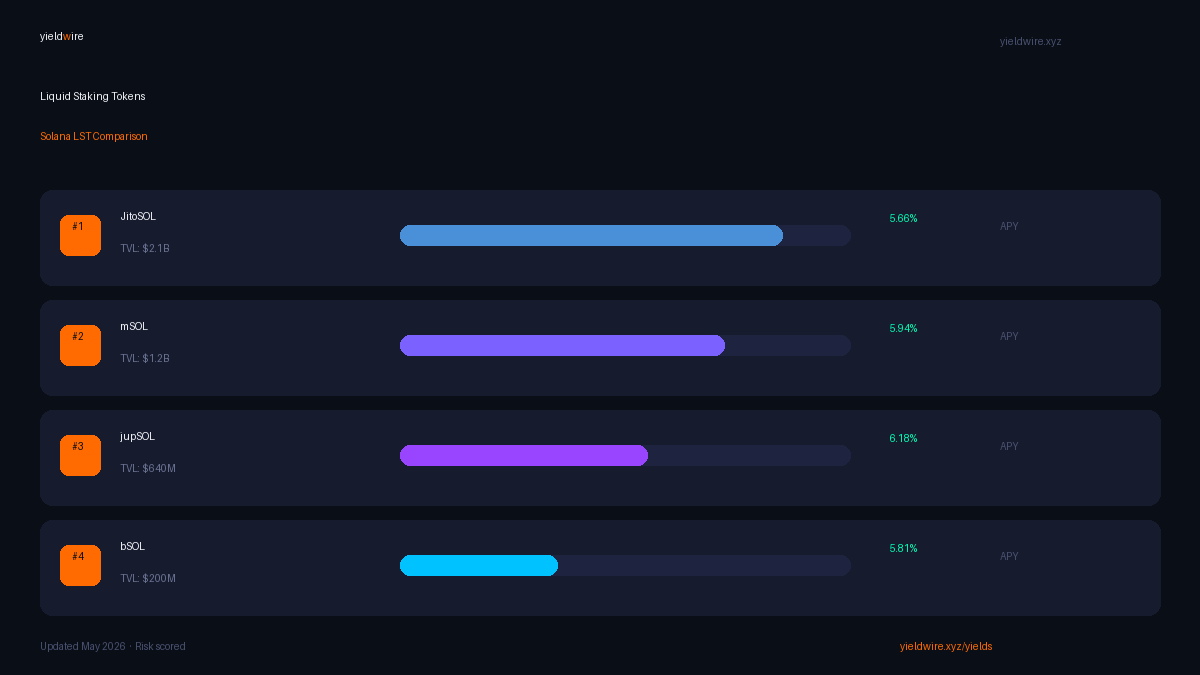
| TVL | $2B+ | $1.2B+ | $200M+ |
| DEX Liquidity | Deep (Orca, Raydium, Jupiter) | Deep (Orca, Raydium, Jupiter) | Moderate (Jupiter, Orca) |
| DeFi Integrations | 30+ protocols | 25+ protocols | 15+ protocols |
| Instant Unstake Slippage | < 0.1% | < 0.1% | 0.1-0.3% |
JitoSOL is the most widely adopted LST on Solana by a significant margin. You'll find JitoSOL accepted as collateral on Kamino, marginfi, and virtually every major Solana DeFi protocol. Swapping JitoSOL to SOL on Jupiter incurs minimal slippage.
mSOL has similarly deep liquidity and broad DeFi integration. It was the first widely-adopted Solana LST and most protocols added mSOL support early.
bSOL has growing but comparatively thinner liquidity. You can swap bSOL on Jupiter efficiently, but for very large positions, slippage may be higher. DeFi integrations are growing but lag behind JitoSOL and mSOL.
Bottom line on adoption: JitoSOL leads, mSOL is close behind, bSOL is a distant third in liquidity and integrations.
DeFi Composability
The real power of LSTs comes from using them across DeFi. Here are the most common strategies.
Yield Stacking with LSTs
-
LST + Lending — Deposit JitoSOL or mSOL on Kamino as collateral, borrow USDC, lend the USDC. You earn staking yield + lending yield.
-
LST + LP — Provide liquidity in a JitoSOL-SOL pool on Orca or Raydium. Since both assets move together, impermanent loss is minimal while you earn trading fees on top of staking rewards.
-
Leveraged Staking — Use Kamino Multiply to deposit JitoSOL, borrow SOL, convert to more JitoSOL, repeat. This amplifies your staking yield at the cost of liquidation risk if the JitoSOL/SOL peg deviates.
Which LST Composes Best?
JitoSOL has the most DeFi integrations and the deepest liquidity pools, making it the easiest to use in complex strategies. Kamino's Multiply product is optimized for JitoSOL leveraged staking specifically.
mSOL is similarly composable and works with most of the same protocols.
bSOL has fewer integration points, which limits advanced strategy options but is perfectly fine for basic lending collateral use.
The Verdict
Choose JitoSOL if:
- You want the highest APY through MEV redistribution
- You plan to use your LST actively in DeFi strategies
- You want the deepest liquidity for easy entry and exit
- You're comfortable with the marginal risk of a custom validator client
Choose mSOL if:
- You prioritize track record and trust above all else
- You value network decentralization (Marinade delegates to 400+ validators)
- You want a conservative, proven liquid staking solution
- You plan to hold long-term without frequent DeFi interaction
Choose bSOL if:
- You want zero protocol fees on staking rewards
- You're interested in BLZE token incentives as supplementary yield
- You value community governance and decentralization principles
- You're staking a smaller amount where fee savings matter proportionally
Or Split Across Multiple LSTs
Diversification across LSTs reduces smart contract and protocol-specific risk. A common allocation:
- 60% JitoSOL — Maximum yield, maximum composability
- 30% mSOL — Trust and track record
- 10% bSOL — Zero fees, token incentives, decentralization support
Track LST Yields in Real Time
LST effective APYs change as staking rewards, MEV, and DeFi rates fluctuate. Rather than checking three protocol dashboards, you can compare all Solana liquid staking yields on YieldWire — updated hourly with data from DeFiLlama.
Check the YieldWire dashboard to see current LST rates side by side.
Related reading: The Complete Guide to Solana DeFi Yields in 2026 | Kamino vs Jupiter Lend
Track all Solana yields in real time
Compare APYs across lending, LP, and liquid staking protocols on the YieldWire dashboard.
Open Dashboard →