
Kamino vs Jupiter Lend: Where to Put Your USDC
A head-to-head comparison of Kamino Finance and Jupiter Lend for USDC yields. We break down APYs, risk profiles, features, and which platform fits your strategy.
The Two Giants of Solana Lending
If you're looking to earn yield on your USDC on Solana, two protocols dominate the conversation: Kamino Finance and Jupiter Lend.
Both offer competitive rates, robust security, and deep liquidity. But they take fundamentally different approaches to lending, and the right choice depends on your priorities. Let's break it down.
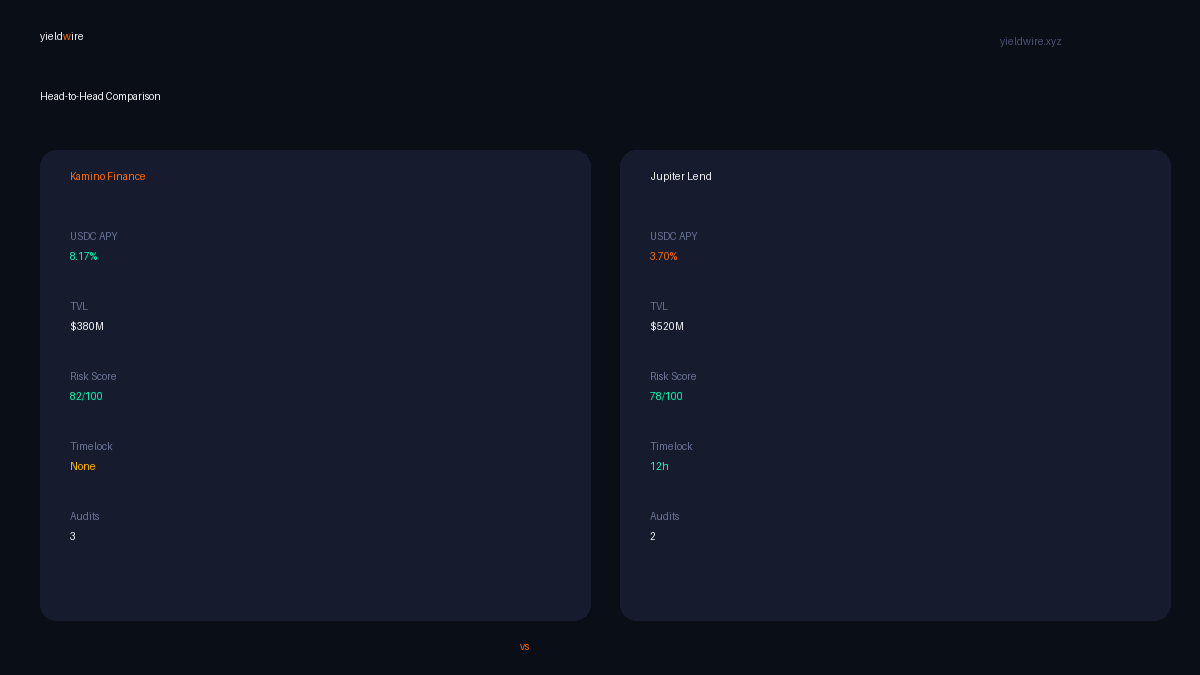
APY Comparison
The most obvious comparison point is yield. Here's where things stand in 2026.
| Metric | Kamino Finance | Jupiter Lend |
|---|---|---|
| USDC Supply APY | 6-10% | 5-11% |
| SOL Supply APY | 3-7% | 2-6% |
| USDT Supply APY | 5-9% | 4-8% |
| Rate Model | Variable, utilization-based | Variable, utilization-based |
Kamino tends to offer more consistent rates. Their utilization stays in a tighter band thanks to Kamino's integrated liquidity management features, which attract both lenders and borrowers consistently.
Jupiter Lend can spike higher during periods of heavy trading activity on Jupiter's DEX aggregator. When traders need margin or leverage, Jupiter Lend's utilization surges and rates follow. The flipside is that during quiet periods, rates can dip lower than Kamino's.
Bottom line: If you want steady, predictable yield, Kamino has the edge. If you're comfortable with more variable rates and want to capture high-utilization spikes, Jupiter can pay more.
Risk Profile
Both protocols have strong security track records, but their risk architectures differ.
Kamino Finance
- Multiple audits from top firms (Halborn, OtterSec)
- Isolated markets for riskier assets, protecting core pools
- Conservative oracle setup using Pyth and Switchboard with fallback mechanisms
- Auto-deleveraging mechanisms to prevent bad debt accumulation
- Insurance fund built from protocol fees
Kamino's risk management is arguably the most sophisticated on Solana. Their k-Lend product was built specifically to address the failure modes seen in other lending protocols (including cross-chain collapses like the ones that hit Ethereum lending in previous cycles).
Jupiter Lend
- Audited by leading security firms
- Integrated with Jupiter's oracle infrastructure — benefits from Jupiter's price feed accuracy across hundreds of trading pairs
- Isolated pools for newer or volatile assets
- Liquidation engine leverages Jupiter's routing for efficient liquidations
- Revenue-backed by Jupiter's massive trading fee income
Jupiter Lend benefits from being part of the Jupiter ecosystem. Jupiter processes a significant share of all Solana DEX volume, which means their liquidation engine can execute liquidations through optimal routing — minimizing bad debt risk.
Bottom line: Both are well-audited and battle-tested. Kamino has a slight edge in risk management sophistication, while Jupiter benefits from ecosystem integration and liquidation routing efficiency.
Features and UX
Kamino Finance
- Multiply (leverage) — One-click leveraged yield positions. Deposit USDC, borrow SOL, stake it as JitoSOL, and loop for amplified yield. Kamino handles the complexity.
- Automated vaults — Kamino's liquidity vaults automatically manage concentrated LP positions, combining lending and LP yields.
- Points/rewards — KMNO token rewards on top of base lending yield.
- Portfolio dashboard — Clean overview of all positions, yields, and health factors.
Jupiter Lend
- Tight DEX integration — Swap and lend in a single flow. Jupiter's UI makes it seamless to move between trading and lending.
- JLP integration — Jupiter Liquidity Pool holders can use JLP as collateral, unlocking yield on yield.
- Perps margin — Lend assets that get used for Jupiter perpetual futures margin, driving utilization.
- JUP governance — JUP stakers get fee sharing from lending protocol revenue.
Bottom line: Kamino is the better choice if you want advanced yield strategies (multiply, vaults). Jupiter wins if you're already active on Jupiter for trading and want a unified experience.
Liquidity and TVL
| Metric | Kamino Finance | Jupiter Lend |
|---|---|---|
| Total TVL | $1B+ | $800M+ |
| USDC Pool Size | $400M+ | $300M+ |
| Active Borrowers | 50,000+ | 40,000+ |
Kamino has the larger lending TVL overall, which means more liquidity and lower withdrawal friction. Jupiter's pools are still very deep, and their utilization rates tend to be slightly higher due to perp and trading demand.
Both protocols have more than enough liquidity for the vast majority of users. You won't face withdrawal issues on either platform unless you're moving eight-figure sums.
When to Choose Kamino
- You want steady, predictable USDC yields in the 6-10% range
- You want to use advanced strategies like Multiply for leveraged staking yield
- You prioritize risk management and conservative protocol design
- You're looking for a primary lending platform for the bulk of your capital
When to Choose Jupiter Lend
- You're already a Jupiter power user and want everything in one place
- You want to capture rate spikes during high trading activity
- You hold JLP and want to use it as collateral
- You want exposure to JUP governance and fee sharing
The Split Strategy
Many experienced Solana DeFi users don't choose one or the other — they split their USDC across both platforms.
A common approach:
- 60-70% on Kamino for the steady baseline yield
- 30-40% on Jupiter Lend to capture utilization spikes and benefit from the Jupiter ecosystem
This diversifies smart contract risk while optimizing for both consistency and upside.
Tracking Rates in Real Time
Rates on both platforms change constantly based on supply and demand. Rather than checking two dashboards, you can monitor both on YieldWire — we pull live APY data from both Kamino and Jupiter (via DeFiLlama) and display them side by side.
Check the YieldWire dashboard to compare current rates across all Solana lending protocols.
Related reading: The Complete Guide to Solana DeFi Yields in 2026
Track all Solana yields in real time
Compare APYs across lending, LP, and liquid staking protocols on the YieldWire dashboard.
Open Dashboard →