
The Complete Guide to Solana DeFi Yields in 2026
Everything you need to know about earning yield on Solana. From lending and LP to liquid staking, we break down every strategy, protocol, and APY range across the ecosystem.
What Are DeFi Yields?
DeFi yields are the returns you earn by deploying your crypto assets into decentralized finance protocols. Instead of letting your SOL, USDC, or other tokens sit idle in a wallet, you can put them to work across lending platforms, liquidity pools, and staking services.
On Solana, DeFi yields have matured significantly since the early days of yield farming. The ecosystem now offers sustainable, transparent returns backed by real economic activity rather than unsustainable token emissions. In 2026, Solana's DeFi TVL sits firmly among the top three chains, and yield opportunities have never been more diverse.
The key question isn't whether to earn yield on Solana. It's where and how to do it efficiently.
Types of DeFi Yields on Solana
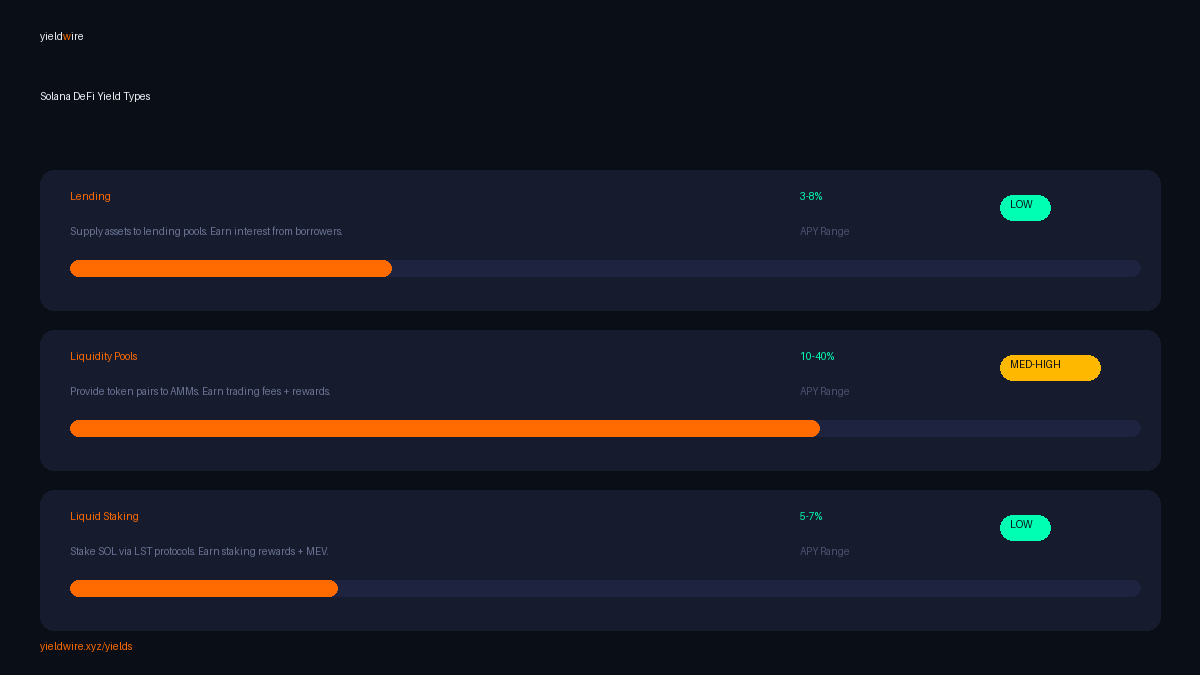
There are three main categories of yield on Solana, each with distinct risk-reward profiles.
1. Lending and Borrowing
Lending is the simplest form of DeFi yield. You deposit tokens into a lending protocol, borrowers pay interest to use them, and you earn a share of that interest.
How it works: You supply assets to a lending pool. Borrowers post collateral and borrow from that pool. The interest they pay is distributed to lenders proportionally.
Typical APY ranges:
- USDC/USDT lending: 4-12% APY
- SOL lending: 2-8% APY
- Volatile assets (wBTC, wETH): 1-5% APY
Risk profile: Low to moderate. Main risks are smart contract bugs, oracle failures, and liquidation cascades that could temporarily affect pool solvency.
Top Solana lending protocols:
-
Kamino Finance — The dominant lending platform on Solana in 2026. Kamino combines lending with automated liquidity management. USDC supply rates consistently sit in the 6-10% range. Their k-Lend product has become the go-to for passive yield seekers.
-
marginfi — A lending protocol focused on risk management and isolated pools. marginfi offers competitive rates and has built a reputation for conservative risk parameters. USDC rates typically range from 5-9%.
-
Jupiter Lend — Jupiter's lending product leverages the platform's massive trading volume. Since Jupiter routes a significant portion of Solana DEX trades, their lending pools see consistent utilization. USDC yields range from 5-11%.
2. Liquidity Provision (LP)
Liquidity provision means depositing token pairs into decentralized exchanges so traders can swap between them. In return, you earn a share of trading fees.
How it works: You deposit two tokens (e.g., SOL and USDC) into a liquidity pool. Every time someone trades through that pool, you earn a portion of the trading fee. On concentrated liquidity AMMs, you can specify a price range to earn higher fees with less capital.
Typical APY ranges:
- Stablecoin pairs (USDC-USDT): 3-8% APY
- Major pairs (SOL-USDC): 15-40% APY
- Volatile pairs: 30-100%+ APY (higher risk of impermanent loss)
Risk profile: Moderate to high. Impermanent loss is the main risk — if the price ratio between your two tokens changes significantly, you can end up with less value than if you'd simply held both tokens.
Top Solana LP protocols:
-
Raydium — Solana's largest AMM by volume. Raydium offers both standard and concentrated liquidity pools. Their CLMM (Concentrated Liquidity Market Maker) pools on major pairs like SOL-USDC consistently offer 20-35% APY from fees alone.
-
Orca — Known for its clean UX and Whirlpools (concentrated liquidity). Orca's whirlpool positions on major pairs yield 15-30% APY. Their fee structure is transparent and they've maintained strong volume through 2026.
-
Meteora — Meteora has carved out a niche with Dynamic Liquidity Market Maker (DLMM) pools. Their approach to concentrated liquidity is more capital-efficient for certain pairs, with yields on popular pools reaching 25-50% APY.
3. Liquid Staking
Liquid staking lets you stake SOL to secure the Solana network while receiving a liquid token that represents your staked position. You earn staking rewards (currently around 7-8% APY on base SOL staking) while keeping your capital liquid and composable across DeFi.
How it works: You deposit SOL into a liquid staking protocol and receive a liquid staking token (LST) like JitoSOL, mSOL, or bSOL. This token accrues staking rewards over time, increasing in value relative to SOL. You can use the LST in DeFi — as collateral for lending, in LP positions, or other strategies.
Typical APY ranges:
- Base staking yield: 7-8% APY
- With MEV rewards (Jito): 8-9% APY
- LST-DeFi strategies (looping, LP): 10-20%+ APY
Risk profile: Low. Liquid staking is considered one of the safest yield strategies. Main risks are smart contract vulnerabilities and validator slashing (extremely rare on Solana).
Top Solana liquid staking protocols:
-
Jito (JitoSOL) — The market leader. JitoSOL earns both staking rewards and MEV (Maximal Extractable Value) tips, giving it a yield edge over competitors. Current APY sits around 8-9%.
-
Marinade Finance (mSOL) — One of the OGs of Solana liquid staking. Marinade delegates to hundreds of validators, promoting decentralization. mSOL yields around 7.5-8% APY.
-
BlazeStake (bSOL) — Focused on decentralization and community governance. bSOL offers competitive yields around 7.5-8% APY plus additional BLZE token incentives.
How to Compare Yields: What Actually Matters
Not all APYs are created equal. Here's what to look for when comparing yields across protocols.
1. Sustainability
Is the yield coming from real economic activity (lending interest, trading fees, staking rewards) or from token emissions that will decrease over time? In 2026, most top Solana protocols have moved to sustainable fee-based models, but always check the source of yield.
2. Risk-Adjusted Returns
A 50% APY on a volatile LP pair isn't necessarily better than 8% on liquid staking. Factor in impermanent loss risk, smart contract risk, and the volatility of the underlying assets.
3. TVL and Utilization
Higher TVL generally means more liquidity and lower slippage risk. For lending protocols, check the utilization rate — very high utilization means you might not be able to withdraw instantly.
4. Protocol Track Record
How long has the protocol been running? Has it survived market downturns? Has it been audited? On Solana, protocols like Marinade, Raydium, and Orca have multi-year track records. Newer protocols may offer higher yields but carry more uncertainty.
5. Composability
Can you use your yield-bearing position elsewhere? For example, JitoSOL can be used as collateral on Kamino, effectively layering yields. This composability is one of Solana DeFi's greatest strengths.
Building a Solana Yield Strategy
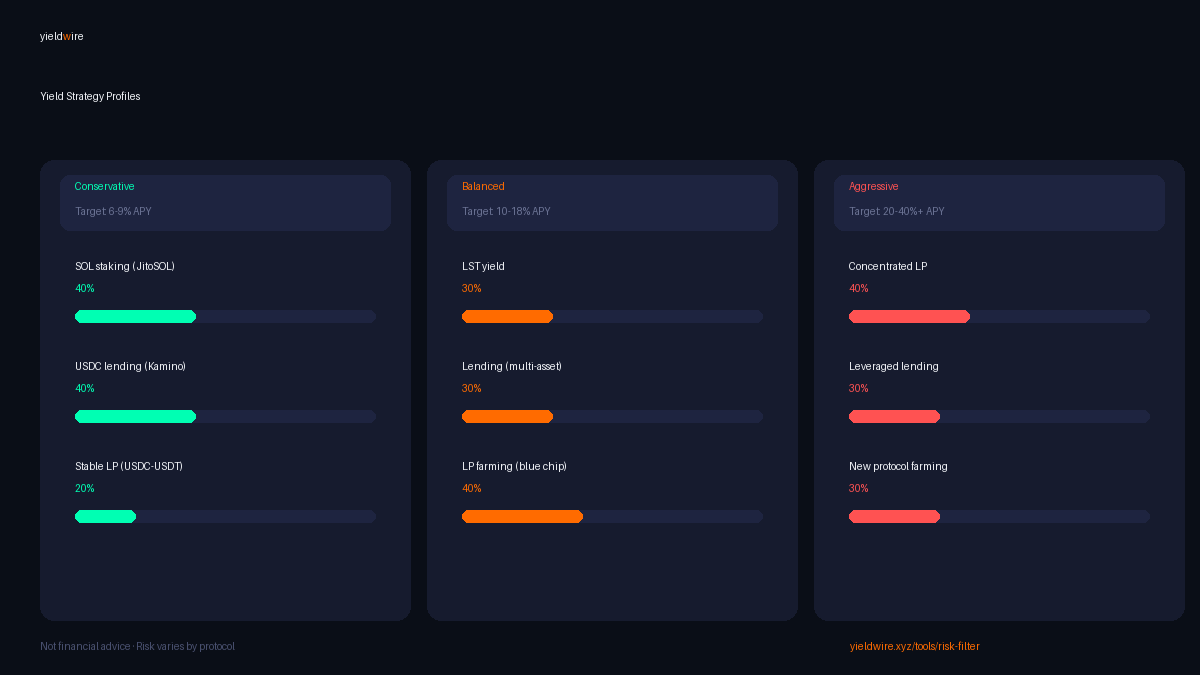
Here's a practical framework for allocating capital across Solana DeFi yields.
Conservative (Low Risk)
- 60% in liquid staking (JitoSOL or mSOL)
- 30% in USDC/USDT lending on Kamino or marginfi
- 10% in stablecoin LP on Orca or Raydium
Expected blended APY: 6-9%
Balanced (Moderate Risk)
- 40% in liquid staking (JitoSOL)
- 30% in SOL or USDC lending on Kamino
- 20% in SOL-USDC LP on Raydium or Orca
- 10% in higher-yield LP positions on Meteora
Expected blended APY: 10-18%
Aggressive (Higher Risk)
- 25% in liquid staking (JitoSOL, used as collateral on Kamino)
- 25% in leveraged lending loops
- 30% in concentrated LP on volatile pairs
- 20% in new protocol yield opportunities
Expected blended APY: 20-40%+ (with correspondingly higher risk)
Tracking Your Yields
Managing positions across multiple protocols gets complex fast. That's why tools like YieldWire exist — to give you a single view of all Solana DeFi yields, updated in real time, so you can compare opportunities and make informed decisions without checking five different dashboards.
Key Takeaways
- Solana DeFi offers three main yield categories: lending, LP, and liquid staking
- Sustainable yields in 2026 range from 5-8% for conservative strategies to 20%+ for aggressive ones
- Always evaluate yields on a risk-adjusted basis, not just raw APY numbers
- Protocol track record, TVL, and audit history matter more than short-term rate spikes
- Composability across protocols (e.g., using LSTs as collateral) can boost returns efficiently
The Solana DeFi yield landscape is mature, competitive, and full of opportunity. Whether you're parking stablecoins for low-risk income or actively managing LP positions for maximum returns, understanding these fundamentals is the first step.
Check the YieldWire dashboard to see current rates across all protocols, updated hourly.
Track all Solana yields in real time
Compare APYs across lending, LP, and liquid staking protocols on the YieldWire dashboard.
Open Dashboard →