DeFi Yield Compression: Why Rates Are Falling and What Comes Next
Stablecoin lending on Solana paid more than 12% at the start of the cycle. Today the deepest pools sit at 4-5%. The compression is not a glitch. It is what happens when capital floods in, borrowers retreat, and a 4% risk-free floor sets the price. Here is the data and where rates go next.
The 12% Era Is Over
Six months ago a USDC deposit on a major Solana money market paid double digits. Borrowers were paying up for leverage, points programs were stacking emissions on top of base rates, and a patient stablecoin lender could clear 12% without touching anything exotic.
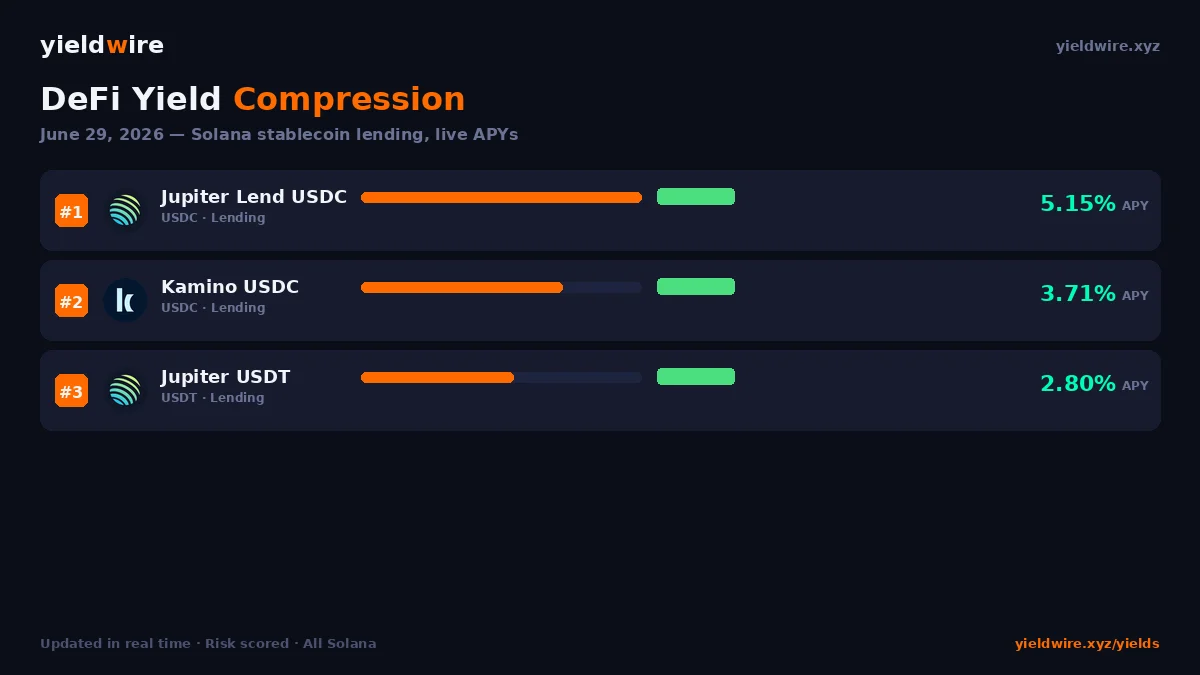
That rate is gone. As of late June 2026, the deepest stablecoin pool on Solana is Jupiter Lend USDC at 5.15% APY across $396.8M in deposits. Kamino USDC sits at 3.71%. Jupiter USDT pays 2.80%. The richest non-incentivized stablecoin yields on the network now live in a 3% to 5% band, and the floor keeps creeping toward the top.
This is yield compression, and it is the defining trend of the 2026 DeFi market. It is not a bug, not a sign the sector is dying, and not specific to Solana. It is the predictable result of three forces working at once. Understanding them tells you where rates go from here.
What the Numbers Show
Here is the current state of major Solana stablecoin venues, ranked by deposits.
| Venue | Asset | TVL | APY | Base | Reward |
|---|---|---|---|---|---|
| Jupiter Lend | USDC | $396.8M | 5.15% | 4.38% | 0.76% |
| Jupiter Lend | JUPUSD | $73.7M | 5.56% | 3.55% | 2.01% |
| Kamino Lend | USDC | $21.0M | 3.71% | 3.71% | 0% |
| Jupiter Lend | USDS | $8.5M | 4.07% | 2.48% | 1.59% |
| Jupiter Lend | USDT | $18.2M | 2.80% | 2.80% | 0% |
| Kamino Lend | PYUSD | $17.5M | 2.04% | 2.04% | 0% |
Two things stand out. First, the spread between venues has narrowed. There is no 12% outlier sitting next to a 4% pool anymore. Everything clusters. Second, the base rate, the part that comes from real borrower demand rather than token incentives, is doing most of the work. Where rewards still pad the headline number, they are thin. The 0.76% reward layer on Jupiter USDC is a fraction of what emissions added a year ago.
Compare that to May 2026, when stablecoin yields on Solana cleared 8% on the strongest pools. One month of further compression knocked off another two to three points at the top. The direction is consistent.
Driver One: Capital Came In Faster Than Demand
The simplest way to read a lending rate is supply versus demand for borrowed capital. When more lenders deposit than borrowers want to borrow, utilization falls and the rate drops. This is exactly what happened.
Stablecoin supply on Solana grew hard through the first half of 2026. New issuers, new yield-bearing dollars, and a wave of capital chasing the double-digit rates that existed at the start of the year all landed in the same money markets. The deposits arrived. The borrowers did not scale at the same pace.
A lending pool with $400M in deposits and modest borrow demand cannot pay 12%. The interest borrowers pay gets spread across a much larger lender base, so the per-lender yield falls even if total interest paid holds steady. Jupiter Lend USDC carrying nearly $400M is the clearest example. That much supply, at healthy but not frantic utilization, mathematically caps the rate in the mid-single digits.
Driver Two: Borrowers Stopped Reaching for Leverage
The other side of the equation is borrow demand, and it cooled.
High lending rates in DeFi are usually a leverage story. Traders borrow stablecoins to lever long, or borrow to loop staking positions, or borrow to farm a richer yield elsewhere and pocket the spread. When that activity runs hot, borrowers bid up the rate they will pay, and lenders capture it.
Through 2026 that demand softened. Looping spreads compressed alongside the base rates, which removed the incentive to borrow in the first place. A loop only makes sense when the yield you earn exceeds the rate you pay by a clear margin. As deposit rates fell, the math on borrowing to farm stopped working, so fewer people borrowed, so utilization dropped further. Compression feeds on itself.
You can see the same pattern on the SOL side. Kamino SOL lending now pays 4.30%, well below the liquid staking tokens it competes against. jupSOL pays 5.57%, JitoSOL 5.46%, mSOL 6.65%. When staking a token outright beats lending it, lending utilization has nowhere to go but down.
Driver Three: The 4% Floor Is Real Now
The third force is structural and it is the most important for what comes next. Tokenized treasuries put a hard floor under every yield in the system.
BlackRock's BUIDL fund holds $636M on Solana and pays 3.51%, backed by short-term US government debt. Ondo's USDY sits at $181M and 3.55%. These are not DeFi yields in the usual sense. They are T-bill yields wrapped in a token, and they carry close to zero smart contract or counterparty risk relative to a money market.
That changes the whole pricing logic. If a tokenized treasury pays 3.5% with minimal risk, no rational lender accepts less than that for taking on the additional risk of a DeFi protocol. The risk-free rate becomes the floor, and every other yield has to price above it by whatever premium the market demands for the extra risk.
Right now that premium is thin. Jupiter USDC at 5.15% is paying roughly 1.6 points over BUIDL for the protocol risk, the oracle risk, and the liquidation risk of a lending market. Whether that premium is fair is a judgment call, and it is exactly the kind of judgment our security scores are built to inform. But the floor itself is not going anywhere as long as US short rates stay where they are.
This Is Not a Solana Problem
It would be easy to read this as Solana-specific. It is not. The same compression is happening across every major chain, for the same reasons. Capital is mobile, the risk-free rate is global, and DeFi rates everywhere are converging on traditional finance plus a shrinking risk premium.
If anything, Solana stablecoin rates have held up slightly better than the comparable venues on other chains, because borrow demand on Solana stayed marginally healthier through the perps and looping activity that the network's low fees support. But the trend is the same everywhere. The era of double-digit stablecoin yield as a baseline is over across DeFi, not just here.
Where Rates Go From Here
Three scenarios are worth holding in mind, and the honest answer is that the path depends mostly on factors outside DeFi.
The base case is that rates stabilize near the current floor. As long as tokenized treasuries anchor the bottom around 3.5% and borrow demand stays subdued, expect stablecoin lending to hold in the 3% to 5% range. Occasional spikes will happen when leverage demand returns in a fast market, but they will be brief, not structural.
The bull case for lenders is a return of borrow demand. A strong directional market brings leverage back. Traders borrow to go long, utilization climbs, and rates push back into the high single digits or briefly past 10% on the most active venues. This is cyclical and it will happen again. It just will not be the permanent baseline it felt like at the start of the cycle.
The bear case is further compression. If the risk-free rate falls because central banks cut, the entire stack reprices downward with it. A 3% T-bill floor pulls DeFi stablecoin yields toward 2% to 4%. In that world the yield premium for taking protocol risk gets even thinner, and the case for sitting in a tokenized treasury over a money market gets stronger.
What This Means If You Lend
Compression does not mean there is no yield left. It means the easy yield is gone and the work shifts from hunting the highest number to understanding what you are actually being paid for.
A few things follow from that. Headline APY matters less than the split between base and reward, because reward emissions can vanish overnight while base rates reflect durable demand. The risk premium over the tokenized treasury floor is the number to watch, since a thin premium means you are taking real DeFi risk for very little extra return. And the gap between lending an asset and staking it has become a live decision on the SOL side, where staking now beats lending outright.
The tools to run these comparisons sit on the site. The yields page ranks every live pool, the lending category isolates the money markets, and the calculator lets you model a position net of the risks rather than off the headline rate. In a 4% world, the difference between a good lending decision and a lazy one is most of your return.
Yield compression is not the end of DeFi yield. It is DeFi growing up into a real rates market, where the price of money reflects supply, demand, and a risk-free floor, the same way it does everywhere else. The protocols that survive this are the ones that pay a fair premium for real risk and stop pretending the 12% days are coming back.
This is analysis, not financial advice. Always assess protocol risk before depositing. Rates cited are live as of June 29, 2026 and move constantly.
Track all Solana yields in real time
Compare APYs across lending, LP, and liquid staking protocols on the YieldWire dashboard.
Open Dashboard →