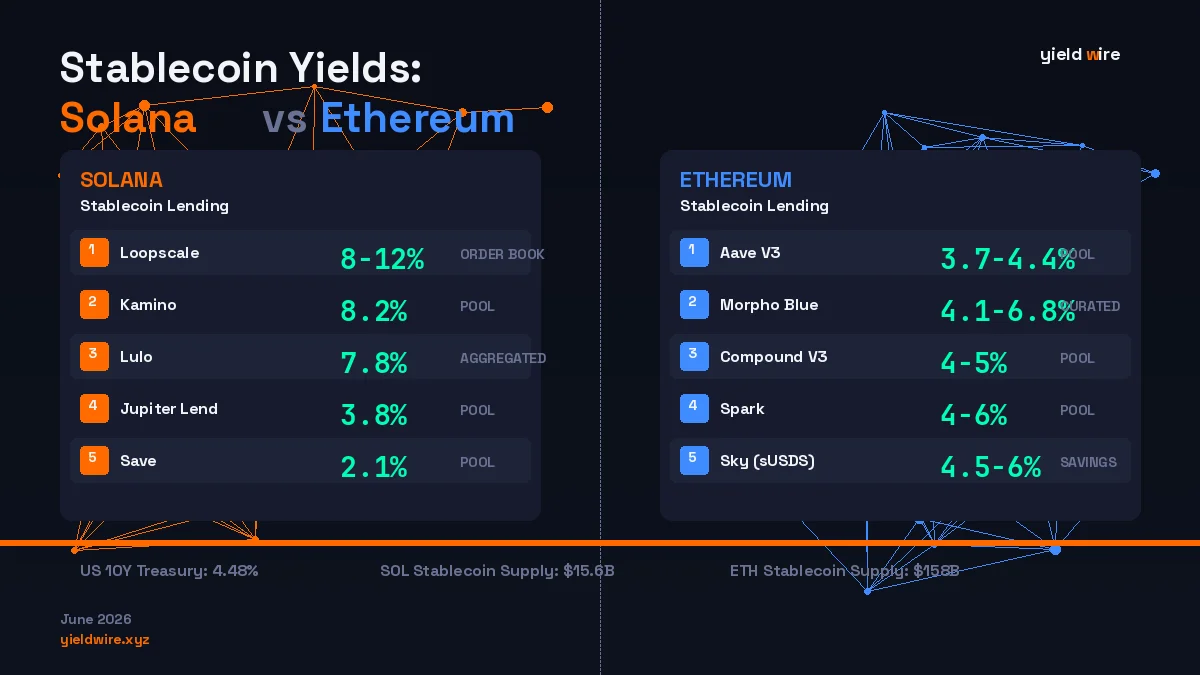
Stablecoin Yields: Solana vs Ethereum in June 2026
Solana stablecoin lending pays 8% while Ethereum sits at 4%. The gap is real, but so are the trade-offs. A data-driven comparison of USDC yields, risk profiles, and protocol depth across both chains.
The Spread Is Wide
The same USDC dollar earns different rates depending on which chain you park it on. On Solana, the top lending protocols pay 7-10% APY. On Ethereum, the equivalent range is 3.7-6.8%.
That is a 200-400 basis point gap on the same asset. At scale, the difference is material. On a $1M stablecoin position, the spread between Kamino's 8.2% and Aave's 3.7% works out to $45,000 per year in additional yield.
The question is whether that premium compensates for the risk. To answer it, you need to look at both sides of the ledger.
Solana: Where the Rates Are
Solana's stablecoin lending market has matured through the first half of 2026. Five protocols handle the bulk of USDC deposits, each with a different risk/return profile.
| Protocol | USDC APY | Model | TVL | yieldwire Score |
|---|---|---|---|---|
| Loopscale | 8-12% | Order book, fixed rates | ~$100M | Pending full audit |
| Kamino | 8.2% | Pool-based, variable | $3B+ | 79/100 (B) |
| Lulo | 7.8% | Aggregated, variable | $150M+ | 75/100 (B) |
| Jupiter Lend | 3.8% | Pool-based, variable | $750M+ | 75/100 (B) |
| Save | 2.1% | Pool-based, variable | $200M+ | 68/100 (C) |
The range is striking. Loopscale's vault pays triple what Jupiter Lend offers on the same USDC. The difference comes down to three factors: protocol design (order book vs pool), incentive programs (active token reward campaigns), and risk appetite (JLP collateral acceptance vs conservative collateral requirements).
Kamino sits in the middle ground: large enough for institutional-grade TVL ($3B+), mature enough for a solid risk score, and aggressive enough on utilization curves to sustain 8%+ base rates through most of Q2.
Solana's stablecoin supply now exceeds $15.6B, with USDC accounting for roughly 75-80% of weekly wallet activity. That is a deep capital base, but a significant share remains uninvested in DeFi. Solana's total DeFi TVL sits near $5.5B, which means billions in stablecoin capital is sitting in wallets earning nothing.
The yield premium on Solana partly reflects this dynamic: protocols compete harder for deposits because borrowing demand (leverage, loop strategies, perpetual trading) outstrips the passive supply that has found its way into lending markets.
Ethereum: Depth Over Rate
Ethereum's stablecoin lending market is older, deeper, and more conservative. The major protocols collectively hold more than $30B in lending TVL.
| Protocol | USDC APY | Model | TVL | Notes |
|---|---|---|---|---|
| Aave V3 | 3.7-4.4% | Pool-based, variable | $19B+ | Largest lending protocol in DeFi |
| Morpho Blue | 4.1-6.8% | Curated vaults | $5B+ | 50-150bps premium over Aave |
| Compound V3 | 4-5% | Pool-based, variable | $2.7B+ | Institutional adoption, simple UX |
| Spark | 4-6% | Pool-based, variable | $6.8B+ | MakerDAO ecosystem integration |
| Sky (sUSDS) | 4.5-6% | Savings rate | Large | Yield-bearing stablecoin, no lending required |
The rates are lower across the board. Aave's 3.7% USDC supply rate is the benchmark for "risk-free" DeFi lending, the way the US 10-year Treasury (currently 4.48%) serves as the TradFi benchmark.
Morpho is the outlier. Its curated vault architecture lets risk curators build customized lending markets with tighter collateral requirements and higher utilization targets. The result is a 50-150 basis point premium over Aave on equivalent collateral types. Some MetaMorpho vaults push USDC yields above 6.5% by accepting higher-risk collateral combinations.
Ethereum's stablecoin supply exceeds $158B, and the chain (including L2s) holds over 60% of all DeFi TVL. The liquidity is an order of magnitude deeper than Solana. A $10M deposit on Aave barely moves the utilization curve. The same deposit on a Solana lending protocol can shift rates by 50-100 basis points.
That depth is both a strength and a limitation. Rates are stable because utilization stays in a narrow band. But stability means compression: lenders earn less because there is more passive capital chasing the same borrower demand.
Why the Gap Exists
The Solana-Ethereum yield spread is not random. It reflects structural differences between the two ecosystems.
Utilization. Solana lending markets run at higher utilization because borrower demand (loop strategies, leveraged LST positions, perpetual trading margin) is large relative to the deposited supply. Higher utilization means higher rates for lenders. On Ethereum, the sheer volume of idle stablecoin capital keeps utilization, and therefore rates, lower.
Protocol maturity. Solana's lending protocols are younger. Kamino launched in 2023, Loopscale in 2025. Younger protocols often run more aggressive rate curves and offer token incentives to attract liquidity. Strip away the incentives and Solana base rates still outperform Ethereum, but the gap narrows.
Transaction costs. A Solana transaction costs $0.001 or less. An Ethereum mainnet transaction costs $2-10 depending on gas. This difference shapes behavior. On Solana, it is economical to rebalance a lending position daily or chase rate spikes across protocols. On Ethereum, small positions are uneconomical to manage actively. The result: Solana attracts more active, rate-sensitive capital. Ethereum attracts more passive, set-and-forget capital.
Incentive programs. Kamino's Season 4 distributes 1.75M KMNO tokens weekly to lenders. Loopscale runs an active airdrop farming campaign. Morpho distributes MORPHO tokens. The incentive layers vary, but Solana protocols tend to offer more aggressive token rewards relative to TVL, which inflates effective yields beyond the base lending rate.
Risk: The Other Side of the Spread
Higher yield means higher risk. The premium is compensation, not a free lunch.
Protocol age. Aave has processed over $100B in cumulative volume across multiple market cycles since 2020. Kamino has operated since 2023. Loopscale lost $5.8M to an oracle exploit two weeks after launch in 2025 (funds were recovered). Time is the most reliable security audit. Ethereum's lending protocols have more of it.
TVL depth. Aave holds $19B+. If a $50M withdrawal hits Aave, the utilization curve barely shifts. The same withdrawal from a Solana protocol with $150M TVL would spike rates and potentially trigger cascading liquidations. TVL depth is a buffer against bank-run dynamics.
Audit coverage. Ethereum's top protocols carry 5-10 audits each from firms like Trail of Bits, OpenZeppelin, Gauntlet, and Sigma Prime. Solana protocols typically carry 1-3 audits. The gap is closing, but it has not closed.
Smart contract risk. Every lending protocol carries smart contract risk regardless of chain. But the surface area differs. Ethereum's protocols are written in Solidity, a language with more tooling, more formal verification libraries, and a larger auditor ecosystem. Solana's Rust/Anchor stack is newer, with fewer specialized auditors.
Oracle risk. Both chains rely on Pyth and Chainlink for price feeds. But Loopscale's 2025 exploit demonstrated that oracle manipulation is easier on lower-liquidity markets. Solana's newer protocols with exotic collateral types (LP tokens, leveraged positions) carry higher oracle manipulation risk than Ethereum's mature lending markets.
The TradFi Benchmark
The US 10-year Treasury currently yields 4.48%. That is the risk-free rate against which all DeFi yields should be measured.
Aave's 3.7% USDC rate sits below the Treasury rate. For a US-based investor, that means Aave is not competitive on a risk-adjusted basis unless you value the composability, 24/7 access, and censorship resistance that DeFi offers over TradFi.
Kamino's 8.2% represents a 372 basis point premium over the risk-free rate. That premium compensates for smart contract risk, oracle risk, regulatory uncertainty, and the opportunity cost of locking capital in DeFi rather than a Treasury bond.
Whether that premium is sufficient is a personal risk assessment. The data is here to help you make it.
Which Chain, Which Protocol
The answer depends on your capital size, risk tolerance, and operational needs.
Under $100K, active management: Solana. Transaction costs are negligible, rate-chasing is economical, and the 8%+ yields are meaningful at this scale. Start with Kamino (best risk/return ratio) or Lulo (automated allocation across protocols). Check risk scores before depositing.
$100K-$1M, moderate risk: Split allocation. Kamino or Lulo on Solana for the higher base rate. Morpho vaults on Ethereum for the depth and institutional-grade risk curation. The blended rate should land around 5.5-7%.
$1M+, institutional: Ethereum mainnet. Aave or Morpho. The liquidity depth matters more at this scale than the rate differential. A 4-5% yield on $5M is $200-250K/year with institutional-grade security. The extra 300bps on Solana is not worth the thinner liquidity buffer and younger protocol risk at that capital level.
Fixed-rate need: Loopscale on Solana is the only major option for fixed-rate, fixed-duration stablecoin lending. If predictability matters more than rate maximization, it is worth the trade-off of working with a younger protocol.
The Bottom Line
Solana pays more on stablecoins. Ethereum is safer. Both statements are true, and the data supports them.
The 200-400 basis point premium on Solana reflects real structural advantages: higher utilization, lower transaction costs, and more aggressive protocol competition. But it also reflects real risk: younger protocols, thinner TVL buffers, and a shorter track record.
The smart money is not choosing one chain. It is using both, sizing positions according to the risk each protocol carries. That is what risk-adjusted yield allocation looks like.
Track rates across both ecosystems at yieldwire.xyz/yields. Compare risk scores at yieldwire.xyz/security. Use the calculator to model your own allocation.
Track all Solana yields in real time
Compare APYs across lending, LP, and liquid staking protocols on the YieldWire dashboard.
Open Dashboard →