TVL Concentration on Solana: When One Protocol Holds Too Much
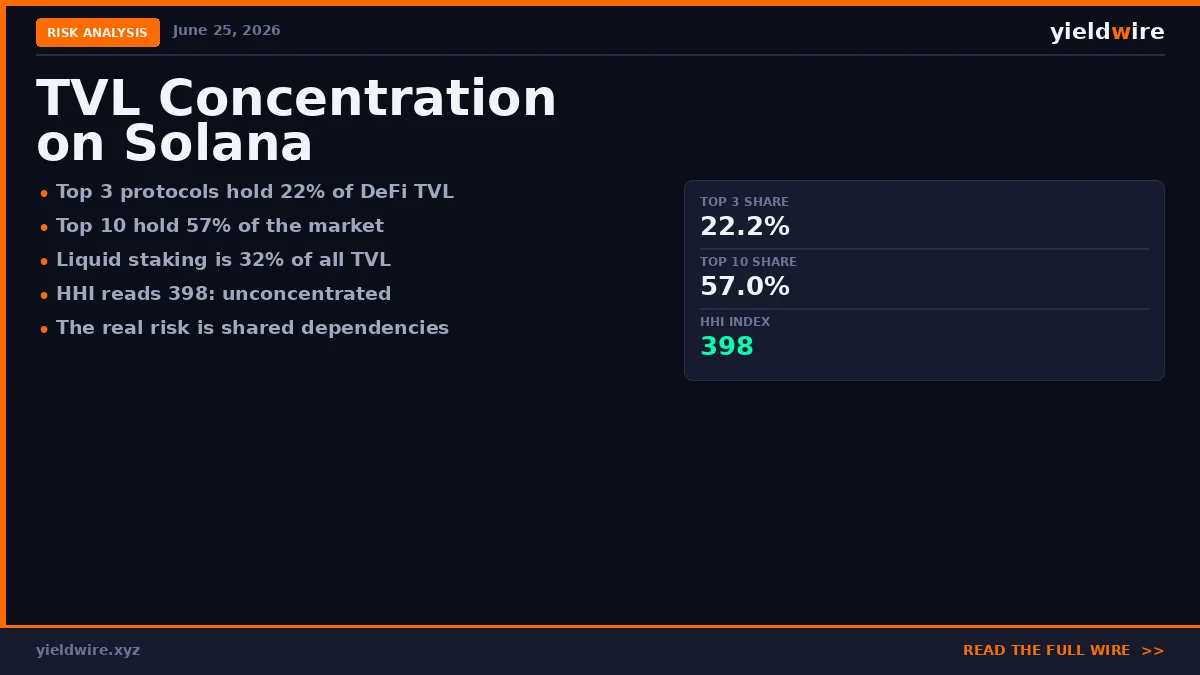
The fear is that a handful of protocols hold all the money on Solana. The data says otherwise: the top three control 22% of DeFi TVL, and the concentration index sits in unconcentrated territory. The real risk is not who is biggest. It is what they share.
The question people get wrong
"What happens if the biggest protocol on Solana fails?" is the wrong place to start. It assumes the danger lives in a single name holding too large a share. Run the numbers and that picture does not hold up.
We measure the universe the same way our security scoring does: every DeFi protocol on Solana with at least $1M in TVL, excluding centralized exchange wallets. As of June 25, 2026, that is 134 protocols holding roughly $13.1B between them.
The single largest, Kamino Lend, holds 8.1% of it. The top three together hold 22.2%. You have to go ten deep to clear half the market. By the standard concentration measure, the Herfindahl-Hirschman Index, Solana DeFi scores 398. Anything under 1,500 is considered unconcentrated. Solana is not close to a dangerous reading.
So the headline fear is mostly wrong. No protocol holds too much. But that does not mean concentration risk is absent. It means it is hiding somewhere the protocol ranking cannot show you.
Where the money actually sits
Here is the top of the table, ranked by Solana TVL.
| # | Protocol | Category | TVL | Share | Cumulative |
|---|---|---|---|---|---|
| 1 | Kamino Lend | Lending | $1.06B | 8.1% | 8.1% |
| 2 | Sanctum Validator LSTs | Liquid Staking | $0.99B | 7.5% | 15.6% |
| 3 | Jupiter Lend | Lending | $0.87B | 6.6% | 22.2% |
| 4 | Raydium AMM | DEX | $0.80B | 6.1% | 28.3% |
| 5 | Binance Staked SOL | Liquid Staking | $0.71B | 5.4% | 33.8% |
| 6 | Jito Liquid Staking | Liquid Staking | $0.68B | 5.2% | 38.9% |
| 7 | Jupiter Perpetual Exchange | Derivatives | $0.67B | 5.1% | 44.0% |
| 8 | BlackRock BUIDL | RWA | $0.62B | 4.7% | 48.7% |
| 9 | xStocks | RWA | $0.58B | 4.4% | 53.1% |
| 10 | Solstice | Basis Trading | $0.51B | 3.9% | 57.0% |
The distribution is flatter than the fear suggests. The gap between first and tenth is a factor of two, not ten. Eight different protocols sit between 3% and 9%. That is a competitive market, not a monopoly.
But look at the category column, not the protocol column. That is where the concentration lives.
The concentration nobody ranks
Group the same $13.1B by what the money is actually doing and the spread collapses.
| Category | TVL | Share |
|---|---|---|
| Liquid Staking | $4.25B | 32.3% |
| Lending | $2.16B | 16.5% |
| RWA | $1.92B | 14.6% |
| DEX / AMM | $1.72B | 13.1% |
| Derivatives | $0.79B | 6.0% |
| Basis Trading | $0.61B | 4.7% |
| Risk Curators | $0.48B | 3.7% |
One in three dollars in Solana DeFi is in a liquid staking token. Add lending and you are at half. The protocol ranking spreads that liquid staking exposure across Sanctum, Jito, Binance Staked SOL, Jupiter Staked SOL, DoubleZero, Marinade, and a dozen smaller LSTs, which makes it look diversified. It is not. They are all the same trade: stake SOL, get a receipt token, earn validator rewards, take on the same SOL price exposure and the same depeg mechanics.
If something breaks the LST model, whether a major validator slashing event, a staking program bug, or a liquidity crunch that snaps the peg on receipt tokens, it does not hit one 8% protocol. It hits a third of the market at once, across names that a TVL chart treats as unrelated.
That is the concentration that matters, and a per-protocol ranking is built to hide it.
Shared dependencies are the real systemic risk
Concentration at the protocol level is easy to see and mostly benign here. The dangerous kind is correlation: distinct protocols that fail together because they lean on the same thing underneath.
Three of these run deep on Solana.
One brand, many lines. Jupiter shows up three times in the top of the table: lending at $0.87B, perps at $0.67B, and a staked SOL product at $0.37B. Counted separately, none looks dominant. Counted as one team shipping one codebase governed by one set of keys, Jupiter touches close to $1.9B, more than any single protocol on the list. A governance compromise or a shared library bug does not respect the category lines DeFiLlama draws.
One price layer. Most lending markets, perps, and looping vaults on Solana read prices from the same two oracles, Pyth and Switchboard. That is good for quality and bad for correlation. A feed failure does not stay inside one protocol. It propagates to everything pricing collateral off that feed at the same moment. We wrote about how that path works in detail in Oracle Risk in DeFi, and it is exactly why oracle setup is a scored dimension rather than a footnote.
One settlement layer. Every number in this article assumes Solana itself keeps producing blocks. The chain has a stronger uptime record in 2026 than it did two years ago, but a multi-hour halt during a volatile move freezes liquidations across every lending market simultaneously. No amount of protocol-level diversification helps when the base layer pauses.
These dependencies do not show up as concentration in any TVL ranking. They show up as correlation on the day a shared input fails.
Does bigger mean safer here?
There is one piece of good news in the data. On Solana, size and safety line up better than they usually do in DeFi.
| Protocol | TVL rank | Security grade |
|---|---|---|
| Jito Liquid Staking | 6 | B (83) |
| Kamino Lend | 1 | B (79) |
| Sanctum Validator LSTs | 2 | B (78) |
| Jupiter Lend | 3 | B (75) |
| Raydium AMM | 4 | C (63) |
The protocols holding the most are mostly graded B in our security rankings, carrying multiple audits, real track records, and credible multisig setups. That is not automatic. In plenty of cycles the biggest TVL belonged to the thinnest-audited yield farm. Here the largest positions are, on balance, among the better-secured ones.
The exception worth naming is Raydium at a C. It is the fourth-largest pool of capital on the chain and it scores below the lending and staking leaders, mostly on governance and timelock gaps rather than code history. Big and only moderately graded is a combination worth watching, because that is where size and risk diverge instead of reinforcing.
What this means for where you put money
Concentration risk on Solana is real, but it is not the risk most people picture. You are not exposed because one protocol is too big. You are exposed because a third of the market makes the same staking bet, because one team runs several of the largest products, and because nearly everything prices off the same two oracles on top of the same chain.
A few things follow from that.
Diversifying across protocol names is not the same as diversifying risk. Holding jitoSOL, mSOL, and a Sanctum LST spreads your counterparty across three issuers but leaves you fully exposed to the liquid staking model. Real diversification crosses categories, not just logos.
Map the shared dependencies before you size a position. Two protocols that read the same oracle, settle on the same chain, and share a governance team are one bet wearing two names. Treat them that way.
Size and a good grade help, but they are not a hedge against correlated failure. A B-rated lending market is safer than a D-rated one in isolation. Both still go dark if the oracle they share posts a bad price or the chain halts mid-liquidation.
You can pressure-test any of this directly. The risk filter lets you screen pools by security grade and category so you can see how much of a planned allocation is really one trade. The yield calculator lets you model returns against the grade you are accepting rather than the APY on the banner. And every pool on /yields carries its security score next to the rate, not buried under it.
The takeaway
By the numbers, Solana DeFi is not dangerously concentrated at the protocol level. The top three hold 22% of TVL, the index reads unconcentrated, and the largest protocols tend to be the better-graded ones. That is a healthier picture than the question "what if the biggest one fails" assumes.
The concentration that should worry you is the kind no ranking displays: a third of the market in one staking model, several top protocols under one team, and almost everything depending on the same oracles and the same chain. Those are the failures that take down many names at once while a TVL chart still shows a tidy, diversified spread.
We score the protocol layer, the oracle layer, and the shared dependencies for every Solana protocol we track. You can see where each one stands at yieldwire.xyz/security.
This post is informational only and is not financial advice. TVL and concentration figures are from DeFiLlama as of June 25, 2026, and move daily. Concentration is one of several risks in any DeFi position. Always do your own research before depositing funds into any protocol.
Track all Solana yields in real time
Compare APYs across lending, LP, and liquid staking protocols on the YieldWire dashboard.
Open Dashboard →