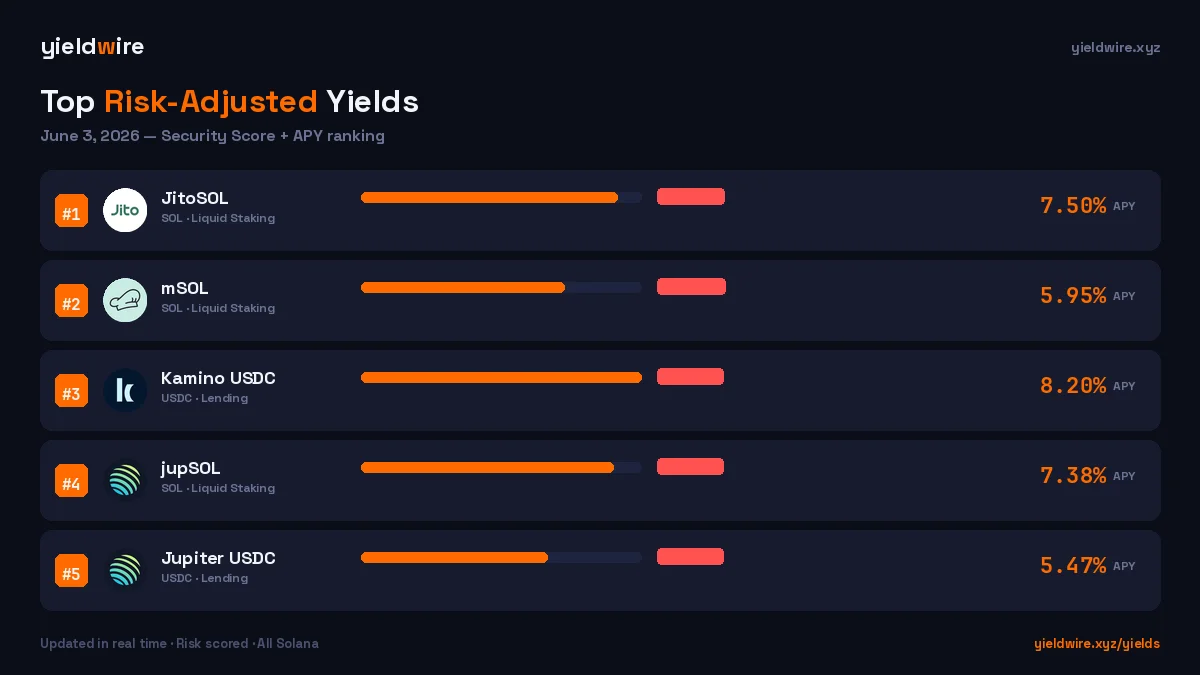
Top Risk-Adjusted Yield Pools on Solana This Week
We ranked every Solana yield opportunity by combining APY with our 10-factor Security Score. Here are the pools where the math actually works in your favor.
The Problem With Chasing APY
Sort any yield aggregator by APY and the top results look incredible. 200%, 500%, sometimes four digits. The numbers are real, technically. But they hide the part that matters: how likely you are to keep the money.
A pool paying 300% APY on a protocol with no audit, $2M in TVL, and admin keys held by an anonymous team is not a yield opportunity. It is a countdown. The Drift exploit in April 2026 proved that even $550M in TVL and multiple audits cannot protect you when governance controls are weak. Loopscale lost $5.8M two weeks after launch despite passing an audit cycle.
Risk-adjusted yield strips away the noise. It asks a simple question: for every unit of risk you take, how much return do you actually get?
We score every protocol on Solana across 10 factors, then combine that score with live yield data to rank the pools where the math works in your favor. Here is what that looks like this week.
How We Define Risk-Adjusted Yield
The yieldwire Security Score evaluates protocols on a 0-100 scale using two weighted components. The Protocol Security Subscore (PSS, 60% weight) covers audit history, multisig configuration, timelock presence, bug bounty programs, incident track record, and code maturity. The Vault Security Subscore (VSS, 40% weight) accounts for TVL depth, oracle reliability, liquidation mechanics, and asset-specific risks like impermanent loss or depeg exposure.
A score of 70+ earns a B grade. That means the protocol has documented audits, meaningful TVL, reasonable governance controls, and no recent exploits. Below 55 enters D territory, where one or more critical safeguards are missing.
For this ranking, we filtered for pools with a Security Score above 65 and an APY above 4%. Then we sorted by the ratio of yield to risk. The result is a list of pools where you are compensated fairly for the exposure you take.
This Week's Top Risk-Adjusted Pools
Tier 1: Highest Confidence (Score 75+)
Jito Liquid Staking (JitoSOL)
| Metric | Value |
|---|---|
| APY | 7.5% |
| Security Score | 83 (B) |
| TVL | $895M |
| Category | Liquid Staking |
| Audits | 9+ (OtterSec, Neodyme, others) |
JitoSOL remains the strongest risk-adjusted yield on Solana. The APY comes from two sources: base Solana staking rewards (roughly 6%) and MEV tips captured by the Jito block engine (adding 1-2%). Neither source depends on token emissions, which means the yield is organic and repeatable.
The score reflects nine completed audits, deep TVL, a proven track record across multiple market cycles, and functional validator infrastructure. No exploits. No governance incidents. JitoSOL is also the most liquid LST on Solana, meaning you can exit to SOL quickly through multiple DEX routes.
The tradeoff: staking yield compresses when network activity drops. During quiet weeks, the MEV component shrinks. But even at the floor, JitoSOL consistently outperforms vanilla staking.
Marinade Liquid Staking (mSOL)
| Metric | Value |
|---|---|
| APY | 5.95% |
| Security Score | 84 (B) |
| TVL | $278M |
| Category | Liquid Staking |
| Audits | 3+ (Kudelski, Ackee, Neodyme) |
Marinade scores highest on protocol security among all Solana protocols in our dataset. Three years of operation, no exploits, and strong multisig governance earn it the top PSS rating. The APY is lower than JitoSOL because Marinade does not capture MEV tips directly, relying purely on validator staking rewards after a 9.5% performance fee (introduced February 2026 via MIP-18).
For users who prioritize security over an extra percentage point of yield, mSOL is the conservative anchor of a Solana portfolio. The TVL is lower than JitoSOL but still deep enough for liquid exits.
Kamino Lend (USDC)
| Metric | Value |
|---|---|
| APY | 4.4-8.2% (variable) |
| Security Score | 79 (B) |
| TVL | $1,496M |
| Category | Lending |
| Audits | 2+ (OtterSec, Sec3) |
Kamino is the largest single DeFi protocol on Solana by TVL. USDC lending rates fluctuate with borrowing demand: during SOL bull runs, margin-long borrowing pushes rates toward 8-9%. In quiet periods, rates settle around 4-5%.
The score reflects strong audit coverage, substantial TVL depth (which reduces counterparty concentration risk), and dynamic interest rate curves that adjust utilization in real time. The main risk factor pulling the score down from A territory: a meaningful share of depositor activity is incentive-driven by KMNO emissions, not purely organic demand.
For stablecoin holders who want yield without price exposure to volatile assets, Kamino USDC is the highest-TVL option on Solana with a B-grade score.
Jupiter Staked SOL (jupSOL)
| Metric | Value |
|---|---|
| APY | 7.38% |
| Security Score | 76 (B) |
| TVL | $814M |
| Category | Liquid Staking |
| Audits | Via Jupiter (protocol-level) |
jupSOL uses optimized validator selection to push APY slightly above vanilla staking. The yield sits close to JitoSOL but through a different mechanism: Jupiter selects high-performing validators rather than capturing MEV. The result is more stable epoch-over-epoch returns with less variance.
The score benefits from Jupiter's massive ecosystem (the largest aggregator on Solana), deep liquidity, and integration across dozens of DeFi protocols. The main weakness: no independent LST-specific audit published, though the Jupiter platform itself has passed multiple security reviews.
Jupiter Lend (USDC)
| Metric | Value |
|---|---|
| APY | 5.47% |
| Security Score | 75 (B) |
| TVL | $874M |
| Category | Lending |
| Audits | Via Jupiter |
Jupiter Lend exited beta and hit $1B in deposits faster than any Solana protocol in history. The tick-based liquidity system offers the highest LTV ratios and lowest liquidation penalties in DeFi, which attracts borrowers and keeps utilization healthy. Current USDC APY runs about 5.5%, with forecasts suggesting a dip below 4.4% as supply growth outpaces demand.
The 12-hour timelock on admin actions is a differentiator. It gives depositors a window to exit before any governance change takes effect, a safeguard most Solana protocols still lack.
Tier 2: Strong Risk-Adjusted (Score 65-74)
Sanctum Validator LSTs
| Metric | Value |
|---|---|
| APY | 6.4% (Infinity pool avg) |
| Security Score | 78 (B) |
| TVL | $1,149M |
| Category | Liquid Staking |
Sanctum operates the LST marketplace on Solana: 40+ validator-specific liquid staking tokens, all fungible through the Sanctum Reserve. The Infinity pool aggregates across validators, giving depositors diversified staking exposure without picking individual validators. Historical APY has averaged around 9% with periods above 20% during high trading volume, though current rates sit closer to 6.4%.
Score reflects SPL compliance, three additional audits, and the largest LST aggregation layer on the network.
BlazeStake (bSOL)
| Metric | Value |
|---|---|
| APY | 7.03% |
| Security Score | 67 (C+) |
| TVL | $89M |
| Category | Liquid Staking |
| Audits | 2 |
bSOL is the decentralization play. BlazeStake automatically delegates across a wide set of validators to strengthen Solana's validator distribution. The APY is competitive with top LSTs at 7%. Two audits and Solana Foundation support push the score to 67, though the lower TVL compared to Jito or Jupiter means less exit liquidity in stress scenarios.
Save (ex-Solend) USDC
| Metric | Value |
|---|---|
| APY | 2-4% (variable) |
| Security Score | 67 (C+) |
| TVL | $77M |
| Category | Lending |
| Audits | 2+ |
Save is the longest-running lending protocol on Solana, formerly Solend. The rebrand came with governance improvements, but rates remain modest compared to Kamino or Jupiter Lend. The lower utilization keeps APY in the 2-4% range. Where Save earns its score: three years of continuous operation, no major exploits (though it weathered the whale liquidation scare of 2022), and proven smart contract maturity.
Best suited for conservative lenders who value track record over rate.
What We Excluded and Why
Loopscale is excluded despite previously paying the highest USDC rates on Solana (8.5%+). The $5.8M exploit in April 2026, just two weeks after launch, dropped its Security Score to 39 (F). The protocol is flagged HACK in our system. Until a full post-mortem, independent re-audit, and recovery plan are verified, we cannot recommend it.
Drift Protocol is excluded for the same reason. The $285M exploit in April 2026 was the largest on Solana this year. Score: 37 (F), flagged HACK. A $148M rescue package led by Tether is in progress, but the protocol has not relaunched.
Meteora DLMM offers high LP yields (15-40%+ on major pairs) but scores 49 (D) due to zero published audits and high impermanent loss risk on concentrated positions. The yield-to-risk ratio does not clear our threshold for this ranking.
Raydium AMM scores 63 (C) with zero documented audits despite $1B+ TVL. LP yields are attractive but the security gap keeps it out of a risk-adjusted ranking.
How to Use This Data
Risk-adjusted yield is not about finding the highest number. It is about finding the highest number you can keep.
A practical allocation based on this week's data might look like:
Conservative (target 6-7% blended): 60% JitoSOL or mSOL, 40% Kamino USDC lending. Liquid staking for SOL exposure, stablecoin lending for dollar stability. All pools score 79+.
Balanced (target 7-8% blended): 40% JitoSOL, 30% Jupiter Lend USDC, 20% Sanctum Infinity, 10% bSOL. Diversified across LSTs and lending, with Sanctum providing validator diversification.
Growth (target 8%+ blended, higher risk): Above allocation plus a smaller position in higher-APY concentrated LP pools (Orca Whirlpools, Raydium CLMM), accepting the impermanent loss risk and lower security scores in exchange for yield.
None of this is financial advice. These are data points. The decision is yours.
Methodology Notes
Data as of June 3, 2026. APYs are live rates from protocol APIs and DeFiLlama, subject to change hourly. Security Scores from yieldwire v2.0 dataset (132 protocols, updated April 2026). SOL price at time of writing: $76.65. Solana DeFi TVL: $5.3B.
Full methodology: yieldwire.xyz/security/methodology. Live yields: yieldwire.xyz/yields. Risk filter: yieldwire.xyz/tools/risk-filter.
Track all Solana yields in real time
Compare APYs across lending, LP, and liquid staking protocols on the YieldWire dashboard.
Open Dashboard →