The Wire: Why We Built a DeFi Newsroom
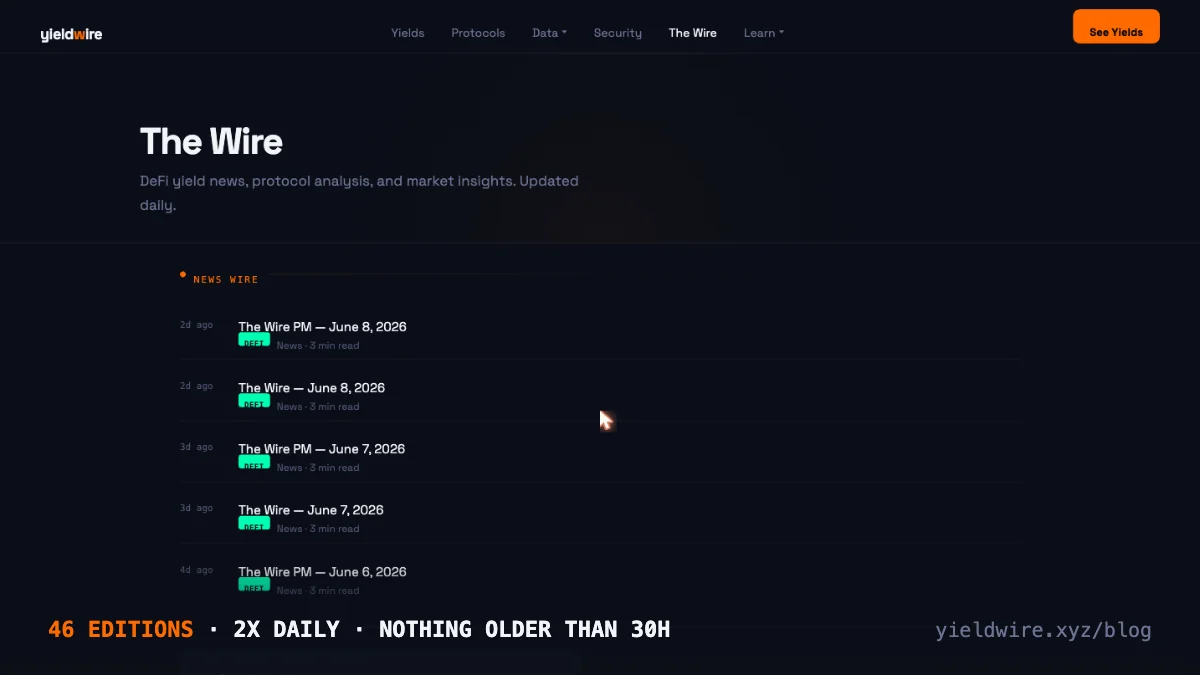
yieldwire is a yields dashboard that runs a twice-daily news desk. 46 editions since mid-May, freshness gates that kill anything older than 30 hours, and a yield angle on every story. Here's why a data product needs an editorial layer, and how we keep it from becoming noise.
Yields Move for Reasons
On June 8, Bitcoin reclaimed $63,000 and liquidated roughly $540 million in shorts. The same week, US spot Bitcoin ETFs bled $1.7 billion, their worst stretch since February 2025. If you only watched a yields dashboard that day, you saw lending rates twitch and funding spike without explanation. The numbers moved. The dashboard didn't tell you why.
That gap is the reason The Wire exists. yieldwire tracks 132 Solana protocols and 3,500+ pools through 12 direct API integrations. The data layer answers "what is the rate right now." It cannot answer "why did the rate change" or "should I expect it to hold." Those answers live in events: a protocol upgrade, an exploit, an ETF flow reversal, a regulatory move. News, in other words.
So we built a newsroom on top of the dashboard. The Wire publishes two editions a day, seven days a week. Morning edition before US markets open, evening edition after the close. 46 editions since the first one went out on May 16. This post explains how it works, what rules it runs on, and why we think a yields product without an editorial layer is half a product.
What The Wire Is
Each edition is a short stack of stories, typically four to six, plus a Numbers section with the market data that frames everything else. Every story follows the same contract:
It happened recently. Nothing in a regular edition is older than 30 hours. Breaking items in our news tweets have a tighter gate: 12 hours. If we can't extract a publication date from a source, the item gets dropped. No "recent reports suggest" filler with no timestamp behind it.
It links to the source. Every story ends with a link to where we read it. If we got it from Decrypt or The Block, you see Decrypt or The Block. We summarize and add the yield read, we don't pretend we broke it.
It carries a yield angle. This is the editorial position that separates The Wire from a generic crypto news feed. We don't cover a story unless we can say something about what it means for rates, TVL, or risk. The June 8 short squeeze mattered to us because violent reclaims show up in funding rates and lending demand. The MetaMask agent-wallet story mattered because wallets that sign transactions autonomously change the risk surface we score. If a story has no path to a yield or a risk, it doesn't run.
The Rules: Fresh, Non-Duplicate, or Nothing
The hard problem with automated-cadence publishing is not writing. It's restraint. A news desk that must ship at 09:00 every day will, left unchecked, ship garbage on slow days. We hit this exact failure in late May: one edition led with a story that was already stale when it ran. The fix wasn't better writing. It was gates.
The freshness gate. Every candidate story gets its publication timestamp extracted and checked against the 30-hour window. On-chain data points get an even tighter rule: if a TVL or APY figure is more than an hour old at publish time, it gets re-fetched or cut.
The dedup gate. Every candidate headline is checked against the last 14 editions. Fuzzy matching, not exact: if a story shares three or more meaningful keywords with something we already ran, it's out. The only exception is the Numbers section, where BTC, SOL, and ETH levels repeat daily by design.
Skip, don't fill. This is the rule we care about most. If fewer than three stories survive both gates, the edition doesn't go out. No "quiet day in crypto" padding, no recycled explainers dressed as news. An edition that exists to exist trains readers to skim. A missing edition tells you the desk has standards. We have skipped editions and we will skip more.
The Numbers Section, and Why It Repeats
Every edition closes with the same scaffolding: BTC, SOL, ETH, Solana TVL, and the yield levels we consider the day's reference points. Here is what that snapshot looks like as this post goes out:
| Asset / Pool | Rate | TVL |
|---|---|---|
| JitoSOL (liquid staking) | 5.44% | $627M |
| jupSOL (liquid staking) | 5.74% | $341M |
| mSOL (liquid staking) | 5.17% | $165M |
| Jupiter Lend USDC | 3.81% | $404M |
| Sanctum Infinity (INF) | 6.15% | $129M |
Source: DeFiLlama, fetched June 10, 2026. Live versions on the yields dashboard.
Repetition here is the point. A single APY reading is trivia. The same five numbers, every day, in the same place, become a baseline. When jupSOL drifts 40 basis points above JitoSOL, Numbers readers notice without being told. The section trains the pattern recognition that one-off headlines can't.
Why a Data Company Runs a Newsroom
The honest answer has three parts.
Context is retention. Dashboards are destinations you visit when you already have a question. News is a habit that brings you back before you have one. A reader who follows The Wire daily checks the dashboard more, not less, because the stories keep pointing at the data.
Coverage feeds scoring. Our Security Score weighs exploit history, audit recency, and incident response. A newsroom that tracks protocol incidents every day is also a research pipeline for the scoring model. When a protocol gets exploited, the desk that writes the story is the same system that flags the score. The two layers share one nervous system.
Nobody owns this beat. Crypto media covers prices, regulation, and drama. Yield infrastructure, the actual plumbing of where rates come from and why they move, gets covered as an afterthought. DeFiLlama has the data but no editorial voice. News outlets have the voice but not the data. The gap between them is exactly the shape of The Wire.
What It Costs Us
Running gates this strict has a price, and it's worth being plain about it. Some days the desk kills four of six candidate stories and the edition runs thin. Freshness checks mean we are sometimes hours behind an outlet that shipped a stale rumor fast. And skipping an edition is visible in a way that padding one never is.
We take that trade every time. Incorrect or stale data presented as current is worse than no data. That principle runs the dashboard, where we hide a feed rather than show a number we can't verify, and it runs the newsroom for the same reason. A media brand built on yield data lives or dies on whether readers trust the numbers. You don't earn that trust with volume.
Where It Goes Next
The Wire today is Solana-first because the dashboard is Solana-first. As the data layer extends to Ethereum and the broader EVM ecosystem later this year, the desk's beat widens with it. Same gates, same yield-angle contract, more protocols in scope.
If you want the feed, every edition lives on the blog, and the day's reference rates are always on the dashboard. Morning edition before US open. Evening edition after the close. No hype, no predictions, and nothing older than 30 hours.
Nothing in this post is financial advice. Yields move, protocols carry risk, and you should read our security methodology before depositing anything anywhere.
Track all Solana yields in real time
Compare APYs across lending, LP, and liquid staking protocols on the YieldWire dashboard.
Open Dashboard →