The Wire PM — July 28, 2026
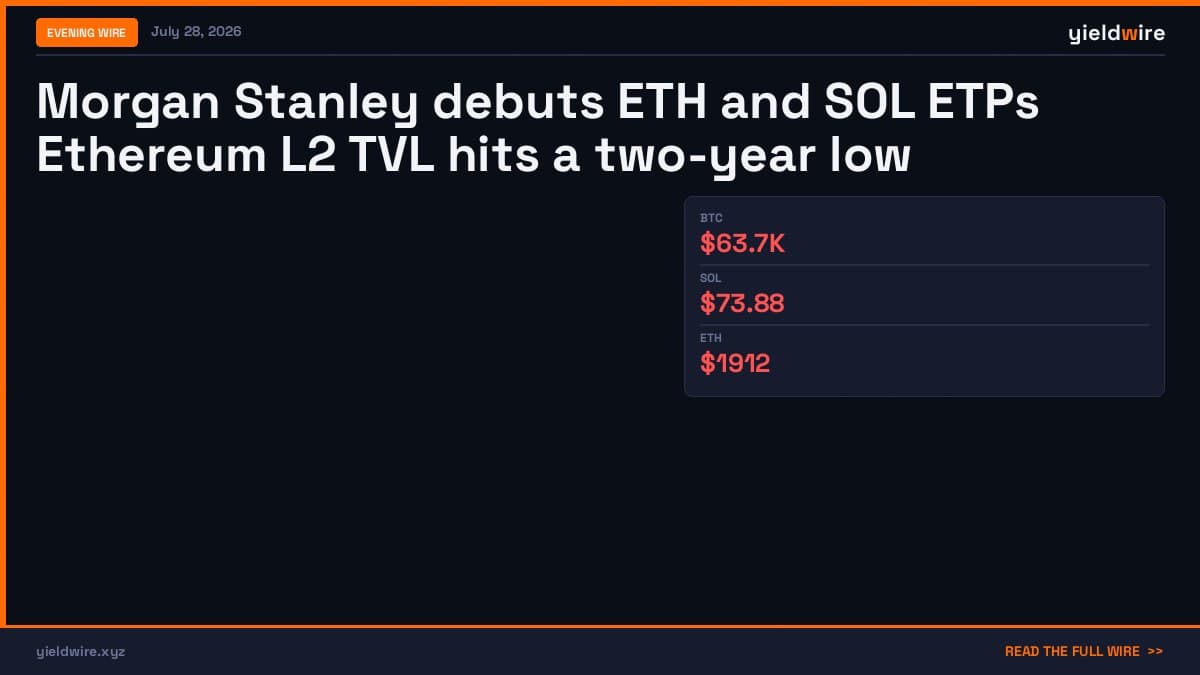
Morgan Stanley launches ether and solana ETPs with the market's lowest fee and pass-through staking rewards, as Ethereum L2 TVL sinks to a two-year low and Wall Street's biggest managers line up behind the Clarity Act.
The Wire PM — July 28, 2026
Morgan Stanley debuts ether and solana ETPs with the market's lowest fee and pass-through staking rewards Morgan Stanley launched ether and solana exchange-traded products after the success of its bitcoin fund, undercutting rivals on fee and passing staking rewards through to holders. For Solana, this is one of the first times a major Wall Street bank packages native staking yield inside a regulated wrapper, letting institutions capture SOL staking returns without running validators or holding keys. Staking rewards routed through an ETP narrow the gap between onchain yield and what regulated capital can actually touch. The catch is that a wrapper fee and a validator set sit between the holder and the raw staking rate, so the net yield lands below what a direct staker earns. Source: CoinDesk, published July 28. Browse Solana yields
Ethereum L2 TVL falls to a two-year low as the rollup thesis cools Total value locked across Ethereum layer 2s dropped to its lowest level in two years, a sign that capital is leaving the rollup ecosystem even while fees stay cheap. Thinner L2 liquidity means wider slippage and shallower lending books on the chains that were supposed to scale DeFi. For yield, less TVL on an L2 usually pushes headline APYs higher as a smaller pool of borrowers chases the same incentives, which is exactly when a rate looks best and the exit looks worst. Depth, not the number on the label, is what tells you whether a yield survives a withdrawal. Source: The Block, published July 28. How we score risk
Hyperliquid pushes perps into DeFi's composability layer Hyperliquid is wiring its perpetuals venue directly into DeFi's money-lego stack, letting other protocols build on top of its liquidity and positions. The move turns a trading venue into shared infrastructure, the same pattern that made lending markets and AMMs load-bearing for everything stacked above them. More composability means more yield surface, since margin and positions can be reused across protocols. It also means more shared risk, because a problem in the base venue now travels to every protocol that plugged into it. Source: CoinDesk, published July 28. Compare DeFi yields
BlackRock, Fidelity and Franklin Templeton throw weight behind the Clarity Act A coalition of Wall Street managers including BlackRock, Fidelity and Franklin Templeton publicly backed the Crypto Clarity Act, days after the Senate shelved the bill to clear other business before the August recess. The endorsement signals that the largest asset managers want the market-structure rules that would let them scale tokenized funds and onchain products with legal certainty. For DeFi, clearer lines on what counts as a security decide which yield strategies institutions can actually allocate to. The bill stalled this session, but backers of this size make it harder to keep shelved for long. Source: CoinDesk, published July 28. See RWA yields
Numbers (Updated)
- BTC: $63,746 (-1.7%)
- SOL: $73.88 (-2.3%)
- ETH: $1,912 (-1.5%)
- Solana DeFi TVL: $4.79B
- Top USDC yield (Solana): Kamino at 7.25%
Explore all Solana yields · Morning edition · Follow @yieldwirexyz
Track all Solana yields in real time
Compare APYs across lending, LP, and liquid staking protocols on the YieldWire dashboard.
Open Dashboard →