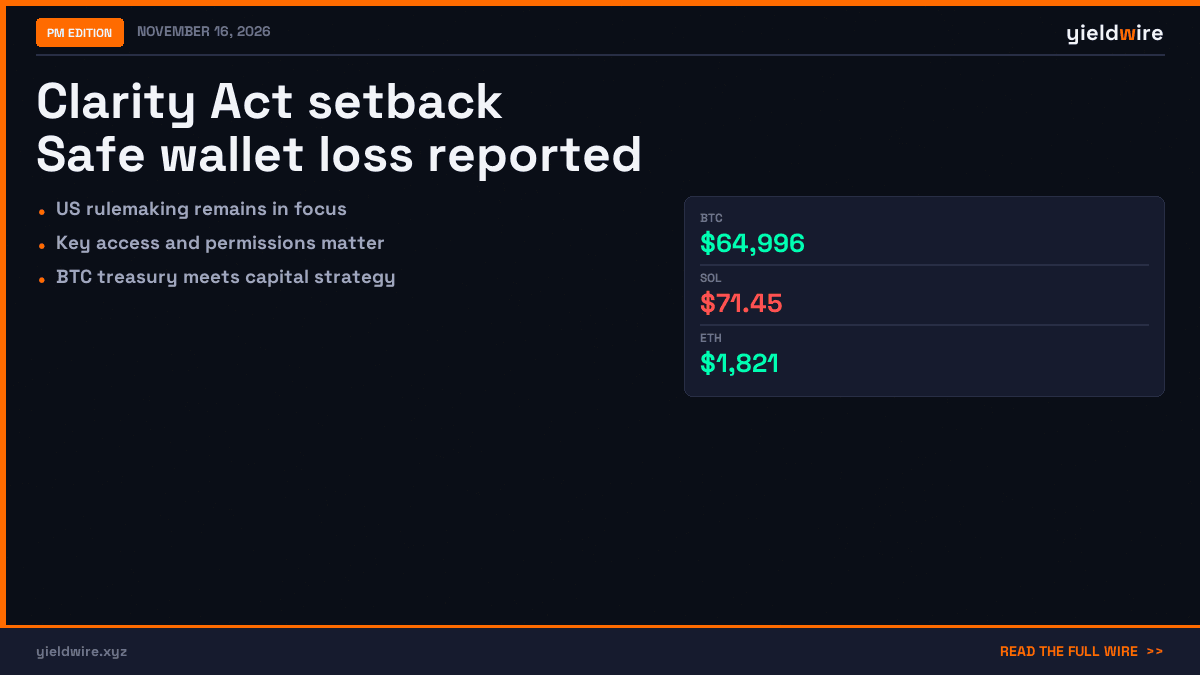
The Wire PM: November 16, 2026
A US crypto-policy setback, a reported Safe wallet loss, miners' AI funding pressure and Strategy's latest purchase shaped the late session.
The Wire PM: November 16, 2026
A former White House crypto adviser called the Clarity Act's defeat a failure of US leadership. Patrick Witt said the bill ran out of time before the midterms after debate focused on ethics provisions tied to President Trump's crypto holdings. He told Solana Breakpoint attendees that, without a comprehensive law, more of the rulebook will be written through SEC and CFTC action. That leaves market-structure questions open for exchanges, token issuers and DeFi teams operating in the US.
The immediate takeaway is procedural rather than directional. Rulemaking can set important boundaries, but it does not provide the statutory clarity that firms had expected from a market-structure bill. Teams with US exposure will still need to track agency actions, enforcement and licensing requirements separately.
A Safe wallet reportedly lost $6.45 million after a likely key compromise. Cointelegraph reported that Zodiac co-founder Chris Whinfrey pointed to a compromised key and overly permissive wallet settings as the likely cause. The report is a reminder that multisig software does not remove operational risk when signer access or permissions are weak. The incident has not been independently attributed in this edition.
For treasury teams and vault users, the useful response is mundane but important: review signer devices, key rotation, module permissions and transaction simulation. Security controls only help when their configuration matches the assets and authority they protect.
Bitcoin miners face a tougher route into AI infrastructure. Cointelegraph says Nvidia's leadership changes and Texas permit restrictions are widening the gap between miners with funded projects and those still seeking capital and approvals. Several miners have positioned data-center capacity as an AI opportunity, but construction costs and long-term contracts still determine whether that pivot produces cash flow. Energy access is an advantage, not a complete business model.
The distinction matters for crypto markets because the same listed miners can carry Bitcoin exposure, debt and data-center execution risk at once. A headline AI partnership says little on its own about funding terms, power availability or delivery timelines.
Strategy added 485 BTC for $33.4 million. Unchained reported that the purchase lifted the company's holdings to 850,849 BTC. It also reported $228.1 million of buybacks for Strategy's Stretch preferred stock, largely funded by a $244.7 million sale of MSTR shares. The split shows the company managing both its Bitcoin treasury and its capital structure.
That makes headline purchase totals incomplete on their own. For investors watching public Bitcoin treasury companies, share issuance, preferred-stock terms and debt remain as relevant as the amount of BTC added.
Numbers (Updated)
| Asset | Price | 24h |
|---|---|---|
| BTC | $64,996 | +0.23% |
| SOL | $71.45 | -0.07% |
| ETH | $1,821.43 | +0.04% |
Track all Solana yields in real time
Compare APYs across lending, LP, and liquid staking protocols on the YieldWire dashboard.
Open Dashboard →