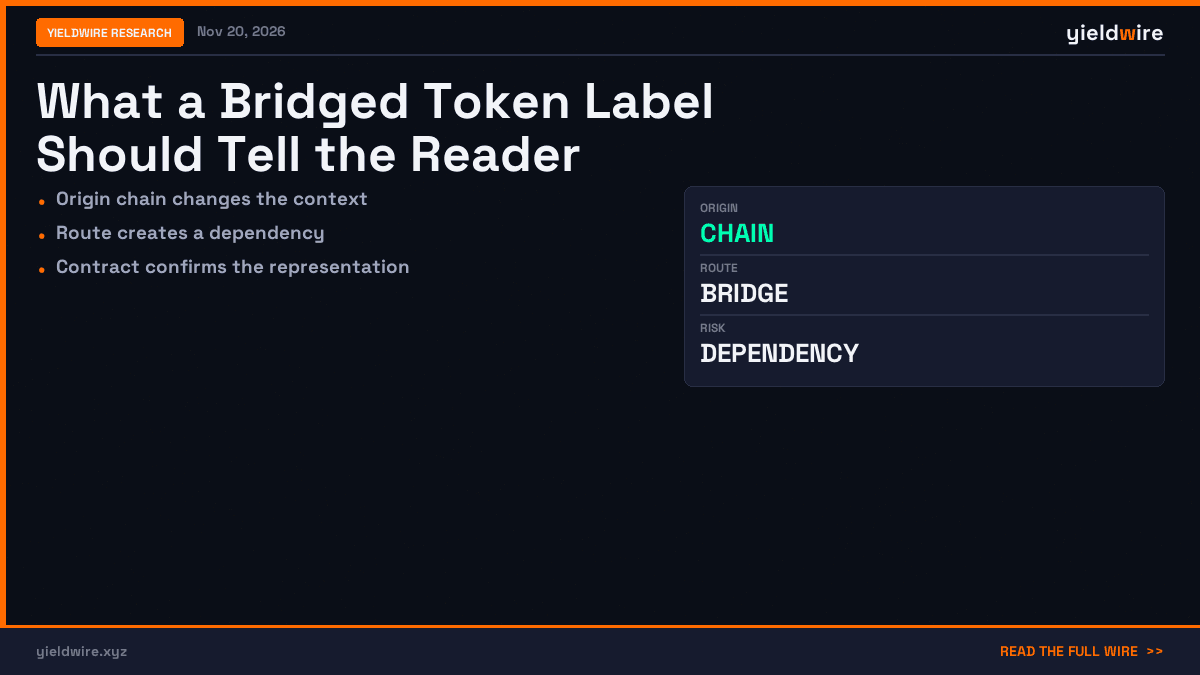
What a Bridged Token Label Should Tell the Reader
A token can keep the same ticker after it crosses chains while gaining a different set of dependencies. Learn what a useful bridge label should disclose before you treat a bridged balance as interchangeable with its native version.
The ticker is not the whole asset
A wallet can show two tokens with the same name, logo, and dollar value while they depend on different systems. One may be native to the chain where it is held. The other may be a representation created after an asset crossed a bridge. That distinction is easy to miss when the interface leaves only a small badge beside a familiar ticker.
For a DeFi user, the question is not whether the represented token is "real." It is what has to keep working for that balance to retain its intended backing and redemption path. A bridge label is useful when it makes that dependency visible before a user deposits the asset, borrows against it, or uses it as LP inventory.
Ethereum.org's bridge overview describes bridges as connections between blockchains that move information and assets across separate networks. The same overview notes that bridge designs carry different trust assumptions. That is the starting point for reading a bridged token: the token is an asset plus the route and controls that produced it.
Native, wrapped, and bridged are not interchangeable labels
The word "wrapped" is often used loosely. It can describe a tokenized form of an asset on the same network, or it can be used in an interface for an asset represented after a cross-chain transfer. Those cases should not be collapsed into one generic warning.
A native token is issued on the network where the application is reading it. A bridged token is generally a representation whose supply or redemption depends on a bridge mechanism. The exact implementation varies. A design may lock an asset on one chain and mint a representation on another. Another may use liquidity, a validator set, or other verification machinery. The practical result is the same for risk review: the holder is exposed to more than the token contract on the destination chain.
This does not mean every bridged asset is unsafe. It means a reader needs enough context to decide whether the extra dependency fits the use case. A stablecoin held for a short swap, collateral in a lending market, and a long-term treasury balance all place different weight on bridge risk.
A good label answers four questions
The most useful labels are compact, but they should allow a reader to answer four basic questions without guessing.
| Label field | What it should identify | Why it matters |
|---|---|---|
| Origin | The network or canonical issuer the representation points back to | It separates the destination-chain balance from the asset's original issuance context |
| Route | The bridge or mechanism used to create the representation | Different routes have different verification and custody assumptions |
| Representation | Whether the destination token is native, wrapped, or bridged | A familiar ticker alone does not describe the redemption dependency |
| Verification link | A route to the token contract and relevant bridge documentation | Users can inspect the exact asset rather than relying on a symbol match |
The label does not need to claim that a route is safe. In fact, it should avoid doing so. "Bridged via X from chain Y" is more useful than a generic green check because it gives the user something concrete to evaluate. A product can then place its broader assessment, audit history, admin controls, and known limitations in a separate risk view.
Why contract address belongs next to the label
Tickers are a convenience layer. Contracts are the identity layer. On a chain with many token deployments, a symbol can be reused and a logo can be copied. A bridge label that does not link to the destination token contract still leaves the user with the hardest verification step.
For routine use, a full hexadecimal address need not dominate the interface. A shortened address, copy action, and explorer link are enough. What matters is that the label resolves to the exact token contract that the pool, vault, or lending market accepts.
There is a second address worth surfacing when possible: the bridge endpoint or canonical route documentation. A token contract tells the user what they hold on the destination chain. The route tells them how that representation relates to its backing. Both are relevant when a position depends on redemption, liquidation, or price parity.
The dependency changes the risk of a yield
An APY is not a complete description of a position. If a pool pays a higher rate for a bridged version of a stablecoin than for a native route, the difference may be compensation for liquidity, incentives, or added operational risk. It should not be treated as free yield simply because the displayed asset name is familiar.
Consider a lending position using bridged collateral. The position can be affected by the lending protocol's smart contracts, the oracle setup, liquidity conditions, and the bridge route behind the collateral. A problem in any one of those layers can matter to the user even if the other layers are functioning normally.
That layered view is useful on YieldWire's yields page. When two pools appear similar, compare the asset route before comparing only the rate. A meaningful comparison asks whether both pools hold the same representation, whether both use the same issuer path, and whether the withdrawal route is equally clear.
What labels should avoid implying
Labels become dangerous when they turn a technical description into an unstated guarantee. A badge should not imply that a representation is always redeemable, that a bridge has no custodial or verification risk, or that a peg will hold under stress. Those are outcomes that depend on the design, the current state of the systems involved, and market conditions.
Likewise, an interface should not treat a cross-chain route as a minor visual detail. Burying the origin network in a tooltip may be acceptable for an advanced view, but the main asset name should still make the representation clear. The user should not have to discover after a deposit that the market accepted a different route from the one they intended.
The cleanest language is descriptive:
- State the origin and destination chain.
- Name the bridge or representation route when it is known.
- Link to the exact contract and route documentation.
- Put risk assessment in a separate, evidence-based section.
This approach does not overload a table with warnings. It preserves the distinction between an identity label and a security score. A label tells the reader what they are looking at. A security review explains what is known about its dependencies.
A practical check before depositing
Before using a bridged token in a vault or lending market, take a minute to answer these questions:
- Is this the token route I meant to use, or only the same ticker?
- Which chain and issuer does the representation point back to?
- What bridge or verification model connects the two sides?
- Can I find the exact destination token contract in the pool or market interface?
- Does the protocol document any asset-specific caps, oracle treatment, or withdrawal constraints?
If the answer to the first four is unclear, the safer conclusion is not that the asset is necessarily bad. It is that the position is harder to evaluate. That uncertainty belongs in the risk calculation, particularly when borrowed exposure or a long lock-up is involved.
YieldWire's security page is built around this kind of layered review. Protocol controls matter, but so do the dependencies introduced by the assets inside a position. A bridge label will not eliminate cross-chain risk. It can make the route visible early enough for users to decide whether the rate is worth it.
The label is a prompt to inspect, not a verdict
Cross-chain assets make DeFi more connected, but connection adds assumptions. A useful asset label exposes those assumptions in plain language: where the value originated, how it arrived, and where the reader can verify the representation. That is enough to improve a yield comparison without pretending to predict the outcome of a bridge under stress.
The next time a pool offers a familiar stablecoin or liquid staking token, read beyond the ticker. Identify the route, inspect the contract, and include the bridge dependency in the same review as APY, liquidity, and protocol controls.
Source: Ethereum.org, Introduction to blockchain bridges.
This article is educational and is not financial advice. Digital assets and DeFi positions carry risk, including the risk of loss.
Track all Solana yields in real time
Compare APYs across lending, LP, and liquid staking protocols on the YieldWire dashboard.
Open Dashboard →