The Wire PM — July 19, 2026
SummerFi is shutting down seven years in, killed not by the size of a $6M exploit but by the runway it burned.
The Wire PM — July 19, 2026
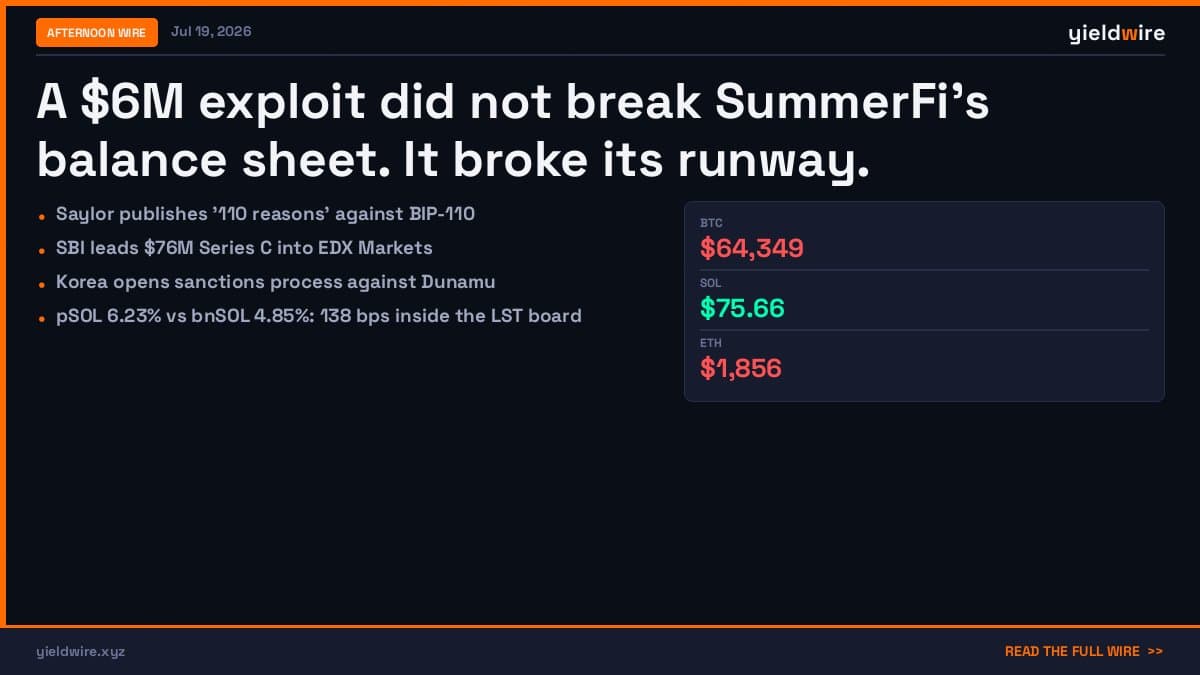
A $6M exploit did not break SummerFi's balance sheet. It broke its runway. The team said Sunday it is winding down Summer.fi and sunsetting the UI, seven years after the project started life inside the Maker Foundation and five years after spinning out as Oasis.app. The trigger was the July 6 attack on two Lazy Summer USDC vaults on Ethereum, where an attacker used a flash loan to manipulate share-price accounting and walked away with roughly $6.04M in one atomic transaction. Aave founder Stani Kulechov called the front end "an OG." The app stays up until August 31 and governance over the affected vaults moves to the Lazy Protocol DAO. Worth sitting with: the loss was survivable in absolute terms. What was not survivable was the cost of rebuilding trust with no capital left to do it. Security scores usually model the size of a possible loss. This is a reminder that the second-order damage, users gone and runway spent, is what actually closes protocols.
Saylor put his name against BIP-110. The man running the largest corporate bitcoin treasury published what he framed as "110 reasons" the proposed temporary fork is the wrong fix, saying he shares the objectives but not the remedy. Read it next to the quantum recovery tooling that surfaced this morning and the shape of the fight is clear: near-total agreement that post-quantum exposure has to be addressed, near-zero agreement on whether a fork is the way to do it. Miner support for BIP-110 was at zero when its deadline passed a week ago.
SBI led a $76M Series C into EDX Markets. The institutional-only US venue, which runs its own central clearinghouse, gets a Tokyo-listed strategic investor and capital to expand. SBI has now put money into Solana Foundation infrastructure, Ondo, Coinhako and EDX inside six weeks. It is the most consistent institutional buyer in the sector right now and almost nobody is tracking it as one story.
Korea's regulator opened a sanctions process against Dunamu, Upbit's operator, over the $36M hack. The complication is legal: the Virtual Asset User Protection Act has no explicit sanctions provisions for hacking incidents, so the scope of any penalty is unclear. Every jurisdiction writing exchange rules right now is about to run into the same gap.
On Solana, the spread inside the LST board is wider than the board's reputation suggests. Phantom's pSOL is paying 6.23% on $121.7M and Marinade's mSOL 6.06% on $180.8M, while the two deepest pools sit at the bottom: bnSOL at 4.85% on $772.3M and jitoSOL at 5.32% on $761.5M. That is 138 basis points between the best and worst payer, with $1.53B parked in the two lowest. All four stake the same asset. The gap is distribution, not yield generation.
Numbers (Updated)
- BTC: $64,349 (-0.22%)
- SOL: $75.66 (+0.57%)
- ETH: $1,856 (-0.09%)
- Solana TVL: $4.87B
- Deepest USDC pool: Jupiter Lend, 4.55% on $419.9M
Sources: The Defiant, Summer.fi blog, Cointelegraph, The Defiant, Cointelegraph, DeFiLlama, CoinGecko.
Explore all Solana yields → · Morning edition → · Follow @yieldwirexyz
Track all Solana yields in real time
Compare APYs across lending, LP, and liquid staking protocols on the YieldWire dashboard.
Open Dashboard →