The Wire — July 19, 2026
$1.6 billion in concentrated DEX liquidity is sitting out of range and forgoing roughly $150 million a year in fees.
The Wire — July 19, 2026
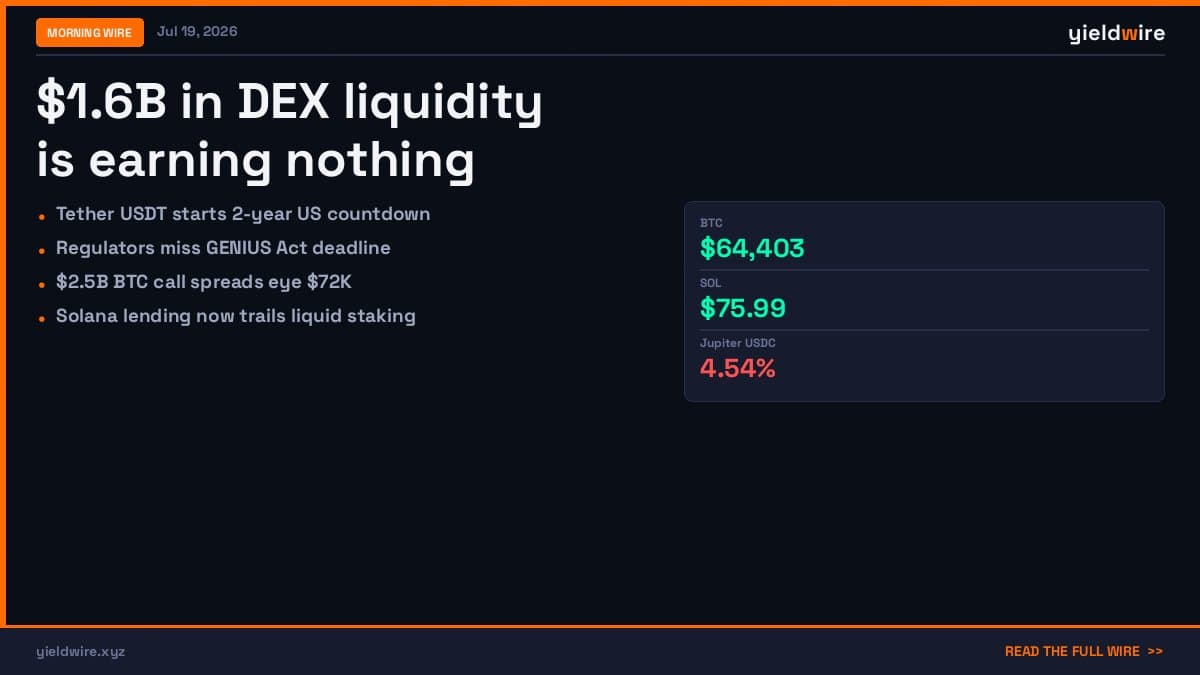
$1.6 billion in DEX liquidity is earning nothing Research by Dune, commissioned by 1inch, found that $1.6 billion of the $1.84 billion it tracked across concentrated liquidity pools on Uniswap, PancakeSwap and Aerodrome was sitting outside its price range. Roughly $542 million, or 29.5%, was fully out of range in an average week, priced so far from spot that no trade could touch it. At a blended in-range fee APR of about 35%, that idle capital forgoes close to $150 million in fees a year. Big positions are the bulk of the problem: those worth more than $1 million account for 47% of all idle capital, around $260 million. The study also found that a steady move in one direction strands more capital than a volatile week that ends near where it started, which cuts against the usual assumption that choppy markets are what hurt LPs. Source: CoinDesk. Compare live LP and lending rates on yieldwire.
Tether's USDT starts a two-year countdown on US platforms The GENIUS Act was signed on July 18, 2025 and limits payment stablecoins to US-domiciled issuers. Tether, headquartered in El Salvador, does not qualify, and the two-year transition window for US venues to stop offering non-compliant tokens is now running. Tether's answer has been USAT, the separate US-regulated stablecoin it launched in January 2026 through Anchorage Digital Bank. The precedent for what comes next is European: Binance pulled USDT from its EEA venues to comply with MiCA. Source: CoinDesk. Stablecoin supply and yields by chain on the stablecoins page.
US regulators miss the GENIUS Act's one-year rulemaking deadline Federal agencies were required to finalize implementing rules within a year of enactment and did not. The OCC issued its proposed rulemaking on February 25, 2026 with comments due May 1, and the FDIC followed in April, but neither has landed a final rule. The slip does not move the law's effective date of January 18, 2027, so issuers and supervisors now share a compressed window to build compliance against rules that are not written yet. Source: The Block.
$2.5 billion of bitcoin call spreads point at $72,000 by July 31 Deribit flow shows 20,000 contracts of the $70,000 July 31 call bought against 20,000 contracts of the $72,000 call sold, for $2.5 billion in notional. The structure pays if bitcoin climbs to $70,000 and caps everything above $72,000, which lowers the cost of entry and the maximum loss if the market stays flat. Size and strike precision of this kind usually mean institutional positioning rather than retail. Settlement lands two days after the Federal Reserve's July 29 decision, where markets currently favor a hold. Bitcoin has bounced to $64,000 from under $58,000 earlier this month. Source: CoinDesk.
Solana stablecoin lending is paying less than liquid staking again Jupiter Lend's USDC Earn pool is the deepest stablecoin venue on the chain at $420 million and pays 4.54%. Every major liquid staking token pays more: mSOL at 6.06%, jupSOL at 5.74%, jitoSOL at 5.32%, bnSOL at 4.85%. That leaves 152 basis points between the deepest USDC pool and mSOL, in favor of taking SOL price risk instead of holding dollars. USDC above 4% still exists on Solana, but it has moved into thin markets: Kamino's OnRe market pays 6.60% on $4.3 million of deposits, less than 1% of Jupiter's size. Depth and yield are pulling apart, which is a different market than the one that existed a week ago. Data: DeFiLlama, live. Risk scores for each of these on the security page.
A zero-knowledge recovery tool for quantum-frozen bitcoin, minus Satoshi's Project Eleven published a zero-knowledge proof system that would let holders recover coins locked by BIP-361, the April proposal from Jameson Lopp and five co-authors that would block new deposits to quantum-vulnerable addresses after three years and freeze whatever remains after five. That sweep covers more than a third of bitcoin's supply. The proof works by demonstrating knowledge of a parent key, which only exists for wallets built after BIP-32 arrived in February 2012. Satoshi mined through 2009 and 2010 using software with no seed phrase and no derivation path, so the roughly 1.1 million BTC attributed to the creator stays out of reach. The prototype is unaudited and covers three address types rather than Taproot. Source: CoinDesk.
France orders ISPs to block Polymarket France's gambling regulator, the ANJ, ordered internet service providers to block the platform on July 16, treating prediction markets as illegal gambling rather than a trading venue, a position it formalized in February 2026. Earlier measures had not worked: Polymarket drew 578,751 visits from 205,057 unique visitors in France in June, per Similarweb data cited by the regulator, despite a ban on financial transactions in place since November 2024 that a VPN was enough to defeat. The ANJ also cited a complaint from Météo-France over a tampered temperature sensor tied to weather bets, which pushed Paris prosecutors to open a cybercrime investigation on May 4. France joins more than 30 countries restricting access. Source: CoinDesk.
Numbers
- BTC: $64,403 (+0.58%)
- SOL: $75.99 (+1.87%)
- ETH: $1,870 (+1.65%)
- Solana DeFi TVL: $4.88B
- Top USDC yield (Solana, deep liquidity): Jupiter Lend at 4.54% on $420M
Explore all Solana yields → · Risk scores → · Follow @yieldwirexyz
Track all Solana yields in real time
Compare APYs across lending, LP, and liquid staking protocols on the YieldWire dashboard.
Open Dashboard →