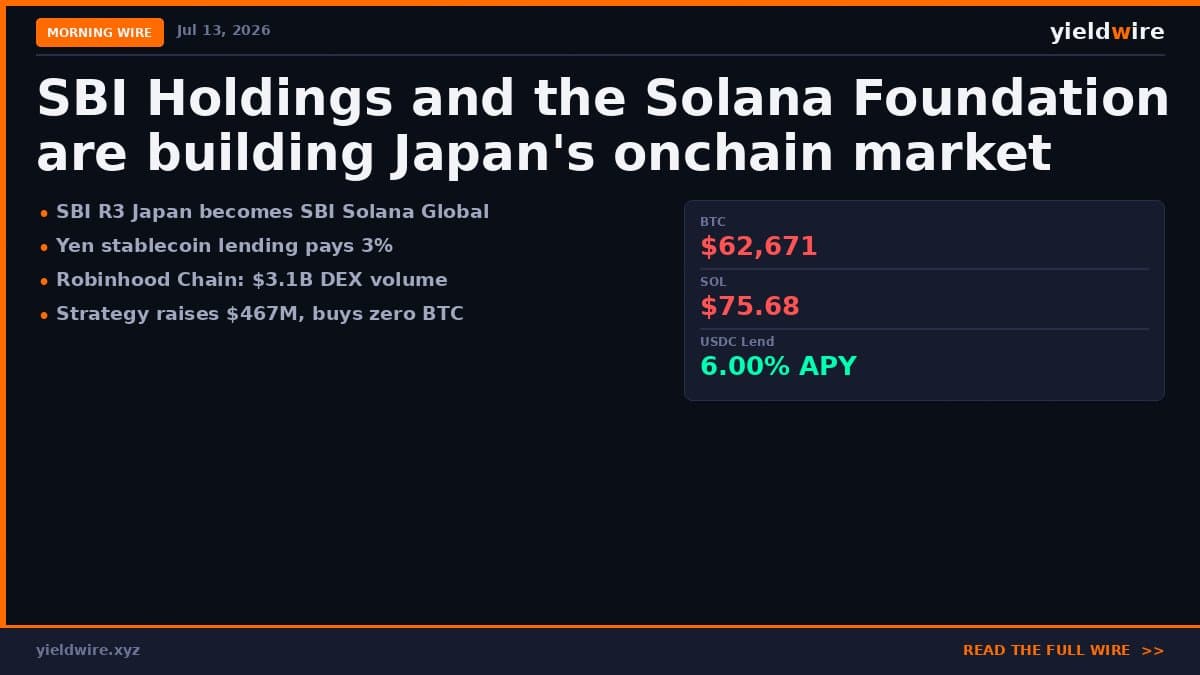
The Wire — July 13, 2026
SBI Holdings is taking the Solana Foundation onto its balance sheet: SBI R3 Japan becomes SBI Solana Global, a vehicle for yen stablecoins and tokenized RWAs.
The Wire — July 13, 2026
SBI Holdings and the Solana Foundation are building Japan's onchain financial market SBI Holdings announced a strategic partnership with the Solana Foundation on Monday. The Foundation is taking an equity stake in SBI R3 Japan, the blockchain venture SBI runs alongside Sumitomo Mitsui Financial Group, and the entity will be renamed SBI Solana Global once the corporate paperwork clears. The remit named in the announcement: stablecoin issuance and distribution, structuring and distribution of tokenized real world assets, cross-border payments, and payment rails for AI agents. Note what this replaces. SBI R3 Japan was built on Corda, the enterprise ledger, and it is now pivoting to a public chain. For Solana this is the deepest institutional anchor it has landed in Asia, and it comes with a distribution channel rather than a press release. (Sources: The Block, CoinDesk, published July 13.) Track Solana protocol risk scores →
SBI will pay 3% on a yen stablecoin. USDC on Solana pays double that Separately, SBI VC Trade opened applications for a lending service on JPYSC, the yen stablecoin issued by SBI Shinsei Trust Bank and the first in Japan backed by a trust bank. The initial rate is 3% annualized on a 12-week lock, which works out to roughly 0.69% gross over the term. SBI's own pitch is the comparison to yen bank deposits at 0.325% to 1%. The fine print is the interesting part: JPYSC lent to SBI VC Trade sits outside statutory asset segregation, there is no deposit insurance, and early cancellation is generally not possible. Put that next to a USDC market on Solana. Kamino's top USDC pool pays 6.00% APY today with no lockup, and Jupiter Lend carries $423 million at 4.20%. Different currency, different risk, but the same product category is repricing in public. Compare USDC yields →
Robinhood Chain is a top five chain by DEX volume two weeks after mainnet Bernstein counts $3.1 billion in DEX volume on Robinhood Chain over the past seven days, enough to put it in the top five and ahead of Hyperliquid, Arbitrum and NEAR on that metric. Mainnet went live July 1. More than 65,000 users hold about $13 million in tokenized stocks and $300 million in stablecoins on the network. The caveat that matters: the volume is memecoin-driven, with Cash Cat and Dog In Hood accounting for most of the 5.2 million transactions in a single day. Tokenized equities across all chains are up about 170% this year to $1.9 billion, so the RWA thesis is real. It just is not what is moving Robinhood Chain right now. (Source: The Block, CoinDesk, July 13.)
Bitcoin drops below $63,000 as the Strait of Hormuz stays shut BTC traded near $62,940 after a weekend of US strikes on Iranian installations, down about 1.4% on the day and taking $252.9 million of leveraged positions with it, most of them longs. Brent gained as much as 4% and approached $80. Polymarket now prices a 3% chance that Hormuz traffic normalizes by July 31. The transmission channel is not risk-off sentiment, it is rates: sustained energy inflation keeps the Fed from cutting, higher yields raise the opportunity cost of holding an asset with no coupon, and the dollar gets the bid instead. That is the same mechanism that puts a floor under stablecoin lending rates. (Source: CryptoSlate, July 13.)
Strategy raised $467 million last week and bought zero bitcoin Strategy sold 4,818,781 MSTR shares between July 6 and July 12, raising roughly $466.7 million, and made no bitcoin purchases or sales. The holdings stay at 843,775 BTC. The proceeds went to the USD reserve, which rose $450 million to $3 billion as of July 12. Read it against last week, when the company sold 3,588 BTC to raise $216 million. Two consecutive weeks of building dollars instead of coins is a pattern, not a pause, and it is happening while the average cost basis on the stack sits well above spot. (Sources: The Block, CoinDesk, July 13.)
Chinese prosecutors float treating mixer and privacy coin use as evidence of laundering A proposal circulating among Chinese prosecutors would let the use of coin mixers or privacy coins count as an indicator of money laundering intent in itself, rather than requiring proof of an underlying predicate offence. It is a procedural shift, not a new ban, and China already prohibits crypto trading. The precedent is what to watch: turning a privacy tool into evidence of intent is a template other jurisdictions can copy without writing new crypto law. (Source: Decrypt, July 13.)
A seven year dormant whale moved $188 million in BTC Onchain data shows a wallet dormant since 2019 moving roughly $188 million of bitcoin. No exchange deposit has been confirmed, so this is a movement, not a sale. Worth flagging on a day when spot is already soft and the market is short of liquidity. (Sources: The Block, Cointelegraph, July 13.)
Numbers
- BTC: $62,671 (-2.1% 24h)
- SOL: $75.68 (-2.0% 24h)
- ETH: $1,773 (-1.9% 24h)
- Solana DeFi TVL: $4.86B
- Stablecoin market cap: $303.7B
- Top USDC yield (Solana): Kamino Lend at 6.00% APY
- Jupiter Lend USDC: 4.20% APY on $423M
- jitoSOL: 5.27% APY
Explore all Solana yields → · Risk scores → · Follow @yieldwirexyz
Track all Solana yields in real time
Compare APYs across lending, LP, and liquid staking protocols on the YieldWire dashboard.
Open Dashboard →