The Wire — July 11, 2026
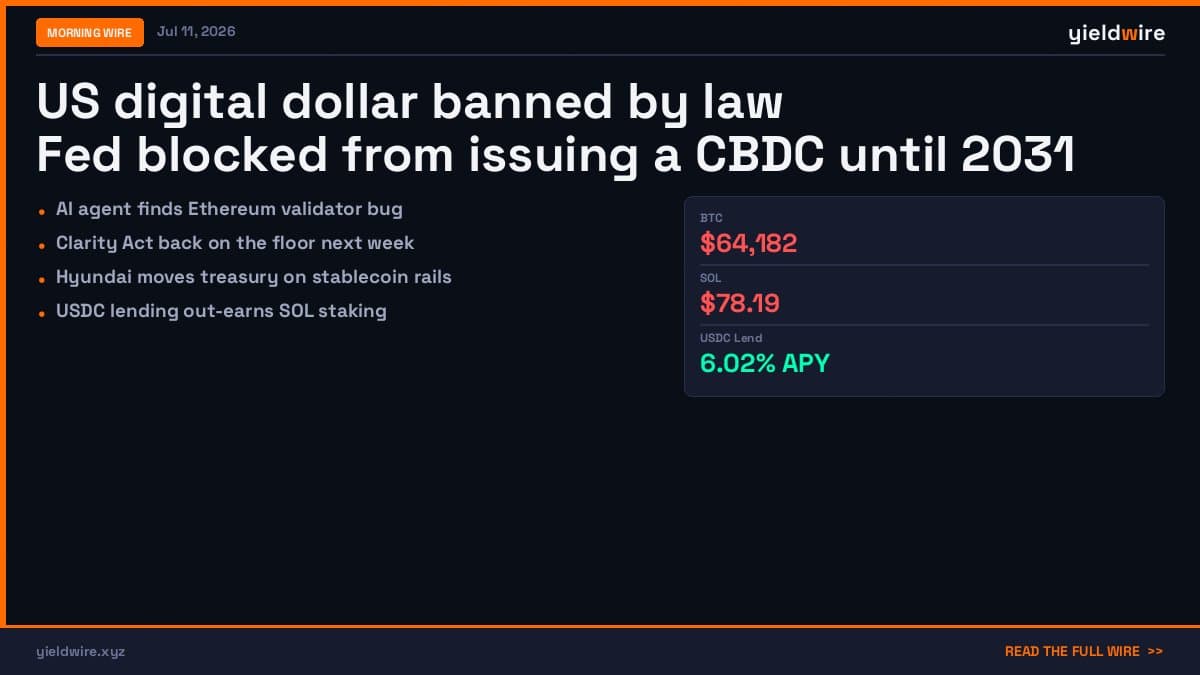
A US central bank digital currency is now banned by law after the housing bill became law without Trump's signature.
The Wire — July 11, 2026
A US digital dollar is now illegal, and nobody signed the bill. The 21st Century ROAD to Housing Act became law without President Trump's signature, and buried inside it is a provision barring the Federal Reserve from issuing a central bank digital currency until 2031. Trump refused to sign, refused to veto, and the clock ran out at midnight. The practical effect is that the dollar's digital future stays in private hands: tokenized deposits from banks, and stablecoins from issuers like Circle and Tether. That is the same rail DeFi lending already runs on, so the ceiling on onchain dollar yield keeps being set by private credit markets, not by a Fed-issued instrument. Sources: CoinDesk, Decrypt. Where those dollars earn today: USDC yields on Solana.
An AI agent found a real Ethereum bug. Humans had to prove it mattered. Ethereum's automated security push produced its first meaningful result: an AI agent surfaced a flaw capable of knocking validators offline, but researchers still had to build the proof that it was exploitable rather than theoretical. That gap is the whole story. Finding candidate bugs is now cheap, and proving exploitability is the expensive part that still needs people. For anyone underwriting a protocol, this is a useful reframe of what an audit is worth: a clean audit report means someone checked, not that no one can break it. Source: CoinDesk. We weight audit depth and track record in our risk scores.
Congress comes back with a crypto bill and a shrinking calendar. Lawmakers return to Washington next week and the Clarity Act is at the top of the pile, with a fresh version possibly landing within days. The pressure is arithmetic: once the midterm calendar takes over, floor time for market structure legislation disappears. CFTC Chair Selig has already said the fallback is regulation by enforcement, which is the outcome DeFi builders least want. Nothing about yields changes this week, but the rules that decide whether an onchain lending market is a broker, an exchange, or neither get written in the next few months. Source: CoinDesk.
Stablecoin lending is now out-earning liquid staking on Solana. The spread has flipped. Kamino Lend is paying 6.02% on USDC, while jitoSOL sits at 5.36%, jupSOL at 5.67% and mSOL at 4.76%. A dollar lender is picking up more yield than a SOL staker, with no price exposure and no validator risk. That is not normal, and it says something about demand: leveraged borrowers are still paying up for stablecoins even with SOL down on the week. The trade-off is credit risk instead of directional risk, which is a different thing, not a free lunch. Compare live: Solana yields.
Solana DeFi capital is rotating, not leaving. Solana DeFi TVL sits at $4.93B with $14.8B in stablecoins on the chain. Under that flat headline, the mix is moving: Kamino Lend is down 3.9% over seven days, Raydium AMM down 7.3%, Jito Liquid Staking down 4.7%, while Jupiter Lend is up slightly. Money is stepping out of AMM LP positions and staking, and holding still in lending. That is what a market with no directional conviction looks like: park in dollars, collect the carry, wait. Source: DeFiLlama.
Hyundai starts moving money between its own units in stablecoins. Hyundai became the first major South Korean company to run internal transfers on stablecoin rails, per CoinDesk. Treasury use is the least glamorous and most durable version of this technology: no speculation, just faster settlement between subsidiaries that would otherwise wait on correspondent banks. If Korean conglomerates follow, the volume shows up on the same chains that DeFi lending markets price against. Source: CoinDesk.
New Hampshire kills its bitcoin bond, and the $300K models get a haircut. The state's $100M bitcoin-backed bond proposal failed its final vote despite Governor Ayotte's public support, ending the first serious attempt at a state-government bitcoin bond. Separately, CoinDesk ran the numbers on the $300,000 to $500,000 bitcoin targets circulating for 2029 and concluded the math does not hold. Both stories point the same direction: the institutional bid is real but slower and smaller than the headline forecasts assume. Sources: CoinDesk, CoinDesk.
Numbers
- BTC: $64,182 (0.0% 24h)
- SOL: $78.19 (-0.9% 24h)
- ETH: $1,802 (+0.3% 24h)
- Solana DeFi TVL: $4.93B
- Solana stablecoin supply: $14.84B
- Top USDC yield (Solana): Kamino Lend at 6.02% APY
Explore all Solana yields → · Risk scores → · Follow @yieldwirexyz
Track all Solana yields in real time
Compare APYs across lending, LP, and liquid staking protocols on the YieldWire dashboard.
Open Dashboard →