The Wire — July 9, 2026
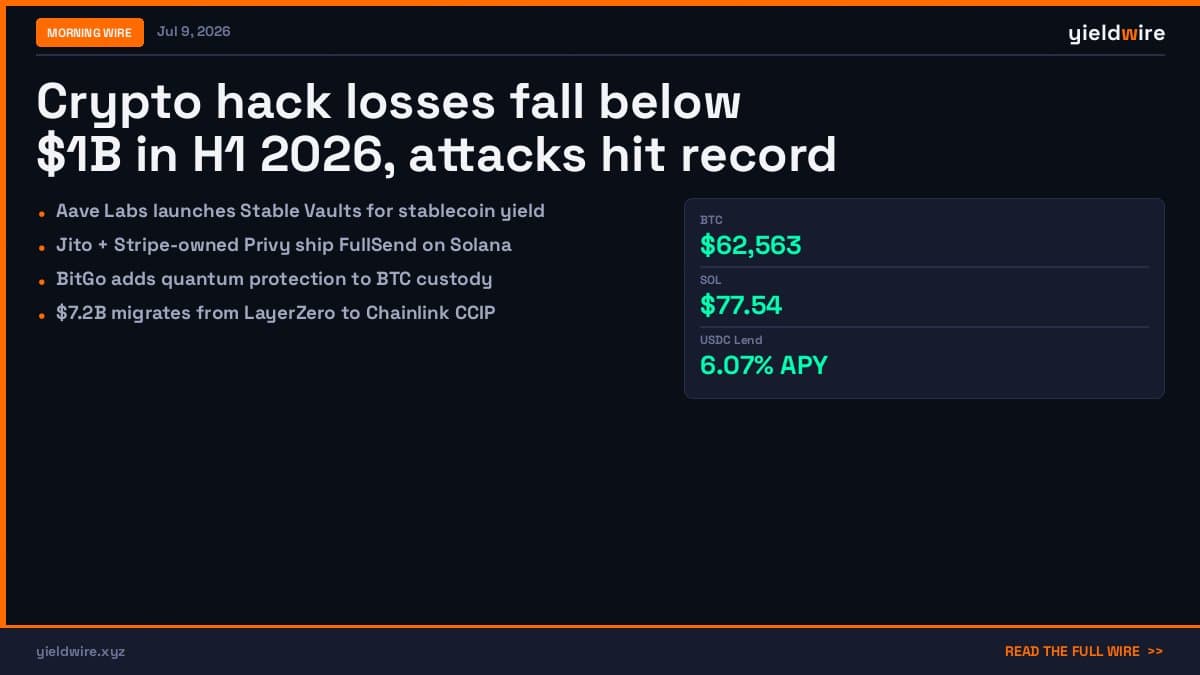
Crypto hack losses fell below $1 billion in the first half of 2026 even as attack volume hit a record, while Aave, Jito and Chainlink CCIP reshaped where DeFi yield and cross-chain flow actually sit.
The Wire — July 9, 2026
Crypto hack losses fell below $1 billion in H1 2026 even as attack volume hit a record Crypto lost $972 million to hacks and exploits in the first half of 2026, the first time a half-year has come in under $1 billion in years, according to Immunefi. The catch is that attack frequency went the other way, hitting a record 207 incidents, so more attempts are landing for smaller average payouts. DeFi exploit damage has dropped 74% from its 2022 peak, a sign that audits, timelocks and better key management are finally showing up in the numbers. Fewer dollars stolen per incident is the whole point of scoring protocol risk before rate, since the tail risk that wipes out a position is exactly what an APY never tells you. Source: The Block citing Immunefi, published July 9. How we score protocol risk →
Stripe-owned Privy and Jito ship FullSend to fix Solana transaction inclusion Privy, the wallet infrastructure firm Stripe acquired, teamed up with Jito to launch FullSend, a tool that routes every transaction signed in a Privy wallet straight to the current Solana block-building leader. The pitch is fewer dropped and delayed transactions during congestion, a chronic complaint for apps building on Solana at scale. Routing directly to the leader cuts out some of the propagation lag that causes failed sends, which matters most for high-frequency use like trading and payments. It also deepens Jito's grip on Solana's block-building layer, the same infrastructure that underpins jitoSOL and a large share of the network's MEV economy. Source: The Block, published July 9. Solana yields →
BitGo adds quantum protection for institutional bitcoin wallets Custodian BitGo rolled out quantum-resistant protection for institutional bitcoin holdings, moving to guard large positions against a threat that is still years from being practical but expensive to retrofit later. The bet is that the real danger is not quantum computing arriving overnight but institutions failing to migrate key infrastructure in time. For custodians holding single-digit percentages of bitcoin's supply, that lead time is the product. It is an early move in what will become a multi-year upgrade cycle across every serious custody stack. Source: The Block, published July 9.
Aave Labs launches Stable Vaults for predictable stablecoin yield Aave Labs introduced Stable Vaults, a product that continuously optimizes capital allocation across DeFi yield strategies, including Aave V3 and V4 markets, to hand users a smoother, more predictable stablecoin return. The target is mainstream users and fintechs that want a dollar yield without actively managing lending positions or chasing rates across protocols. Abstracting allocation away from the user is where a lot of DeFi is heading, but it also moves the risk one layer down, into whatever strategies the vault picks. That is the trade to watch: a cleaner rate on the surface, more to understand underneath. Source: The Block, published July 9. Compare stablecoin yields →
Brazil's B3, Latin America's biggest exchange, lists options on bitcoin, ether and solana futures B3 began offering options on bitcoin, ether and solana futures, giving Brazilian traders a regulated venue to hedge crypto exposure and trade volatility without touching offshore markets. The contracts settle into underlying futures rather than spot tokens, so there is no custody or token transfer, and they trade under the codes BIT, ETR and SOL. Bitcoin options are denominated in reais while ether and solana are priced in US dollars, with all three referencing Nasdaq crypto indexes. Regulated derivatives on solana at a national exchange is a quiet milestone for how far the asset has moved into mainstream finance. Source: CoinDesk, published July 9.
Cross-chain migration to Chainlink CCIP tops $7.2 billion as Mantle joins the exodus Cumulative assets moved from LayerZero to Chainlink's CCIP bridge have reached $7.2 billion, up from roughly $5 billion in May, after Mantle became the latest network to switch cross-chain infrastructure. The exodus traces back to a spring bridge exploit that pushed protocols to reweigh their bridge security, and it has been building steadily since. Where bridged liquidity lives is not an abstract question for yield, because a large share of stablecoin and staked-asset supply depends on the security of whichever bridge carries it. When billions move rails, the risk surface under a lot of cross-chain yield moves with it. Source: CoinDesk, published July 9. Where the yield is →
Numbers
- BTC: $62,563 (+1.0%)
- SOL: $77.54 (+0.7%)
- ETH: $1,739 (0.0%)
- Solana DeFi TVL: $4.94B
- Top USDC yield (Solana): Kamino Lend at 6.07%
Explore all Solana yields → · Risk scores → · Follow @yieldwirexyz
Track all Solana yields in real time
Compare APYs across lending, LP, and liquid staking protocols on the YieldWire dashboard.
Open Dashboard →