The Wire — June 14, 2026
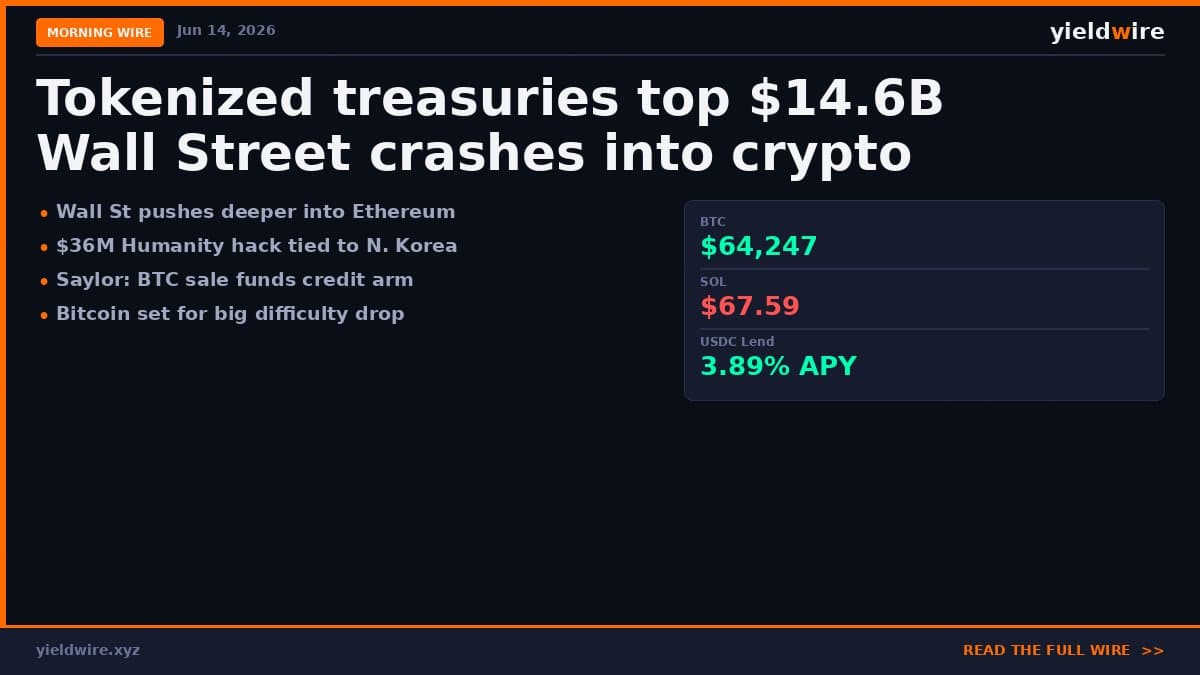
Tokenized treasury markets hit $14.6B as crypto exchanges turn into brokerages, Wall Street pushes deeper into Ethereum, and a $36M hack is tied to North Korean actors.
The Wire — June 14, 2026
Tokenized Treasury Markets Top $14.6 Billion as Exchanges Morph Into Brokerages
The on-chain treasury market has reached $14.6 billion, and the line between crypto exchanges and stock brokerages keeps fading, CoinDesk reported. Tokenized U.S. Treasuries have become the fastest-growing slice of a real-world-asset market that now clears $32 billion, driven by institutions looking to park idle cash where it earns yield without leaving the chain. The same venues that listed spot tokens are now adding tokenized equities, funds, and money-market products, while incumbents such as DTCC and JPMorgan build their own rails. For a yields desk the signal is simple: short-duration government paper is becoming a base layer of on-chain return, and it competes directly with stablecoin lending for institutional balances. Source: CoinDesk. Track RWA yields →
Wall Street Pushes Past Pilots and Deeper Into Ethereum
Institutions have stopped dipping a toe and started treating public chains as production infrastructure, Etherealize founder Vivek Raman told CoinDesk. "A year and a half ago it was proof-of-concept, dip your toe in," he said. "Now it's: we need to jump in head first and use public chains just like we all use the internet." Stablecoins were the first institutional use case, and the conversation has widened to tokenized stocks, bonds, real estate, and funds, most of it settling on Ethereum. Raman argues the infrastructure is largely built but the assets have not migrated at scale yet, which is why ETH's price has lagged the institutional interest. The gap, he says, is a function of long enterprise sales cycles, not weak demand. Source: CoinDesk. See ETH yields →
Humanity Protocol's $36M Hack Traced to North Korean Actors
A fake Bithumb email used in the $36 million Humanity Protocol exploit points to North Korean threat actors, security firm Quantstamp said. The lure fits a pattern that has defined the worst DeFi losses of the past year, where social engineering and operational security failures, not smart-contract bugs, open the door. State-linked groups have spent months embedding inside teams before draining funds, and a single spoofed message remains enough to start the chain. The episode is a reminder that an audited contract is only as safe as the humans and keys around it, which is exactly what protocol-level risk scoring is meant to surface. Source: Cointelegraph, Quantstamp. Check protocol risk scores →
Saylor Says Strategy's Bitcoin Sale Funds Its Credit Machine
Strategy's recent Bitcoin sale looked like a break from Michael Saylor's "never sell" mantra, but he says it reflects how the company's digital credit business actually works. The firm has built a stack of yield-bearing preferred instruments on top of its Bitcoin holdings, and Saylor frames selective sales as servicing those obligations rather than abandoning the treasury thesis. For holders watching the largest corporate Bitcoin balance sheet, the message is that the position is now a financing engine, not a static hoard, and that engine occasionally needs to move coins. The nuance matters because Strategy's playbook is the template a growing list of treasury companies are copying. Source: Cointelegraph. BTC yields and treasuries →
Bitcoin Faces One of Its Largest Difficulty Drops as Miner Margins Collapse
The Bitcoin network is set for one of the biggest downward difficulty adjustments in its 17-year history, CryptoSlate reported, a direct readout of margin compression forcing operators to switch off hardware. The recalibration, tied to block height 953,568, lowers the cost of finding the next block for the miners who stay online, easing pressure after a stretch of thin economics. Difficulty drops of this size historically mark capitulation among higher-cost operators and a hash-rate reshuffle toward cheaper power. It is a network-health story rather than a price call, but it shapes the security budget that every Bitcoin-collateralized yield ultimately leans on. Source: CryptoSlate. Compare BTC opportunities →
Numbers
- BTC: $64,247 (+0.08% 24h)
- SOL: $67.59 (-0.46% 24h)
- ETH: $1,665.10 (-0.84% 24h)
- Solana DeFi TVL: $4.77B
- Top USDC yield (Solana): Jupiter Lend at 3.89% ($424M TVL)
Explore all Solana yields → · Risk scores → · Follow @yieldwirexyz
Track all Solana yields in real time
Compare APYs across lending, LP, and liquid staking protocols on the YieldWire dashboard.
Open Dashboard →