The State of RWA Yields on Solana
Tokenized treasuries, private credit, and home equity are live on Solana with $2.5B+ in RWA TVL. Here's what yields look like, who the players are, and why this category matters for DeFi.
RWA on Solana: From Experiment to $2.5 Billion
A year ago, real world assets on Solana barely registered. Around $215M in total value, a handful of experimental protocols, and a lot of theoretical narratives about tokenization.
Today: $2.5B in RWA TVL. 340% year-over-year growth. BlackRock, Ondo, and Figure are deploying on Solana alongside DeFi-native protocols. The theoretical part is over.
This article maps out the current state of RWA yields on Solana: what's live, what it pays, what the risks look like, and where the category is heading.
What Counts as RWA
Real world assets in DeFi are tokens backed by off-chain value. That includes:
Tokenized treasuries -- U.S. Treasury bills wrapped as on-chain tokens. You hold the token, earn the yield, redeem for dollars. Ondo's USDY and BlackRock's BUIDL are the main ones on Solana.
Private credit -- Loans to real businesses, tokenized as on-chain positions. Higher yields, longer lockups, and real credit risk. Credix and Maple are the names here.
Tokenized home equity -- Home equity lines of credit (HELOCs) packaged as yield-bearing tokens. Figure's PRIME product leads this category.
Real estate -- Fractional ownership of physical property. Homebase and Parcl take different approaches: Homebase tokenizes individual properties, Parcl creates synthetic exposure to real estate price indices.
Tokenized equities -- Stocks and ETFs wrapped as SPL tokens. Ondo Global Markets launched 200+ tokenized U.S. stocks on Solana in January 2026.
Each category carries fundamentally different risk. A tokenized T-bill is not the same as a tokenized HELOC. The yields reflect that.
The Current Yield Map
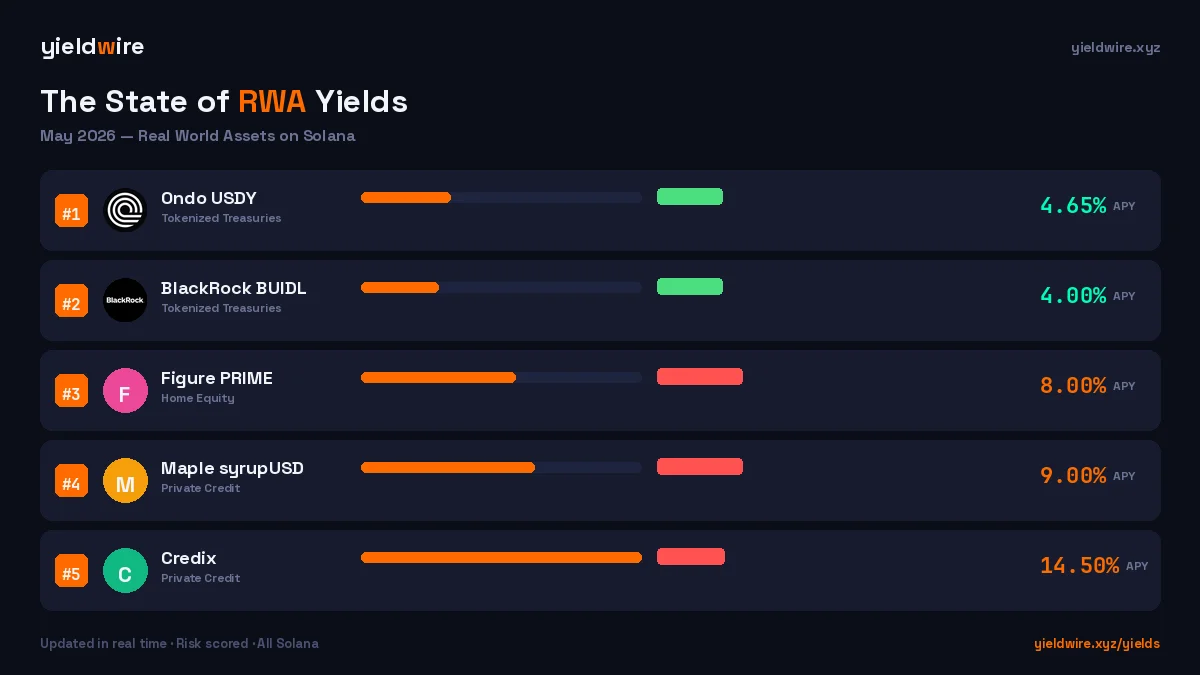
Here's what RWA yields look like on Solana right now, ranked by risk profile from lowest to highest.
| Protocol | Asset Type | Product | APY | TVL | Min. Investment | Risk Profile |
|---|---|---|---|---|---|---|
| BlackRock | Tokenized Treasuries | BUIDL | ~4.0% | $231M | $5M | Very Low |
| Ondo Finance | Tokenized Treasuries | USDY | ~4.65% | $179M (Solana) | $500 | Low |
| Ondo Finance | Tokenized Treasuries | OUSG | ~4.5% | Institutional | $100K | Low |
| Figure/Hastra | Home Equity (HELOCs) | PRIME | ~8.0% | $322M | Varies | Medium |
| Maple Finance | Private Credit | syrupUSD | ~8-10% | Growing | Varies | Medium-High |
| Credix | Private Credit | Credit Pools | ~14-15% | ~$50M | Institutional | High |
A few patterns stand out.
The treasury floor is 4-4.65%. This is the risk-free rate of crypto. If you can get 4.65% on USDY with U.S. government debt backing, anything that pays less needs a very good reason (like deeper liquidity or composability).
Private credit pays double to triple the treasury rate. Credix at 14-15% and Maple at 8-10% reflect the premium for real credit risk: borrower defaults, longer lockups, less liquidity. These aren't stablecoin lending rates. They're fixed income products with actual underwriting behind them.
Figure's PRIME sits in the middle. At 8% with $322M in TVL, PRIME is the largest single RWA protocol on Solana. Home equity as collateral is well understood in TradFi, and the yields reflect that middle-ground risk between treasuries and unsecured private credit.
How RWA Yields Compare to DeFi-Native Yields
The natural question: why park money in a 4.65% treasury token when Kamino pays 8.17% on USDC?
It comes down to what you're actually exposed to.
| Yield Source | APY Range | Risk Type |
|---|---|---|
| Tokenized Treasuries (USDY, BUIDL) | 4.0-4.65% | Government credit risk + smart contract + oracle |
| USDC Lending (Kamino, Jupiter) | 3.7-8.2% | Protocol risk + utilization + smart contract |
| SOL Staking (LSTs) | 5.1-6.5% | Validator risk + smart contract |
| LP (major pairs) | 15-40% | IL + directional + smart contract |
| Private Credit (Credix, Maple) | 8-15% | Borrower default + lockup + smart contract |
Tokenized treasuries add smart contract risk on top of what is otherwise a very safe asset. The premium over buying T-bills directly through a broker is convenience and composability: USDY can be used as collateral in DeFi protocols, transferred 24/7, and settled in milliseconds instead of T+1.
DeFi-native yields (lending, staking, LP) don't have off-chain counterparty risk but do carry protocol risk, smart contract risk, and in the case of LP, impermanent loss. Our risk scoring methodology evaluates six factors for every protocol, and RWA protocols get scored on the same framework.
The key insight: RWA yields and DeFi yields aren't competing. They're complementary. A portfolio that combines 4.65% USDY for stability with 8% lending for alpha and a slice of LP for upside is a more complete position than any single category alone.
The Institutional Signal
The names matter here.
BlackRock's BUIDL fund -- $2.85B total across seven chains -- didn't show up on Solana by accident. Solana's 400ms settlement finality, low transaction costs, and growing institutional infrastructure made the case. With the Alpenglow consensus upgrade expected later this year, finality could drop to 100-150ms, making Solana even more attractive for high-frequency settlement.
Ondo expanded aggressively in early 2026. USDY across five chains with $740M total supply, 35% of which lives on Solana. Then the launch of Ondo Global Markets with 200+ tokenized stocks. And in April, Ondo partnered with JPMorgan, Mastercard, and Ripple for cross-border treasury redemptions.
Figure (Nasdaq: FIGR) launched an RWA consortium on Solana with $19 billion in loans originated on-chain to date. This isn't a startup experiment. It's a publicly traded company building its core infrastructure on Solana.
These aren't yield plays in the traditional DeFi sense. They're signals that institutional capital views Solana as viable settlement infrastructure for real financial products.
Risks Specific to RWA
RWA protocols carry a different risk stack than DeFi-native protocols. Worth understanding before allocating.
Counterparty risk. Unlike a permissionless lending pool, RWA yields depend on off-chain entities. USDY's yield depends on Ondo's ability to manage the underlying treasury portfolio. PRIME's yield depends on Figure's HELOC borrowers making payments. If the off-chain entity fails, the on-chain token doesn't automatically protect you.
Redemption risk. Most RWA tokens can't be instantly redeemed for dollars like you'd withdraw from a lending pool. USDY has daily liquidity windows. BUIDL requires qualified investor status and minimum hold periods. Credix pools have lockups of 30-90 days. In a stress event, you might not be able to exit when you want to.
Regulatory risk. Tokenized securities live in a gray zone that's getting clearer but isn't resolved. MiCA in Europe, the SEC's evolving stance in the U.S., and the question of whether tokenized treasuries are "securities" all create uncertainty. This probably won't affect your yield today, but it could affect access or structure tomorrow.
Oracle and bridge risk. RWA tokens need reliable price feeds and, in some cases, cross-chain bridges. An oracle failure on a tokenized treasury could trigger liquidations in DeFi protocols that accept USDY as collateral. Our security scoring factors oracle reliability into every protocol's score.
Smart contract risk. Same as every other DeFi protocol. The code could have bugs. Audits help but don't eliminate the risk.
What's Missing
For all the growth, the RWA category on Solana is still early. A few gaps:
Yield variety. Most RWA yield on Solana is treasury-adjacent (4-5%) or credit-based (8-15%). There's little in between. Structured products, insurance-backed yields, and tokenized real estate income are either absent or too small to track meaningfully.
Composability. USDY is starting to integrate with DeFi protocols as collateral, but most RWA tokens still sit in isolated ecosystems. The real power of on-chain treasuries comes when you can LP with them, borrow against them, or stream them as payroll. That infrastructure is being built but isn't mature yet.
Retail access. BUIDL requires a $5M minimum. OUSG needs $100K. Credix is institutional-only. The highest-quality RWA yields on Solana are gated behind accreditation or high minimums. USDY at $500 is the exception, and it shows in its adoption.
Risk scoring. Most RWA protocols haven't been through the kind of battle-testing that lending and staking protocols have endured. There's less historical data to work with. We score them on the same 0-100 framework, but the confidence intervals are wider for newer protocols.
Where It's Going
Three trends worth watching.
Treasury yields as the DeFi risk-free rate. As more protocols accept USDY and BUIDL as collateral, the 4-5% treasury yield becomes the baseline that all other DeFi yields are measured against. If you can't beat treasuries, why are you taking the extra risk?
Credit protocols growing. Maple's syrupUSD launch, Credix's expansion, and new entrants like Multiliquid (instant RWA redemptions on Solana) suggest the private credit vertical is about to get more competitive. More competition means better yields and lower fees for depositors.
RWA as collateral. The biggest unlock isn't the yield on the tokens themselves. It's using yield-bearing RWA tokens as collateral in DeFi lending markets. Deposit USDY (earning 4.65%), borrow USDC against it, deploy the USDC in a lending pool (earning 8%). Now you're earning on both layers. This is already starting to happen, and it will accelerate.
Bottom Line
Solana's RWA market went from $215M to $2.5B in one year. The yields range from 4% on tokenized treasuries to 15% on private credit, with home equity and structured products filling the middle.
For most users, USDY is the entry point: low minimum, real yield, growing composability. For institutions, BUIDL and Credix offer larger scale with higher barriers.
The category is still early. Composability is limited, retail access is restricted for the best products, and the regulatory picture is evolving. But the trajectory is clear: real-world yield is becoming a permanent part of the Solana DeFi stack.
Track all RWA yields alongside 3,500+ other pools on yieldwire. Filter by category, sort by risk score, compare side by side.
This analysis is based on data from yieldwire, DeFiLlama, RWA.xyz, and protocol documentation. All yields are variable and subject to change. This is not financial advice.
Track all Solana yields in real time
Compare APYs across lending, LP, and liquid staking protocols on the YieldWire dashboard.
Open Dashboard →