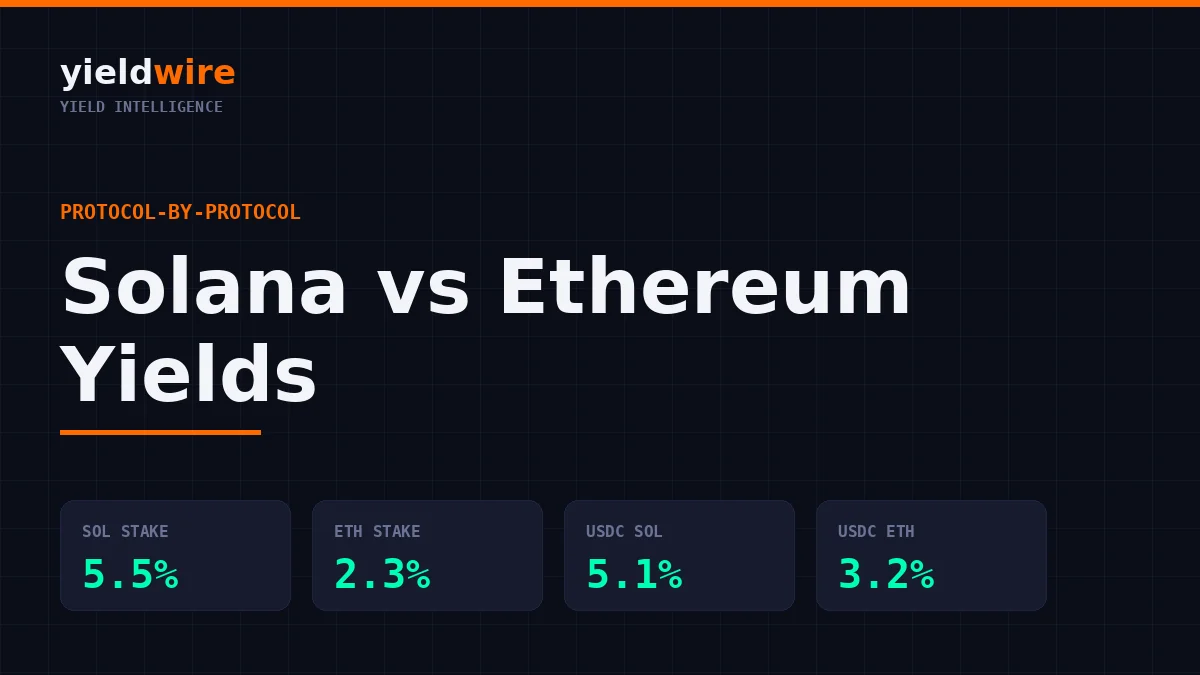
Solana vs Ethereum Yields: A Protocol-by-Protocol Comparison
Same dollar, two chains, different rates. USDC lending on Kamino and Jupiter vs Aave and Fluid. SOL staking vs ETH staking. Here are the live numbers and where each chain actually wins on risk-adjusted return.
The Short Version
A dollar is a dollar. USDC on Solana is the same token, redeemable for the same buck, as USDC on Ethereum. So if one chain pays you 5% to lend it and the other pays 3.2%, the obvious question is why, and whether the extra two points are free money or a risk you are not pricing.
They are rarely free money. The yield gap between Solana and Ethereum is real, but most of it traces back to two things: token incentives that someone can switch off, and staking inflation that pays you in coins the network is printing. Strip those out and the two chains look closer than the headline rates suggest.
This post puts them side by side. Stablecoin lending first, then staking, then the part nobody tweets about: pool depth and protocol track record. All numbers pulled June 30, 2026. Rates float with utilization, so read them as a snapshot, not a promise.
Stablecoin Lending: USDC Head to Head
Lending USDC is the cleanest comparison because the asset is identical on both chains. You deposit, a borrower pays interest, you earn. The only differences are the protocol, how much borrowers want to borrow, and whatever incentives are layered on top.
Here are the deepest USDC supply markets on each chain.
| Chain | Protocol | Supply APY | Base | Reward | Pool TVL |
|---|---|---|---|---|---|
| Solana | Jupiter Lend | 5.06% | 4.30% | 0.76% | ≈$396M |
| Solana | Kamino (main) | 3.63% | 3.63% | 0% | ≈$22M |
| Solana | Save | 2.32% | 2.32% | 0% | ≈$7M |
| Ethereum | Fluid | 7.67% | 6.87% | 0.80% | ≈$132M |
| Ethereum | Compound v3 | 3.34% | 3.24% | 0.10% | ≈$33M |
| Ethereum | Aave v3 (main) | 3.20% | 3.20% | 0% | ≈$201M |
Read the base column, not the headline.
Aave's main USDC market on Ethereum pays 3.20%, all of it base interest. That is the most honest number on the board: $201M of supply, no incentives, a pure read on borrower demand. Solana's Kamino main market sits right next to it at 3.63% base. Two of the deepest, most battle-tested lending markets in DeFi, on opposite chains, paying within half a point of each other. That is the real baseline.
Now look at the two highest numbers. Fluid on Ethereum shows 7.67%, but 0.80% is reward and the 6.87% base reflects a smaller, hotter market than Aave's. Jupiter Lend on Solana shows 5.06% with 0.76% coming from JUP-side incentives. Both look great until you remember the reward portion is a faucet the protocol controls and can cut at any time. yieldwire splits base from reward on every pool for exactly this reason. The durable number is what survives after the incentives stop.
Net read on stables: the floor is roughly the same on both chains, somewhere around 3.2% to 3.6% for deep, plain-vanilla USDC lending. Solana's headline edge comes mostly from incentive programs that are still running. Ethereum's headline edge (Fluid) comes from a hotter, thinner market. Neither is a structural 2-point advantage you can count on through a cycle.
One real Solana advantage that does not show up in APY: transaction cost. Moving in and out of a Solana lending position costs fractions of a cent. On Ethereum mainnet a deposit, an approval, and a withdrawal can run into double-digit dollars in gas. On a $1,000 position that gas drag can erase a chunk of the year's yield before you have earned it. The smaller your balance, the more this matters. Compare the full set on the stablecoin yields page and the broader lending category.
Staking: SOL vs ETH, and the Inflation Question
Staking is where the chains look most different, and where the difference is most misunderstood.
| Chain | Token | APY | TVL | Type |
|---|---|---|---|---|
| Solana | jupSOL | 5.57% | ≈$395M | Liquid staking |
| Solana | jitoSOL | 5.47% | ≈$728M | Liquid staking + MEV |
| Solana | mSOL | 4.81% | ≈$181M | Liquid staking |
| Ethereum | cbETH | 2.84% | ≈$230M | Liquid staking |
| Ethereum | weETH | 2.75% | ≈$2.8B | Liquid restaking |
| Ethereum | stETH | 2.26% | ≈$14.4B | Liquid staking |
| Ethereum | rETH | 2.04% | ≈$2.15B | Liquid staking |
The gap is wide. SOL liquid staking clusters around 5% to 5.6%. ETH liquid staking clusters around 2% to 2.8%. More than double, on the surface.
Here is the part that matters. A big slice of that SOL yield is inflation. Solana still issues new SOL to stakers at a meaningful rate, and that issuance is the bulk of the staking reward. Ethereum's net issuance is close to zero after the burn, so ETH staking pays you mostly from real fee and tip revenue, not from printing.
What does that mean for you in practice? If you measure yield in the token, SOL wins clearly. If you measure in dollars and account for dilution, the gap narrows because part of your SOL reward is offset by every other holder receiving newly minted SOL too. Staking protects you from dilution. It does not hand you a free 5.5% of real purchasing power. ETH's lower nominal rate is closer to a real rate because there is barely any dilution to protect against.
The honest framing: SOL staking is the better nominal yield and a reasonable bet if you are already long SOL and want to neutralize inflation. ETH staking is a lower but cleaner real yield. Neither is strictly better. They are answering different questions. jitoSOL carries one extra wrinkle worth knowing: part of its yield comes from MEV tips captured by Jito's block engine, which is real revenue rather than issuance, so it is a slightly higher-quality slice than base staking. Full breakdowns live on the Jito and Marinade protocol pages, and every staking option sits on the liquid staking yields page.
The Numbers Nobody Compares: Depth and Track Record
APY is the easy part. The harder comparison is how much money you can move and how long the contract holding it has survived.
On depth, Ethereum still wins outright at the top. Lido's stETH holds $14.4B. Aave's USDC market holds $201M in a single venue. These are the largest pools in DeFi, and that size means you can deposit eight figures without meaningfully moving the rate or worrying about exit liquidity. Solana's deepest staking pool, jitoSOL at $728M, is healthy but an order of magnitude smaller. Its deepest single USDC market, Jupiter Lend at $396M, is real but younger.
On track record, Ethereum's blue chips have simply been live longer through more stress. Aave and Lido have traded through multiple drawdowns, depegs, and a full bear market without a protocol-level failure. Solana's leaders, Kamino, Jupiter, Jito, are strong and audited but have fewer cycles behind them. That is not a knock. It is the reason a security score should weigh time-in-market, not just code quality.
This is exactly what yieldwire's Security Score is built to capture. A high APY on a six-month-old contract with a thin multisig is a different product than the same APY on a four-year-old protocol with a timelock and a dozen audits, even when the rate on the screen is identical. The rate tells you the reward. The score tells you what you are risking to earn it.
Where Each Chain Wins
Stablecoin lending is close to a tie on base rate. Solana wins on cost for small and mid-size positions because gas is negligible. Ethereum wins on depth and on the multi-cycle track record of Aave and friends if you are parking large size and want the most stress-tested venue.
Staking goes to Solana on nominal yield and to Ethereum on real, dilution-adjusted yield. Pick based on whether you are optimizing token count or purchasing power.
Restaking and the more exotic ETH yield stack (weETH and the liquid restaking layer) have no clean Solana equivalent yet, so if that is the trade you want, Ethereum is the only venue.
The practical answer for most people is not one chain. It is USDC lending where gas is cheapest for your size, staking on the chain whose token you already hold, and a security score check before either. Run your own position through the yield calculator and compare any two pools side by side on the compare page.
Data pulled June 30, 2026 from live on-chain sources. APYs float with utilization and change constantly. None of this is financial advice. Yields carry smart contract, market, and depeg risk, and a higher rate usually means more of at least one of those. Check the security score before you deposit.
Track all Solana yields in real time
Compare APYs across lending, LP, and liquid staking protocols on the YieldWire dashboard.
Open Dashboard →