
What Solana's Alpenglow Upgrade Means for DeFi Yields
Alpenglow replaces Solana's consensus layer with 150ms finality and frees 75% of block space. Here's what changes for yield farmers, stakers, and protocols.
Solana Is Replacing Its Consensus Layer
Solana is replacing its consensus layer. Not patching it, not optimizing it — replacing it entirely.
The upgrade is called Alpenglow. It passed governance with 98.27% approval in September 2025, and co-founder Anatoly Yakovenko confirmed it ships as early as Q3 2026. When it lands, transaction finality drops from 12.8 seconds to roughly 150 milliseconds. That is not incremental. That is a structural change to how the chain works.
For yield farmers, stakers, and protocol builders on Solana, Alpenglow is not just a speed upgrade. It changes the economics.
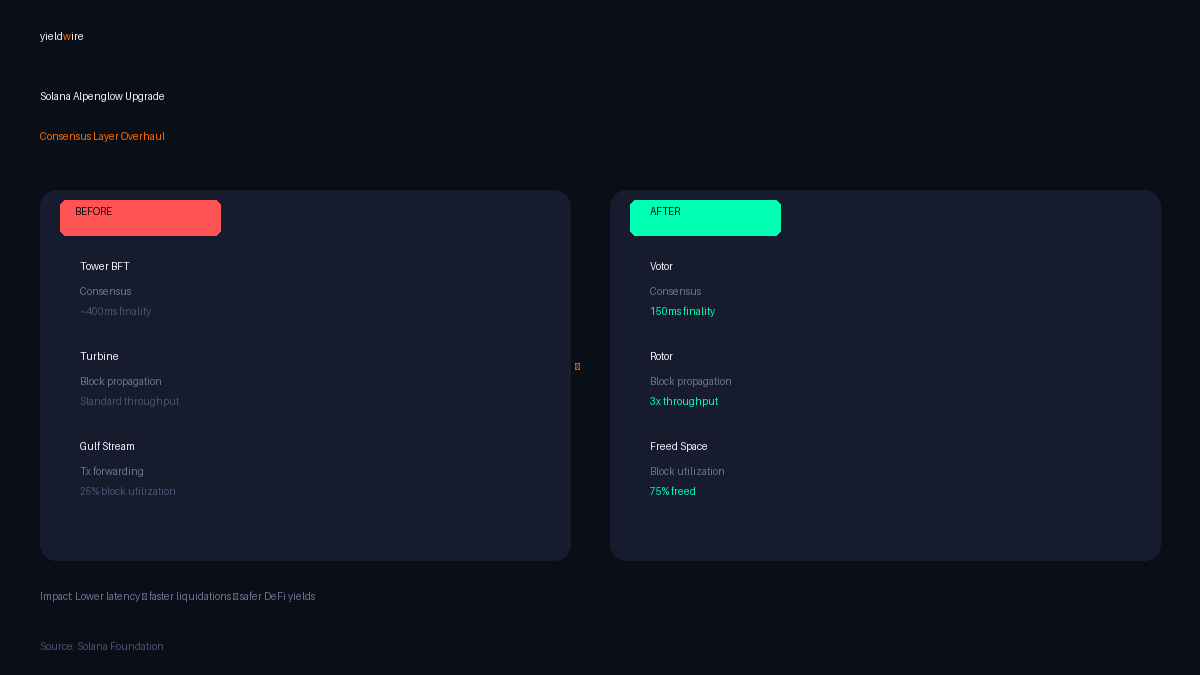
What Alpenglow Actually Changes
Solana's current consensus runs on two mechanisms: Proof of History (PoH) for ordering transactions, and Tower BFT for validator voting. Both are being replaced.
Votor replaces Tower BFT. Instead of validators casting votes across multiple rounds over ~12 seconds, Votor aggregates votes off-chain and finalizes blocks in one round when 80% of stake is participating. Two rounds if participation drops to 60%. Either way, finality goes from seconds to milliseconds.
Rotor replaces Turbine. Turbine currently propagates blocks through a multi-layer tree of validators. Rotor collapses this into a single layer of relay nodes weighted by stake. Simulations show block propagation completing in 18 milliseconds under normal conditions.
The net result: blocks finalize in 100-150ms. That puts Solana's settlement speed ahead of Visa's processing time.
The Block Space Dividend
This is the part most people miss.
Right now, roughly 75% of Solana's block space is consumed by validator votes. Every slot, validators submit vote transactions that compete for the same space as user transactions. This is a core reason why Solana hits congestion during high-demand periods.
Alpenglow moves voting off-chain entirely. That 75% of block space becomes available for actual transactions — swaps, deposits, liquidations, everything that makes DeFi work.
More usable block space means higher transaction throughput before congestion kicks in, lower priority fees during peak demand, and more room for protocols to build complex on-chain logic.
For DeFi protocols, this is capacity they have never had. The chain can handle significantly more activity without the congestion that has historically disrupted yield strategies during volatile markets.
What Changes for Stakers
SOL staking currently yields approximately 6-7% annualized — roughly double Ethereum's ~3.1%. Alpenglow does not directly change the inflation schedule or rewards formula, but it shifts the economics in two ways.
Validator costs drop. Without voting fees, validators spend less to operate. The breakeven point drops, which means smaller validators become more viable. More validators generally means better decentralization, and the network's security posture improves.
Net staking yield improves. When validators pay less in operating costs, the net reward rate for delegators goes up without any change in protocol parameters. The yield stays the same on paper, but more of it reaches the end staker.
For liquid staking protocols like Jito, Marinade, and Sanctum, this is a direct improvement to their product. LST holders get slightly better returns from the same underlying staking mechanism.
What Changes for Yield Farmers
The yield impact is indirect but compounding.
Faster finality = more DeFi activity. Sub-second settlement unlocks use cases that do not work at 12-second finality. High-frequency trading strategies, real-time arbitrage, and payment rails all become viable. More activity means more fees, more borrowing demand, and more yield generation across the ecosystem.
Less congestion = more reliable strategies. Yield farmers running leveraged positions or automated rebalancing depend on transactions landing in time. When Solana congests during market volatility, liquidations pile up and strategies break. With 4x more usable block space, the probability of congestion-related losses drops significantly.
Lending rates respond to activity. USDC lending yields on Solana are currently in the 3-4% range during quiet markets, but spike to 8-12% during periods of high demand. If Alpenglow attracts more protocol deployments and trading activity to Solana, the baseline demand for borrowing goes up — and lending yields follow.
What Changes for Protocols
Protocols building on Solana get three things from Alpenglow.
Instant confirmations for user-facing transactions. Deposits, withdrawals, and swaps confirm before the user can look away from the screen.
Room to build. Complex DeFi strategies that require multiple transaction steps can execute within a single slot without worrying about block space contention from validator votes.
Better composability. When finality is sub-second, protocols can compose with each other in tighter loops. Flash loans, cross-protocol arbitrage, and automated yield optimization all work better when the chain is faster.
Timeline
The path to mainnet is structured in stages. Agave 4.1 with Alpenglow support is expected in Q3 2026, followed by community testing on devnet/testnet and security audits through Q3-Q4 2026, with mainnet activation via validator consensus targeted for late 2026 or early 2027.
Anza (the core development team) has already demonstrated the first successful consensus switch on the Alpenglow test cluster. The mechanism works. What remains is hardening, auditing, and coordinating the rollout.
The Bottom Line
Alpenglow is a plumbing upgrade. It does not add new features to Solana — it makes the existing features work better. Faster finality, more block space, lower validator costs.
For yield farmers, the impact is a better operating environment. Strategies that break during congestion become more reliable. Staking returns improve at the margin. And if faster finality attracts more DeFi activity to Solana — which is the bet — then the entire yield landscape expands.
We track every yield on Solana in real time. When Alpenglow goes live and the numbers shift, you will see it first on yieldwire.
Track all Solana yields in real time
Compare APYs across lending, LP, and liquid staking protocols on the YieldWire dashboard.
Open Dashboard →