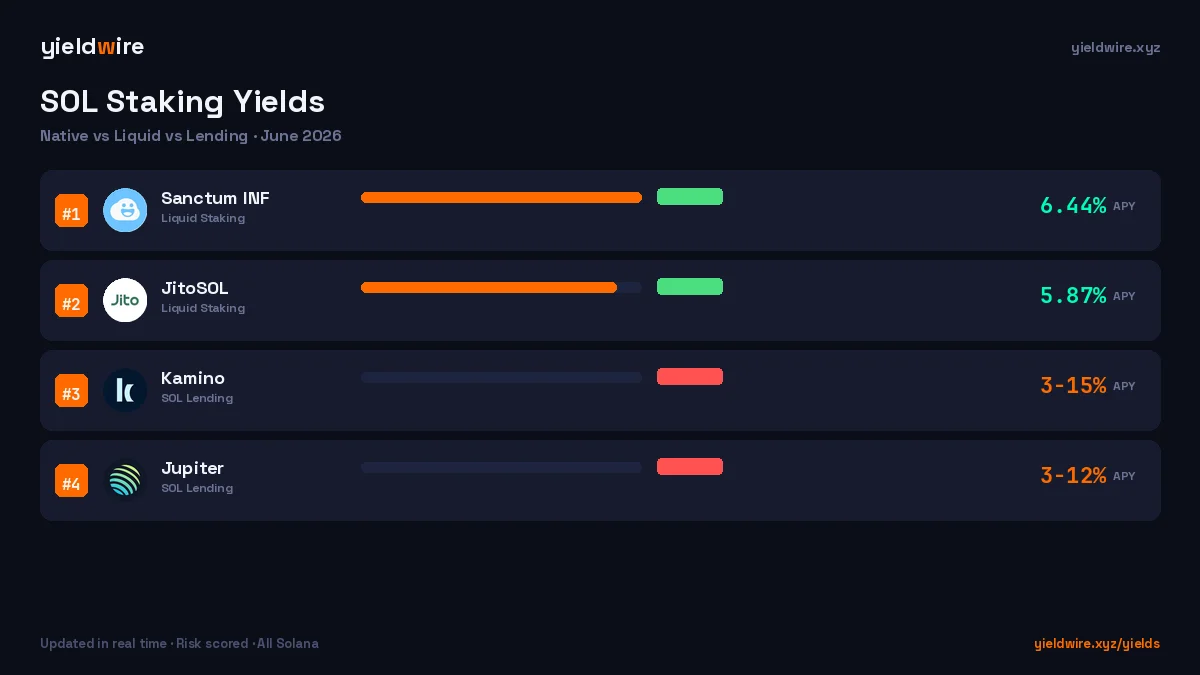
SOL Staking Yields Compared: Native, Liquid, and Lending
Three ways to earn yield on SOL. Native staking pays 5.8%. Liquid staking tokens push past 6.4%. Lending rates spike to 15% when borrowing demand runs hot. Here is how each path works, what it actually pays, and which risks come with it.
Three Paths to SOL Yield
Holding SOL without earning yield on it is leaving money on the table. But "staking" is no longer one thing. In 2026, Solana offers three distinct yield paths for SOL holders, each with different return profiles, risk trade-offs, and liquidity constraints.
Native staking delegates your SOL to a validator. Liquid staking wraps that delegation into a tradable token. Lending deposits your SOL into a money market where borrowers pay interest. Same asset, three mechanisms, wildly different outcomes depending on market conditions.
This post breaks down what each path actually pays today, where the yield comes from, and which risks you take on.
Native Staking: The Baseline
Native staking is the simplest yield source on Solana. You delegate SOL to a validator, and the network pays you inflation rewards every epoch (roughly every 2.5 days). No smart contracts beyond the base layer. No counterparty risk beyond your validator's uptime.
Current native staking yields sit around 5.8% APY, though the exact rate depends on your validator's commission and performance. Zero-commission validators like Helius can push effective rates above 6%, since they pass all rewards to delegators.
The yield comes from Solana's inflation schedule, which started at 8% annually and decreases 15% per year until it reaches a long-term floor of 1.5%. In 2026, inflation sits around 4.5%, but because roughly 65% of SOL supply is staked, the effective yield for stakers is higher than the inflation rate itself. Stakers are essentially earning a share of newly minted SOL, diluting non-stakers.
The trade-off is liquidity. Unstaking takes 2 to 3 days (one epoch plus cooldown). During that window, your SOL is locked. You cannot trade it, use it as collateral, or redeploy it. For long-term holders who do not need flexibility, this is a non-issue. For active DeFi users, it is a dealbreaker.
| Factor | Native Staking |
|---|---|
| APY | 5.5-6.2% |
| Risk | Low (validator performance only) |
| Liquidity | 2-3 day unlock |
| Complexity | Minimal |
| Smart contract risk | None (base layer only) |
Liquid Staking: Better Yield, Better Liquidity
Liquid staking tokens (LSTs) wrap native staking into a tradable asset. You deposit SOL, receive a token (JitoSOL, jupSOL, mSOL, INF), and that token accrues staking rewards over time while remaining fully liquid. You can sell it, swap it, or use it as collateral on lending protocols.
The base yield source is identical to native staking: inflation rewards. But LSTs add layers on top. JitoSOL captures MEV tips from the Jito block engine. Sanctum INF earns trading fees from LST swaps. JupSOL benefits from Jupiter's validator selection and subsidized commissions. These additions push LST yields above native staking for most tokens.
Here are the major LSTs ranked by 10-epoch APY, based on Sanctum's January 2026 data (the most recent comprehensive ranking available):
| Token | APY (10-epoch) | SOL Staked | Holders | Yield Source |
|---|---|---|---|---|
| Sanctum INF | 6.44% | 1.9M | 42,877 | Staking + swap fees |
| dSOL (Drift) | 6.36% | 1.7M | 5,102 | 100% validator fee pass-through |
| JupSOL | 6.16% | 4.7M | 30,080 | Staking + MEV + Jupiter subsidy |
| mSOL (Marinade) | 6.10% | 3.4M | 148,663 | Staking across 100+ validators |
| bbSOL (Bybit) | 5.93% | 1.8M | 11,471 | Exchange-backed staking |
| JitoSOL | 5.87% | 14.3M | 192,514 | Staking + MEV tips |
| bSOL (BlazeStake) | 5.79% | 1.0M | 57,197 | Community stake pool |
| BNSOL (Binance) | 5.51% | 10.7M | 13,440 | Exchange-backed staking |
A few patterns stand out.
Size compresses yield. JitoSOL is the largest LST by far at 14.3M SOL staked, but its APY (5.87%) trails smaller competitors. The same MEV revenue gets split across a much larger base. INF at 1.9M SOL earns 6.44%, partly because its swap fee revenue distributes across fewer tokens.
Not all yield is created equal. JupSOL's 6.16% includes a commission subsidy from Jupiter. That subsidy is protocol policy, not a market force. It could change. INF's swap fee premium depends on LST trading volume, which rises during volatile markets and falls during quiet ones. JitoSOL's MEV premium is tied to network activity and transaction ordering demand.
Exchange-backed LSTs trade yield for distribution. BNSOL (5.51%) and bbSOL (5.93%) sit at the bottom of the yield table. Their value proposition is convenience and integration with centralized exchange infrastructure, not APY optimization.
Liquidity and Composability
The real advantage of LSTs over native staking is not the extra 0.3-0.6% yield. It is what you can do with the token while it earns.
JitoSOL and mSOL are accepted as collateral on Kamino, Jupiter Lend, and most major lending protocols. You can borrow against your LST, effectively keeping your staking yield while accessing liquidity. Some users loop this: deposit LST as collateral, borrow SOL, convert to more LST, repeat. Kamino Multiply automates this strategy, pushing effective yields to 10-15% during favorable rate spreads, though with liquidation risk attached.
INF can be swapped instantly through Sanctum's liquidity layer. During the October 2025 flash crash, Sanctum processed withdrawals while INF holders earned higher fees from increased swap activity.
LST Risks
LSTs add smart contract risk on top of native staking. Every LST relies on contract code that could contain vulnerabilities. The major LSTs (JitoSOL, mSOL, INF) have been audited by firms like OtterSec, Sec3, and Neodyme, and have operated without exploits for over a year. But audits reduce risk; they do not eliminate it.
Market concentration is another concern. Jito and Marinade's combined market share has dropped from 95%+ to roughly 42% as JupSOL, INF, and exchange-backed LSTs have grown. More competition is healthy for the ecosystem, but it also means liquidity for each individual LST is thinner than it would be in a two-player market.
Lending: Variable, Volatile, Opportunistic
Lending protocols let you deposit SOL into a money market. Borrowers take overcollateralized loans and pay interest. That interest flows to depositors based on their share of the pool.
SOL lending yields are fundamentally different from staking yields. Staking pays inflation rewards at a relatively stable rate. Lending pays interest driven by borrowing demand, which swings with market conditions.
During calm markets, SOL lending on Kamino or Jupiter Lend typically pays 3-6% APY. That is often less than staking. But when borrowing demand spikes (SOL price rallying, traders going long), rates surge and rates can hit 10-15%+. In extreme cases, SOL lending has briefly exceeded 20%.
| Protocol | Typical SOL Lending APY | TVL | Notes |
|---|---|---|---|
| Kamino Finance | 3-6% (calm), 10-15% (hot) | $4B+ | Largest money market on Solana |
| Jupiter Lend | 3-5% (calm), 8-12% (hot) | $1.6B+ | Integrated with Jupiter perps |
| Save (ex-Solend) | 2-4% (calm), 6-10% (hot) | ~$200M | Isolated pools, long-tail assets |
When Lending Beats Staking
SOL lending rates inversely correlate with staking's value proposition. When SOL price is rising fast, traders borrow SOL to short or to go long with borrowed capital. Borrowing demand spikes, rates rise, and lending temporarily pays more than staking. When the market cools, rates compress back below staking yields.
This makes lending a poor set-and-forget strategy for SOL. The average annualized rate over a full cycle often lands below liquid staking returns. But for users who actively monitor rates and can deploy capital during demand spikes, lending offers bursts of higher yield.
Lending Risks
Utilization risk. When 95% of a pool is borrowed, only 5% of deposits can withdraw until borrowers repay. During market stress, everyone wants to exit at once.
Smart contract risk. Lending protocols are historically the most exploited category in DeFi. Kamino, Jupiter Lend, and Save have strong audit records, but the attack surface of a lending protocol is larger than a simple staking contract.
Rate volatility. You cannot predict what lending will pay next week. A position earning 12% today might earn 2% tomorrow if borrowing demand drops.
Side-by-Side Comparison
| Factor | Native Staking | Liquid Staking | SOL Lending |
|---|---|---|---|
| Typical APY | 5.5-6.2% | 5.5-6.5% | 3-15% (variable) |
| Yield source | Inflation rewards | Inflation + MEV/fees | Borrower interest |
| Predictability | High | Moderate | Low |
| Liquidity | 2-3 day unlock | Instant | Usually instant* |
| Smart contract risk | None | Low-Medium | Medium |
| Composability | None | High (collateral, LP) | Limited |
| Best market condition | Any | Any | High borrowing demand |
| Complexity | Low | Low | Medium |
*Lending withdrawals can be constrained during high utilization.
Which Path Fits You
You want simplicity and minimum risk. Native staking. Pick a reliable, low-commission validator. Earn 5.8% with zero smart contract exposure. Accept the 2-3 day unlock period.
You want the best risk-adjusted yield. Liquid staking. INF or JitoSOL give you staking returns plus additional yield sources, with instant liquidity and the ability to use your position as DeFi collateral. For most SOL holders, this is the optimal path.
You want to maximize short-term returns. SOL lending during high-demand periods. This requires active rate monitoring and willingness to move capital. It is not passive income. It is yield trading.
You want all three. Split your SOL. Stake 60% in an LST for stable baseline yield. Keep 20% in a lending protocol for rate spikes. Hold 20% as liquid SOL for trading or DeFi opportunities. The exact split depends on your risk tolerance and how actively you want to manage positions.
The yields quoted here are snapshots. They change daily. Track them all at yieldwire.xyz/yields, where every pool, protocol, and LST is updated hourly with risk scores attached.
Track all Solana yields in real time
Compare APYs across lending, LP, and liquid staking protocols on the YieldWire dashboard.
Open Dashboard →