How SOL Price Moves Affect DeFi Yields: A Data Analysis
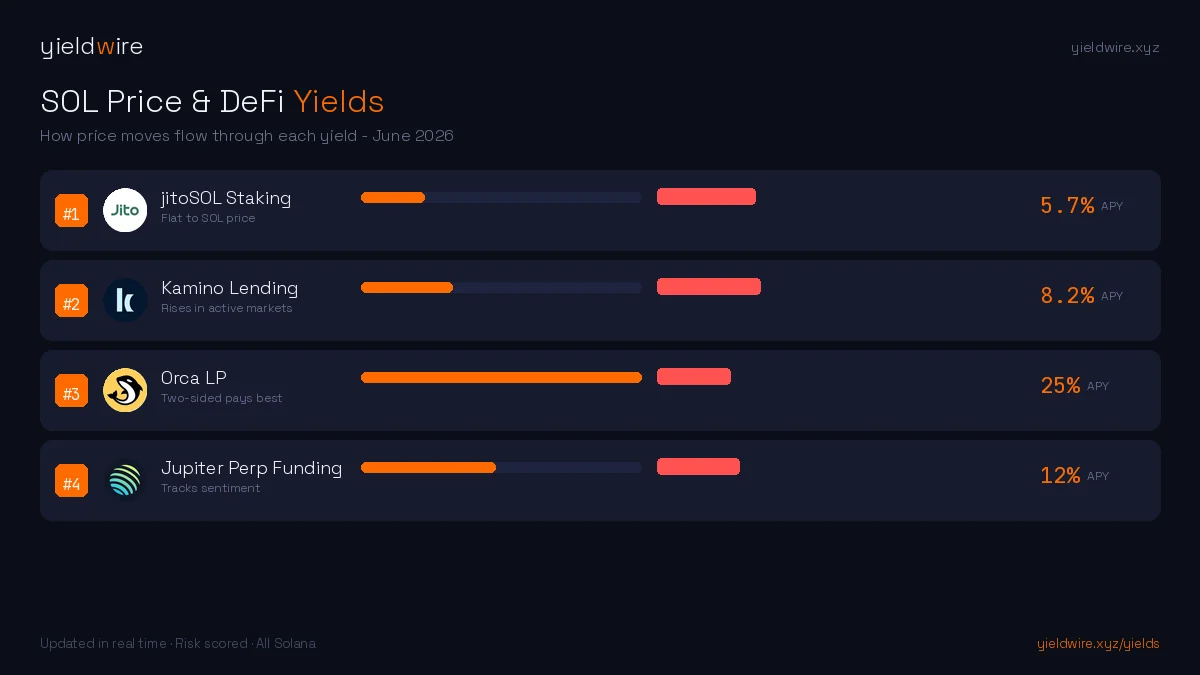
SOL trades near $65, down 78% from its January 2025 peak. Most people assume falling prices crush yields. The data says it depends entirely on which yield you hold. Here is how price moves flow through staking, lending, LP, and perp funding, with the numbers.
The Question Worth Answering
SOL trades near $65 today. That is down roughly 78% from the $293 all-time high set in January 2025, and the chain has spent most of 2026 grinding sideways in a wide band while Alpenglow milestones and ETF headlines push it around.
A falling price feels like it should drag every yield down with it. It does not. Some yields barely notice. Others move hard in the opposite direction of what most people expect.
The reason is mechanical. Each yield category on Solana earns from a different source, and price feeds into each source differently. Staking earns from inflation and tips. Lending earns from borrowing demand. LP earns from trading volume. Perp funding earns from leverage imbalance. Price hits all four, but not the same way and not in the same direction.
Here is the breakdown, with real numbers from the protocols we track on yieldwire.
Staking: The Yield That Ignores Price
Native staking and liquid staking tokens are the most price-insensitive yields on the chain, and the reason trips people up constantly.
Staking APY is denominated in SOL, not dollars. When you stake and earn 6%, you earn 6% more SOL. That rate comes from network inflation (currently disinflating toward a long-run floor) plus priority fees and MEV tips redistributed to stakers. None of those inputs care what SOL costs in USD.
Here is where the LSTs sit right now:
| LST | APY (in SOL) | TVL | What drives the rate |
|---|---|---|---|
| jupSOL | ~6.2% | $814M | Validator selection by Jupiter |
| dSOL | ~6.5% | $64M | Smaller validator set, fewer integrations |
| jitoSOL | ~5.7% | $895M | MEV tip redistribution |
| mSOL | ~5.1% | $278M | Oldest, deepest liquidity |
When SOL drops 40%, your jitoSOL position still compounds at roughly 5.7% in SOL terms. Your dollar value falls with the market, but the yield engine keeps running at the same rate. When SOL rallies, the same 5.7% suddenly looks great in USD, and that is the only thing that changed.
There is one second-order effect worth flagging. MEV tips and priority fees spike during high-volatility periods, because that is when arbitrage and liquidation activity peaks. Big price moves in either direction tend to lift the tip component of staking yield for a few days. So staking APY is not perfectly flat. It ticks up when the market gets violent, regardless of direction.
Full staking comparison and validator scores live on the yields page.
Lending: Where Price Moves Show Up First
Lending is the opposite story. Stablecoin lending APY on Solana is one of the most price-reactive yields on the chain, and it reacts in a way that surprises people.
Lending rates come from utilization. The more of a pool that gets borrowed, the higher the rate paid to suppliers. The question is what makes people borrow.
When SOL rallies, traders borrow stablecoins to go long. They post SOL as collateral, borrow USDC, buy more SOL. That pushes stablecoin utilization up, which pushes supply APY up. A strong SOL uptrend is usually a high-yield environment for stablecoin lenders.
When SOL crashes hard, two things happen at once. Leverage longs get liquidated, which spikes borrowing demand for a few hours as positions unwind, then collapses it as the leverage flushes out. After the flush, utilization drops and stablecoin lending APY cools off.
You can see the band this creates. Kamino USDC supply sat around 8.17% during the leverage-heavy stretch earlier this quarter. In quieter, lower-leverage conditions it drifts toward 3.5-4%.
| Protocol | Asset | APY (active) | APY (quiet) | TVL |
|---|---|---|---|---|
| Kamino Lend | USDC | ~8.2% | ~4% | $1.5B |
| Jupiter Lend | USDC | ~3.7% | ~3% | $874M |
| Lulo (aggregated) | USDC | ~7.8% | ~4.5% | $87M |
| Save | USDC | ~3.5% | ~3% | $77M |
The takeaway: if you lend stablecoins, you are short volatility in a sense. You earn the most when leverage demand runs hot, which usually means price is moving. Flat, boring markets compress your yield toward the floor.
Borrowing SOL itself follows a different rhythm. SOL borrow demand climbs when shorts pile in during downtrends, so SOL-denominated lending rates can actually rise while price falls. Direction matters per asset.
LP Yields: Volatility Pays, Direction Hurts
Liquidity provision is the messiest relationship of the four, because price feeds in through two opposing channels.
Channel one is volume. LP fees scale with trading volume, and volume spikes during big price moves. A 15% SOL day generates far more swap fees than a flat day. More volatility, more fees, higher realized APY on the fee component.
Channel two is impermanent loss. When SOL moves sharply against your position, the pool rebalances you out of the winning asset and into the losing one. On a directional move, IL can erase the entire fee advantage and then some. Concentrated liquidity positions, like Orca Whirlpools and Meteora DLMM, amplify both channels: more fee capture in range, more brutal losses when price blows through your bounds.
| Pool | Protocol | APY (fees) | Risk |
|---|---|---|---|
| SOL-USDC | Orca (concentrated) | 15-35% | High, IL plus range risk |
| SOL-USDC | Raydium | ~25% | High, IL plus directional |
| USDC-USDT | Orca (0.01%) | 8-18% | Low to medium, no directional IL |
The pattern: choppy, two-sided volatility is the best LP environment. Price swings hard but mean-reverts, you bank fees on every swing, and IL washes out because price returns near where it started. A sustained one-way trend is the worst environment. You collect fees the whole way, but IL on the directional move swallows them.
Stable-stable pools like USDC-USDT sidestep the directional channel entirely. They have no SOL-price IL, so their yield tracks volume and stablecoin demand, not SOL itself. That is why they show up in conservative portfolios. Model your own IL exposure with the calculator before committing to a SOL pair.
Perp Funding: A Direct Read on Sentiment
Perpetual funding rates are the cleanest price-to-yield signal on Solana, because funding is literally a payment between longs and shorts based on which side is crowded.
In a SOL uptrend, longs dominate and pay positive funding to shorts. Delta-neutral strategies that hold spot SOL and short the perp collect that funding as yield, often in the high single digits to low teens annualized when the trend is strong. In a downtrend, funding flips negative, shorts pay longs, and the same strategy bleeds.
Funding is the one yield here that gives you a direction, not just a magnitude. Positive and rising funding tells you longs are crowded. Deeply negative funding tells you shorts are. It is a sentiment gauge that happens to pay or charge you to read it.
What Actually Correlates
Pulling the four together, the relationship between SOL price and yield is not one number. It splits by source:
Staking yield is near-flat to price, with a small volatility kicker from tips. Stablecoin lending yield is driven by leverage demand, so it rises in active markets and compresses in quiet ones, with direction mattering per asset. LP fee yield loves two-sided volatility and hates one-way trends because of IL. Perp funding tracks directional sentiment and flips sign with the trend.
So "does the SOL drawdown crush yields?" has no single answer. It crushed the USD value of every position, because that is what a drawdown does. But the staking rate held, lending stayed in its band, stable-stable LP kept paying, and shorts collecting negative funding actually got paid more on the way down. The yield engine and the price are two different machines that happen to share a chassis.
Positioning, Not Prediction
None of this is a call on where SOL goes next. It is a map of how the yield you choose will behave when price does whatever it does.
If you want yield that survives a drawdown intact, staking and stable-stable LP are the price-insensitive corners. If you want yield that pays the most when the market is active, stablecoin lending and two-sided LP capture that, with the risk that quiet markets starve them. If you have a directional view, perp funding lets you get paid to express it, with the obvious risk if you are wrong.
Match the yield mechanism to the market you expect, not the price you hope for. Check current rates and security scores across all 132 protocols on yieldwire.xyz/yields, and stack positions side by side with the pool comparator.
This is analysis, not financial advice. Every yield here carries smart contract, market, and liquidation risk. Read the security scores before you deposit.
Track all Solana yields in real time
Compare APYs across lending, LP, and liquid staking protocols on the YieldWire dashboard.
Open Dashboard →