Sanctum Validator LSTs: Custom Staking on Solana Explained
Sanctum powers 1,300+ validator LSTs on Solana with $1.4B in TVL. Its Infinity pool, zero-slippage swaps, and staking-as-a-service model have turned liquid staking into programmable infrastructure. Here is how it works and what the yields look like.
What Sanctum Does
Sanctum is the infrastructure layer behind most liquid staking tokens on Solana. Not a single-validator staking pool. Not a fork of Lido. It is a system that lets any validator, project, or community launch their own LST, then connects all of those tokens through a shared liquidity layer called Infinity.
The numbers as of late May 2026: $1.4B in TVL, 1,300+ validator LSTs created, and the protocol underpins several of Solana's largest staking products. Jupiter's jupSOL ($749M TVL), Bybit's bbSOL ($274M), Drift's dSOL ($266M), and dozens of smaller validator-specific tokens all run on Sanctum's infrastructure.
Solana's liquid staking sector now holds over $8B in TVL, with roughly 14% of all staked SOL in liquid form. Sanctum sits at the center of that growth.
How Validator LSTs Work
Traditional liquid staking on Solana works like this: you deposit SOL into a stake pool (Marinade, Jito, etc.), and you get back a token that represents your staked position. That token accrues staking rewards while remaining tradeable and usable in DeFi.
Sanctum takes this further. Any Solana validator can create its own LST in minutes. The validator stakes the deposited SOL, and the LST tracks the value of the underlying stake account. No custom smart contracts needed. Sanctum handles the pool program, the minting, and the integration with Solana's native staking system.
The result is a long tail of validator-specific tokens. Each one delegates to a specific validator (or set of validators), each one earns staking rewards, and each one is tradeable through the Infinity pool.
What makes this interesting is the use cases that emerge beyond basic staking.
laineSOL pays roughly 20% APY because the validator returns extra block rewards to stakers on top of standard staking yield. The LST becomes a delivery mechanism for above-market returns.
pathSOL was designed for NFT access. Users paid 10 SOL to mint a Pathfinder NFT, but the SOL went into a stake pool rather than a treasury. Staking yields funded the project's development. Holders could burn the NFT to reclaim their SOL.
alphaSOL uses staking yield to pay for a subscription service. Stake your SOL, get access to premium content, and unstake whenever you want.
These are three different business models, all built on the same LST primitive. The validator LST is the building block. What gets built on top varies.
The Infinity Pool
Sanctum's core innovation is Infinity: a multi-LST liquidity pool that solves the fragmentation problem.
When you have 1,300+ different LSTs, liquidity is a challenge. A small validator LST with $500K in TVL would normally be illiquid. Swapping it for SOL or another LST would mean slippage, thin order books, or long unstaking cooldowns.
Infinity fixes this with a pricing mechanism that reads directly from on-chain stake account data. Every LST can be converted into a stake account, and every stake account has a known SOL value. Infinity uses those values as reference prices instead of relying on constant-product AMM curves. The result: zero price impact on swaps between any two whitelisted LSTs, regardless of trade size.
Users who deposit LSTs into Infinity receive INF, a token that represents a share of the entire pool. INF earns yield from two sources: the weighted average staking rewards of every LST in the basket, plus trading fees generated when users swap through the pool.
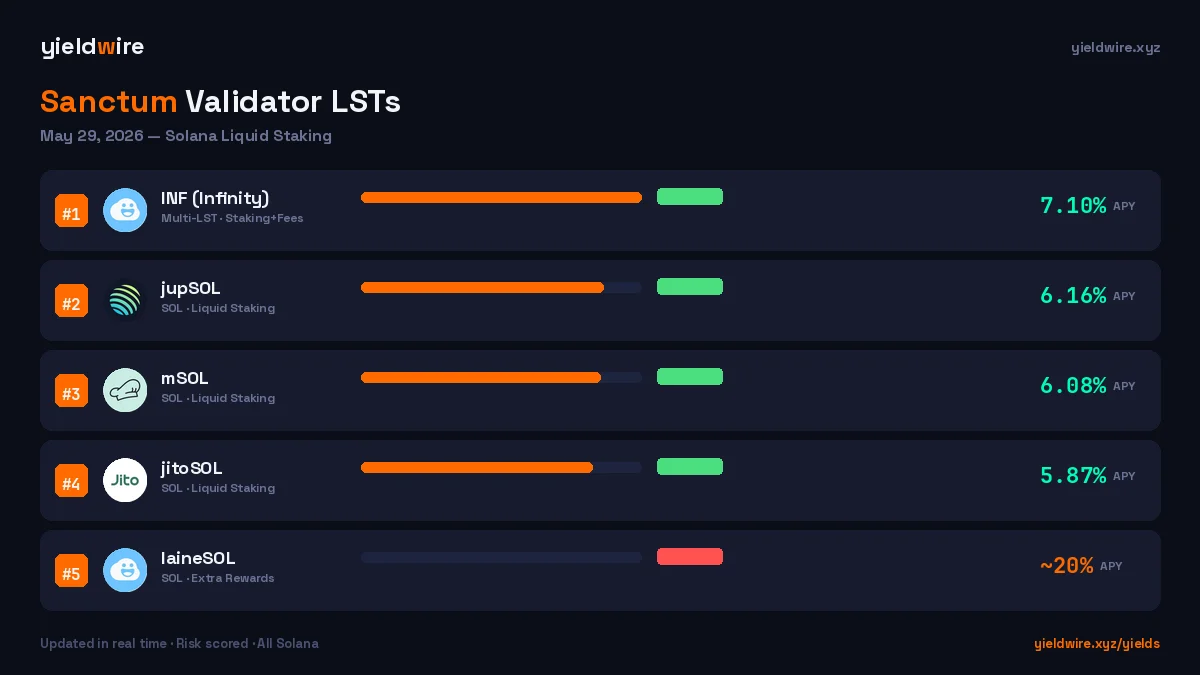
INF's APY currently sits around 7.1%, making it the highest-yielding broadly accessible LST on Solana. That premium over single-validator LSTs (which typically pay 5.5-6.5%) comes from the trading fee component.
| LST | APY (10-epoch) | SOL Staked | Holders | Source |
|---|---|---|---|---|
| INF (Infinity) | ~7.1% | Multi-LST basket | N/A | Staking + swap fees |
| jupSOL | 6.16% | Major | 100K+ | Jupiter validator set |
| mSOL | 6.08% | 5M+ | 148,663 | Marinade 100+ validators |
| jitoSOL | 5.87% | 14.3M | 192,514 | Jito StakeNet 200+ validators |
| dzSOL | 5.78% | 13.2M | 12,202 | DoubleZero validator |
| dSOL | ~6.5% | Moderate | Fewer | Smaller validator set |
| laineSOL | ~20% | Small | Niche | Extra block rewards |
The tradeoff with INF is composability. Single-validator LSTs like jitoSOL and mSOL have deep integrations across Solana DeFi: lending markets, LP pools, collateral in perps protocols. INF is growing its integrations but is not yet accepted everywhere that jitoSOL is. For users who plan to hold an LST and use it in DeFi, the integration depth of the token matters as much as the raw APY.
Staking-as-a-Service
Sanctum offers a white-label product for projects that want to launch validators and LSTs without building infrastructure from scratch. Jupiter, Bybit, and Drift all launched their staking products through this service.
The package includes: a managed validator node, a custom LST with branded tokenomics, integration with the Infinity pool for instant liquidity, and ongoing operational support. Sanctum handles the staking program, the stake pool management, and the connection to its unified liquidity layer.
For projects, this means staking becomes a product feature rather than an infrastructure project. Jupiter did not build its own staking system from scratch. It used Sanctum's infrastructure and focused on distribution through its existing DEX user base. That distribution advantage, combined with Sanctum's backend, is why jupSOL reached $749M in TVL.
Risk Profile
Sanctum's risk is concentrated in a few areas.
Smart contract risk. The Sanctum programs are audited and have been live since 2023. The core stake pool program was co-developed with Solana Labs. Still, any smart contract carries residual risk, and the Infinity pool adds complexity compared to a simple single-validator LST.
Validator risk. Individual validator LSTs inherit the risk of their specific validator. If a validator has poor uptime, the LST's staking yield drops. If a validator gets slashed (rare on Solana but possible in theory), stakers take the hit. Sanctum does not guarantee validator performance for third-party LSTs.
Liquidity risk for tail LSTs. The Infinity pool provides baseline liquidity for all whitelisted LSTs, but the pool is not infinite in practice. During a bank-run scenario where many LST holders try to exit simultaneously, the Sanctum Reserve (a pool of idle SOL for instant unstaking) could deplete. In that case, users would need to wait for the standard Solana unstaking period (~2-3 days).
CLOUD token governance. Sanctum's governance token is CLOUD, with a max supply of 1B and ~34% currently circulating. Governance changes to the protocol (whitelist additions, fee parameters, reserve ratios) go through CLOUD holders. Concentration of governance power is worth monitoring.
For yield seekers, the practical risk question is: are you comfortable earning 5.5-7% from a system that routes through multiple layers (your LST, the validator, the Infinity pool, the Sanctum programs) versus earning 5.5-6% from a single established LST like jitoSOL that has fewer moving parts?
The answer depends on your tolerance for protocol complexity and your need for the yield premium.
When to Use What
You want maximum APY with broad diversification: INF. It earns the highest yield among major LSTs because it captures trading fees on top of staking rewards. Good for passive holding.
You want DeFi composability: jitoSOL or mSOL. These are accepted as collateral across Kamino, Jupiter Lend, Drift, and most major Solana protocols. The yield is lower but the integration depth is unmatched.
You want validator-specific delegation: Pick a validator LST directly. Sanctum lets you stake to any validator you trust, and the LST remains liquid through Infinity.
You are a project building on Solana: Staking-as-a-service. Launch a branded LST, use staking yield to fund your product, and give users a reason to stake with you rather than a generic pool.
Compare all LSTs side by side: yieldwire.xyz/yields/category/liquid-staking.
Full protocol profile: yieldwire.xyz/protocol/sanctum.
Methodology
TVL figures sourced from DeFiLlama as of May 29, 2026. APY data based on 10-epoch trailing yields reported by Sanctum and cross-referenced against DeFiLlama and Solana on-chain data. Holder counts from Sanctum's public dashboard and Solana Explorer. laineSOL yield estimate includes supplemental block rewards above standard staking yield. INF APY includes both staking rewards and Infinity pool trading fees. Individual validator LST yields vary by epoch and validator performance.
See the live Sanctum profile: yieldwire.xyz/protocol/sanctum.
This is not financial advice. Liquid staking involves smart contract risk, validator risk, and potential liquidity constraints during high-redemption periods. Past yields are not indicative of future returns. Conduct your own research before staking with any protocol.
Track all Solana yields in real time
Compare APYs across lending, LP, and liquid staking protocols on the YieldWire dashboard.
Open Dashboard →