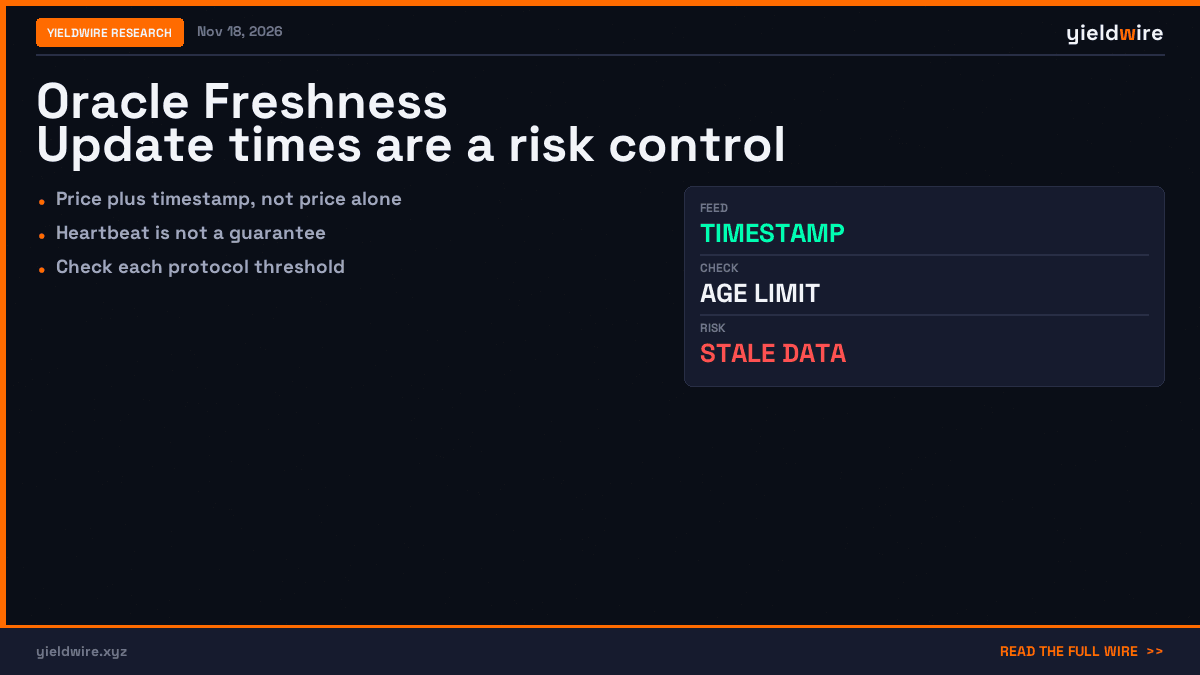
Oracle Freshness: Reading Update Times and Feed Parameters
An oracle price is only useful if it is recent enough for the action a protocol is about to take. Learn to read update times, heartbeats, and feed-specific parameters without treating a displayed price as a guarantee.
A price can be correct and still be unsafe to use
A lending market can display the right price and still make the wrong decision. The missing question is timing. A price that matched the market five minutes ago may be too old for a liquidation, collateral withdrawal, or margin trade during a fast move. Oracle freshness is the check that separates a number being visible on-chain from a number being usable for a specific action.
That distinction matters because a DeFi contract does not see a chart. It sees the latest value written to a feed, its update timestamp, and any validation rules built around that feed. If the protocol accepts a value after its intended age, it can lend against collateral that has already fallen or liquidate against a price that no longer reflects the market.
Chainlink's Data Feeds documentation describes feeds as data services with feed-specific configuration and a latest-round interface. That interface exposes both the answer and the time associated with the update. The pair should be read together. A dashboard that highlights only the price is showing half of the risk surface.
Start with the action, not the displayed number
There is no universal definition of fresh. The acceptable delay for a stablecoin collateral check is different from the acceptable delay for a thin token during a sharp sell-off. It also differs between a user interface that is only displaying a reference price and a contract that is about to transfer value.
For a deposit or liquidation path, the useful question is: what is the maximum age this protocol permits before it rejects the feed? That is a protocol-level rule, usually enforced in its smart contract or adapter. The oracle provider may publish updates, but the consuming protocol decides whether an update is recent enough for its own risk model.
This is why a green oracle status page is not the same as a green lending market. A feed can be operating normally while a specific market is configured with a stale threshold that is too loose, a fallback that is poorly understood, or no check at all. The protocol integration is part of the security review.
The fields worth reading
For a Chainlink-style price feed, readers will commonly encounter a latest answer and an update timestamp. Exact function names and interfaces vary by chain and integration, but the interpretation is stable.
| Field | What it tells you | What it does not tell you |
|---|---|---|
| Latest answer | The most recently reported value | Whether the value is recent enough for this action |
| Updated time | When that reported value was last updated | Whether the protocol will reject it when old |
| Feed decimals | How the integer answer should be scaled | Whether the market is liquid or manipulation-resistant |
| Round metadata | Context for the latest reported round | Whether an application validates the round correctly |
| Protocol threshold | The maximum age the consuming contract allows | Whether that threshold fits the asset's volatility |
The timestamp is not a prediction of the next update. It is evidence about the last one. If it is older than the protocol's allowed window, a defensive integration should stop and revert rather than continue with a potentially stale price. A user cannot infer that behaviour from the timestamp alone. It has to be documented or verified in the protocol's code and risk materials.
Heartbeats are cadence limits, not a safety guarantee
Many oracle systems describe a heartbeat or update cadence. It is tempting to read that as a promise that every price will change on a fixed schedule. That is not the safe interpretation.
A heartbeat generally describes an expected maximum interval for updates under the feed's configuration. Price feeds can also update when a deviation condition is met. In quiet markets, the price may not change much. In volatile markets, updates may happen more often. The relevant detail is the configuration for the exact feed and network, not a generic number copied from another asset or chain.
For risk review, a heartbeat answers a narrow question: how long could the system reasonably wait before an update is expected under normal conditions? It does not prove that a consuming protocol will enforce that limit. It does not guarantee that transactions, network conditions, or an integration bug cannot create a longer effective delay.
Treat the heartbeat as one input to a maximum-age policy. A protocol that uses a feed with an hourly configuration should not silently accept a two-hour-old update for a liquidation-sensitive asset. Conversely, setting an extremely short threshold can cause valid user actions to fail during congestion. There is a real trade-off between rejecting stale data and keeping the market operable.
A practical freshness review
You do not need to inspect every oracle contract before opening a position. You do need a repeatable way to identify whether a yield source depends on a price path that you understand.
- Identify the asset that matters to the position. For lending, that includes collateral and borrowed assets. For perps, it includes the mark and index inputs. For an LP used as collateral, it may include a separate valuation path.
- Find the oracle provider and exact feed for the relevant chain. A provider name alone is not enough, because feeds and parameters can differ by network.
- Check the latest update time next to the answer. If the data is visibly old, do not treat the displayed health factor or liquidation price as current.
- Look for the protocol's maximum-age check, fallback logic, and pause behaviour. If those controls are not documented, that uncertainty belongs in the risk assessment.
- Ask whether the threshold matches the asset. A major stable asset and a low-liquidity collateral token should not automatically share the same tolerance.
This sequence is especially useful when a high APY comes from looping or borrowing. The quoted return may assume the position can be monitored and adjusted continuously. The actual position depends on an external price path reaching the contract in time for its rules to work.
Freshness is separate from price quality
A very recent price can still be poor quality. Freshness does not address whether the underlying market is deep, whether the feed has enough independent sources, or whether a volatile asset can be manipulated. It only addresses the age of the last accepted observation.
The reverse is also true. A well-designed, deeply sourced feed can become risky to use if a protocol reads it without a sensible age check. Oracle risk is therefore layered: source quality, market quality, update timing, and integration controls all matter. Improving one does not remove the others.
That is why YieldWire treats oracle design as more than a provider logo. When comparing positions on the yields page, a displayed APY should be read alongside the route through which collateral and liquidation values are calculated. The security page is the place to inspect the broader control surface before treating a rate as risk-adjusted income.
What a user can and cannot verify
Users can often observe a price, its timestamp, and a protocol's public documentation. They may also be able to read contracts or use an explorer. Those checks help, but they do not produce a guarantee. A user interface can cache data, contracts can be upgraded, and a healthy feed can be integrated incorrectly.
The reasonable conclusion is not to avoid every oracle-dependent position. It is to avoid treating an oracle price as a neutral fact. It is an input with a source, a timestamp, and a set of rules around it. Before depositing, know which of those rules the protocol enforces and which ones you are assuming.
Source: Chainlink Data Feeds documentation.
This article is educational and is not financial advice. Digital assets and DeFi positions carry risk, including the risk of loss.
Track all Solana yields in real time
Compare APYs across lending, LP, and liquid staking protocols on the YieldWire dashboard.
Open Dashboard →