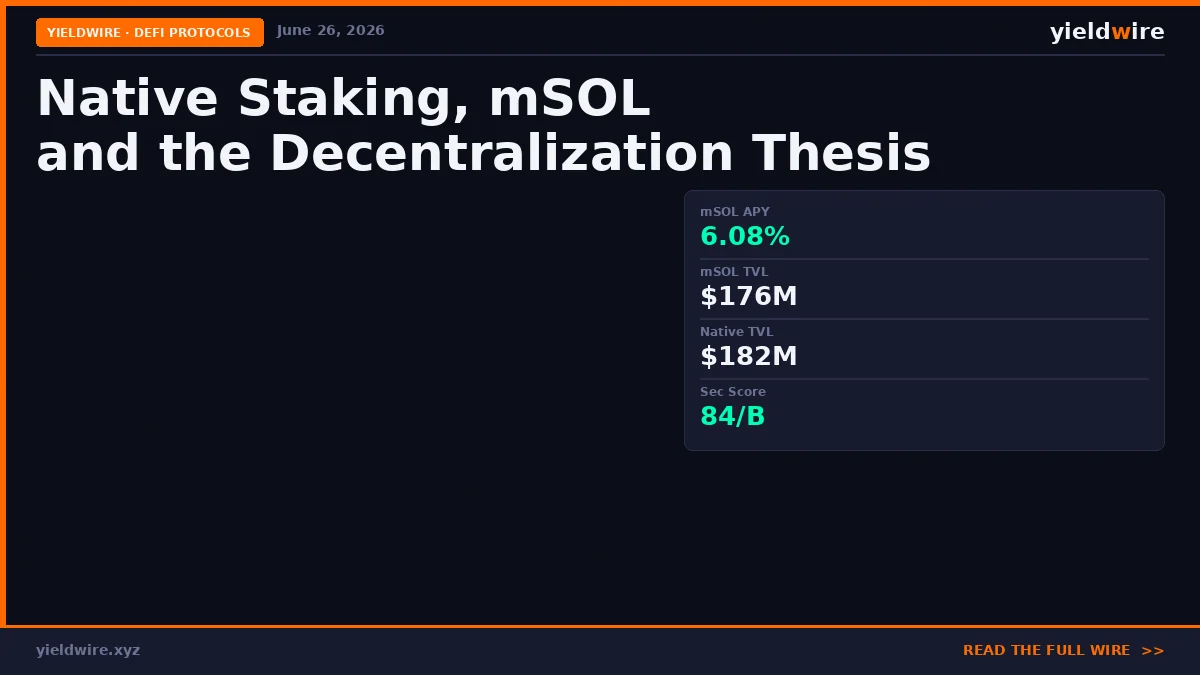
Marinade Finance: Native Staking, mSOL, and the Decentralization Thesis
Marinade runs two staking products on Solana. mSOL pays 6.08% with full DeFi composability. Marinade Native pays slightly more with zero smart contract risk but no liquidity. Here is the yield, the risk, and why Marinade's validator set matters for Solana itself.
Two Products, One Protocol
Marinade is the oldest staking protocol on Solana. It launched mSOL in 2021 and survived every cycle since, including the FTX collapse that took out half the ecosystem around it. Most people know Marinade as the mSOL liquid staking token. Fewer know it actually runs two distinct products with different yield, risk, and composability profiles.
The first is mSOL, the classic liquid staking token. You deposit SOL, get mSOL, and the token appreciates against SOL as staking rewards accrue. You can use it across DeFi as collateral or in LP pools.
The second is Marinade Native. You delegate SOL directly to Marinade's validator set without ever touching a smart contract. No token, no liquidity, no protocol layer between your stake and the validators. Just native Solana staking with Marinade's delegation strategy applied.
Same validator set underneath. Very different products on top. This post breaks down both.
The Numbers Right Now
| Product | TVL | APY | Smart contract risk | Liquidity |
|---|---|---|---|---|
| mSOL (liquid staking) | ~$176M (2.5M SOL) | 6.08% (30d) | Yes (audited) | High |
| Marinade Native | ~$182M (2.59M SOL) | ~6.5-7% | None | None |
mSOL's 30-day APY sits at 6.08% as of late June 2026. That figure is net of Marinade's management fee and validator commissions. The mSOL/SOL exchange rate currently runs around 1.39, meaning each mSOL is redeemable for 1.39 SOL worth of staked principal plus accrued rewards.
Marinade Native yields a bit more for a simple reason. There is no protocol fee skimming the rewards and no liquidity buffer to maintain. You get closer to the raw validator yield. The trade-off is total. Your stake is illiquid for the standard unstake period and earns nothing in DeFi.
For context, Marinade peaked above $1B in TVL during the 2024 cycle. The combined ~$358M across both products today reflects how much LST competition has intensified. Jito, Jupiter, and Sanctum-powered tokens have pulled meaningful share. Marinade is no longer the default. It is now the decentralization choice.
Why mSOL Exists
mSOL solves the core problem of staking. Native SOL staking locks your capital. You earn rewards, but the stake sits idle. It cannot be used as collateral, cannot earn LP fees, cannot do anything except accrue staking yield.
mSOL turns that locked stake into a liquid, composable asset. The token is a receipt for staked SOL that grows in value automatically. You hold it, lend it, LP it, or loop it.
Where mSOL is accepted across Solana DeFi:
- Lending collateral: Kamino, Save, Drift, and most major money markets accept mSOL. Borrow against it without unstaking.
- LP pairs: mSOL/SOL pools on Orca and Raydium carry some of the deepest historical liquidity on Solana. Minimal impermanent loss since both legs track SOL.
- Looping: Deposit mSOL, borrow SOL, stake again. A standard loop can push effective SOL-denominated yield into the 8-11% range, with liquidation risk attached.
This composability is the entire point of liquid staking. The 6.08% base is the floor. What you build on top is where the real yield lives. We track every mSOL DeFi integration and its live rate on the liquid staking category page.
Why Marinade Native Exists
Marinade Native answers a different question. What if you want Marinade's validator selection but refuse to take on any smart contract risk at all?
With mSOL, your SOL passes through Marinade's staking contracts. Those contracts are audited and have a multi-year track record, but they are still code that could fail. With Marinade Native, there is no contract. Marinade acts purely as a delegation manager. Your stake accounts stay native to the Solana runtime, owned by your wallet, delegated across the same spread of validators that mSOL uses.
This is why our security score treats them differently. Marinade Liquid Staking scores 84 (B), reflecting audited contracts, SOC2 Type II compliance, and a 6-of-13 multisig. Marinade Native scores 80 (B) on a different basis. It has no audits because there is no contract to audit. The risk surface is Solana staking itself plus Marinade's off-chain delegation logic. For a certain kind of staker, that is the cleanest risk profile available on the network.
The cost of that cleanliness is composability. Marinade Native gives you no liquid token. You cannot lend it, LP it, or loop it. It is pure staking yield with no DeFi layer. If your goal is set-and-forget exposure to SOL staking with minimal trust assumptions, that is a feature. If you want to put your stake to work, it is a dealbreaker.
The Decentralization Thesis
Here is the part that gets overlooked in yield comparisons. Marinade's validator set is the most decentralized of any major Solana staking product, and that is not an accident. It is the core design choice.
Marinade runs an algorithmic delegation strategy that spreads stake across hundreds of validators. Instead of concentrating delegation on a handful of high-performance nodes, the protocol distributes it based on performance, commission, and decentralization metrics. The result is stake spread far wider than most LSTs.
This matters for Solana's health, not just yours. Validator concentration is one of the network's real risks. When a small number of validators control a large share of stake, the network's liveness and censorship resistance degrade. Solana has worked to push the Nakamoto coefficient higher for years. LSTs that concentrate stake on a few validators work against that. Marinade's design works with it.
So the trade is explicit. Jito pays more because of MEV capture, but its validator footprint is heavier. Marinade pays less and spreads stake wide. If you believe Solana decentralization is undervalued, staking through Marinade is one of the few ways an individual staker can vote with capital.
That is the thesis. Whether it justifies giving up 30-50 basis points versus jitoSOL is a judgment call. We are not here to make it for you. We are here to make the trade-off legible.
mSOL vs Marinade Native: How to Choose
| Factor | mSOL | Marinade Native |
|---|---|---|
| Yield | 6.08% net | ~6.5-7% (no protocol fee) |
| Smart contract risk | Low (audited) | None |
| Liquidity | High (DEX + lending) | None |
| DeFi composability | Full | None |
| Decentralization | Wide validator set | Same wide validator set |
| Unstake | Instant via swap, or 1-2 epochs native | 1-2 epoch cooldown |
| Best for | Active DeFi users | Passive, risk-minimizing stakers |
The decision is not about which is better. It is about what you plan to do with the stake.
Pick mSOL if you want your staked SOL to keep working. Collateral, LP, loops, instant exit through a DEX. The 6.08% is a base you build on, and the smart contract risk is low given Marinade's track record.
Pick Marinade Native if you want maximum staking yield with the smallest possible trust surface and you have no intention of touching DeFi. No token risk, no contract risk, slightly higher yield, full illiquidity.
Most large stakers split. Keep a core position in Native for the clean risk profile, run a working position in mSOL for composability. The yields are close enough that the split costs little and the risk diversification is real.
Where Marinade Sits in 2026
Marinade is no longer the biggest LST on Solana. Jito holds that crown by a wide margin, and Sanctum-powered tokens collectively dwarf it. Marinade's combined ~$358M is a fraction of its 2024 peak.
But size is not the only metric. Marinade is the longest-running staking protocol on the network, it has the most decentralized validator set, and it is the only major player offering a true zero-contract native staking path alongside a liquid token. That combination is unique.
The MNDE governance token has faded as a yield driver. The days of heavy token emissions juicing returns are over. What is left is the underlying product, and the underlying product is solid. For stakers who weight decentralization and track record over raw APY, Marinade remains the reference choice.
If you are comparing staking options, run the numbers through our yield calculator and check the live security scores before you commit. The 30-50 basis point spread between Marinade and the highest-yielding LSTs is real, but so is the validator concentration you take on to capture it.
We track mSOL, Marinade Native, and every other Solana staking product in real time on yieldwire.xyz. The APY updates each epoch as validators report rewards.
This is not financial advice. Staking carries slashing, validator, and smart contract risk. Do your own research before allocating capital.
Track all Solana yields in real time
Compare APYs across lending, LP, and liquid staking protocols on the YieldWire dashboard.
Open Dashboard →