Jupiter on Solana: DEX Volume, Lending Rates, and Where the Yield Comes From
Jupiter routes more swap volume than any aggregator on any chain and now runs an $877M lending market on the side. Here are the live supply rates, the jupSOL and JLP yields, the security scores, and where the money actually comes from.
The Short Version
Most people know Jupiter as the thing their wallet uses to swap tokens. That part is real. Jupiter routes more volume than any other aggregator in DeFi, around $852M in the last 24 hours and $20.9B over the last 30 days. For context, the entire aggregator category did $2.48B in the same 24 hours, so Jupiter is roughly a third of all aggregated swap volume across every chain.
What gets less attention is that Jupiter is now also a lender, a liquid staking provider, and the operator of one of the largest perps pools on Solana. Jupiter Lend holds about $877M in TVL. jupSOL holds another $369M. The JLP pool behind Jupiter Perps holds roughly $659M.
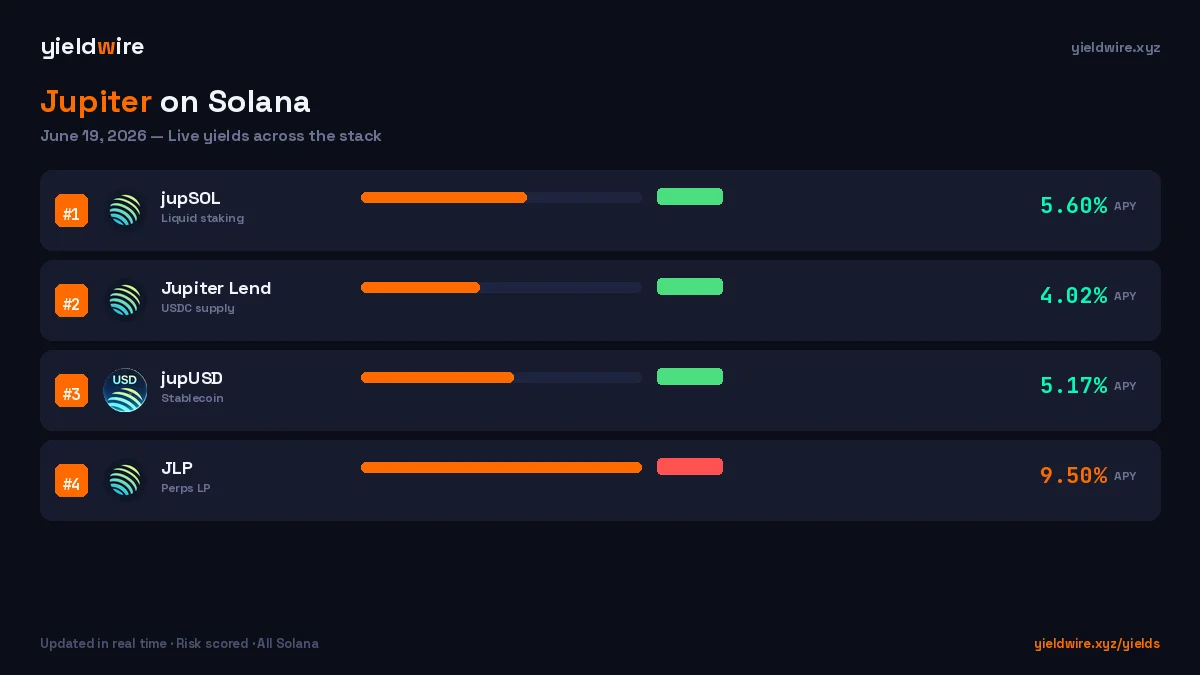
That is four distinct yield surfaces under one brand, each with its own rate, its own risk, and its own answer to the question that matters most: where does the yield actually come from. This post pulls the live numbers and reads them honestly.
The Aggregator Is the Engine, Not the Yield
Start with the swap router, because it explains everything downstream.
Jupiter does not run its own order book or AMM. It scans liquidity across every venue on Solana, Orca, Raydium, Meteora, and dozens of smaller pools, and splits an order across whichever path gives the best execution. That is why it dominates volume. A trader does not need to know which DEX has the deepest book. Jupiter finds it.
The thing to be clear about: routing swaps does not pay you a yield. The aggregator is free to use and Jupiter takes a small fee on some routes, but you cannot deposit into "the aggregator" and earn. The volume matters for a different reason. It is the flywheel that funds everything else. Fee revenue, token value, and the trust that lets users park real money in the lending and staking products all trace back to the fact that Jupiter sits in the default swap path for most of Solana.
So when you see Jupiter described as a yield protocol, the yield is not in the swaps. It is in the three products below.
Jupiter Lend: The Supply Rates
Jupiter Lend is the lending market, and it has scaled fast. At about $877M in TVL it is one of the top lenders on Solana, second only to Kamino in size.
These are the live supply APYs, pulled June 19, 2026. Supply APY is what you earn for lending into the pool. It floats with utilization, so read these as a snapshot.
| Asset | Supply APY | Base | Reward | Pool TVL | Notes |
|---|---|---|---|---|---|
| USDG | 8.06% | 8.06% | 0% | ~$3.8M | High rate, small pool, rate-sensitive |
| jupUSD | 5.17% | 2.63% | 2.53% | ~$74.7M | Half the yield is token rewards |
| USDS | 4.74% | 3.09% | 1.65% | ~$8.1M | Reward-boosted |
| WSOL | 4.57% | 4.57% | 0% | ~$74M | Pure base rate on SOL |
| USDC | 4.02% | 3.28% | 0.73% | ~$415.7M | Deepest pool by far |
| USDT | 3.33% | 3.33% | 0% | ~$19.1M | Lower utilization |
| EURC | 2.38% | 2.38% | 0% | ~$4.7M | Euro stablecoin, thin |
Two things to read carefully.
First, watch the base versus reward split. USDC at 4.02% is almost all base rate, real interest paid by borrowers. jupUSD at 5.17% looks higher, but 2.53% of that is token rewards, which are an incentive Jupiter controls and can cut at any time. Strip the incentive and jupUSD base is 2.63%, below USDC. The headline number is not the durable number. This is the exact reason yieldwire separates base APY from reward APY on every pool. You should know which part of your yield depends on someone keeping the faucet open.
Second, the USDG pool pays 8.06% but holds only $3.8M. Tiny pools throw off high rates because one borrower moves utilization hard. That rate can collapse the moment liquidity arrives or the borrower repays. Deep pools like USDC are slower and more reliable. The $415M USDC market is the one to anchor on if you want a rate you can plan around.
yieldwire scores Jupiter Lend at 75, Grade B, with HIGH confidence. That reflects a real audit history and fast growth, balanced against the fact that the protocol is still young and several markets are running on parameters that have not been stress-tested through a full cycle. Solid, not bulletproof. See the full breakdown on the Jupiter protocol page and compare it against every other lender on the lending yields page.
jupSOL: Liquid Staking, Sanctum Under the Hood
jupSOL is Jupiter's liquid staking token. Deposit SOL, get jupSOL, and the token accrues staking yield while staying liquid enough to use as collateral or trade.
It currently pays about 5.6% APY on roughly $369M in deposits. That rate is base staking yield, no token incentive propping it up, which makes it cleaner than a lot of the headline LST numbers floating around.
The detail worth knowing: jupSOL is powered by Sanctum's infrastructure rather than a standalone validator set Jupiter runs itself. That is normal for newer LSTs and it is not a knock, but it means the staking risk is partly inherited from Sanctum's stake pool design. yieldwire scores jupSOL at 76, Grade B, HIGH confidence, slightly above the lending market, mostly because liquid staking is a more understood risk surface than floating-rate lending.
If you are choosing between Solana LSTs, jupSOL belongs in the comparison alongside jitoSOL and mSOL. The 5.6% is competitive. Run them side by side on the liquid staking page.
JLP: The Highest Yield and the Most Risk
This is the one people chase, and the one most often misread.
JLP is the liquidity-provider token for Jupiter Perps. When you hold JLP, you own a slice of the pool that takes the other side of leveraged traders. The pool holds a basket, roughly 44% SOL, 26% USDC, 11% WBTC, 10% ETH, and 9% USDT, and it earns 75% of all perp trading fees. At about $659M in pool value, it is one of the biggest single yield sources on Solana.
Here is the part that trips people up. JLP does not pay an APY into your wallet. The fees accrue into the pool, which pushes the price of JLP up over time. Your yield is the token appreciating, not a number ticking up in a claim. That is why it shows as 0% APY on most yield trackers. The return is real, it just lives in the price.
How much? It swings hard with trading volume. Recent figures have been in the high single digits to low double digits, around 9 to 10% earlier this year, but the historical range has run anywhere from 20% to 60% in high-volume stretches. There is no fixed rate to quote, and anyone quoting one is quoting a moment.
The catch is the basket. Holding JLP is holding 65% crypto exposure, mostly SOL and BTC. If SOL drops 30%, your JLP drops too, fees or no fees. You are not earning a stable yield on stable principal. You are running a market-making position that pays you to absorb price risk. There is also a subtler edge: when leveraged traders win big, they win against the pool, which dents returns exactly when markets are most volatile.
yieldwire scores the perps product at 60, Grade C, the lowest of Jupiter's four surfaces. That is not a red flag on the contracts, which are battle-tested, it is the honest read that JLP carries real directional and counterparty risk that the headline yield hides. Treat it as a position, not a savings account.
One advanced wrinkle worth flagging: JLP is now accepted as collateral inside Jupiter Lend. Some users borrow jupUSD against their JLP to loop the position and push effective yield higher, up toward 40% in aggressive setups. That stacks lending risk and liquidation risk on top of the basket risk. It can work. It can also unwind fast in a drawdown. If you do not know exactly how the liquidation math behaves when SOL gaps down, do not run it.
Where Each Yield Actually Comes From
Pull it together and the four surfaces tell four different stories.
The aggregator generates volume, not yield. It is the engine that funds the brand. The lending market pays you borrower interest, real and durable on the base rate, with a reward layer on top that can be cut. jupSOL pays you Solana staking yield, clean and steady at 5.6%. JLP pays you trading fees in exchange for holding a leveraged-market-maker position with real price risk, which is why the yield is high and variable.
The yield ladder maps almost perfectly to the risk ladder. jupSOL and base-rate USDC lending sit at the safe end with B-grade scores and mid-single-digit returns. JLP sits at the far end with a C-grade score and a yield that can be triple that, because you are taking on triple the risk. That is not a flaw. It is the whole point. Knowing which rung you are standing on is the only thing that matters.
Run any of these through the yield calculator to see what a position actually returns after the risk is priced in, and check the live security scores before you commit. How those grades are built is documented in our scoring methodology.
Bottom Line
Jupiter is no longer just the swap router. It is a four-product stack, and each product answers the yield question differently. The lending base rates are honest and the USDC pool is deep enough to trust. jupSOL is a clean 5.6% on liquid staking. JLP is a high, volatile return that is really a leveraged market position wearing a yield costume.
Pick the rung that matches your risk. Read the base rate, not the headline. And remember that the high number always comes with the thing the high number is paying you to hold.
Volume, TVL, and supply APY figures pulled from DeFiLlama and on-chain data as of June 19, 2026. Aggregator volume reflects the trailing 24-hour and 30-day windows. JLP basket weights are approximate targets and drift with rebalancing. Security scores derived from yieldwire's scoring methodology. Yields float with utilization and trading volume and change continuously. This is not financial advice.
Track all Solana yields in real time
Compare APYs across lending, LP, and liquid staking protocols on the YieldWire dashboard.
Open Dashboard →