Ethereum Transaction Fees: Reading Base Fee, Priority Fee, and Total Cost
Ethereum transaction fees combine gas used with a base fee and a priority fee. The estimate helps set a budget, but it cannot guarantee inclusion, execution, or the final outcome of a DeFi action.
A fee quote is a budget, not a completion signal
Ethereum wallets often reduce a transaction fee to one number. That is useful for deciding whether to send a transaction, but it hides several distinct pieces of the request. A fee estimate tells the wallet how much ETH may be needed to pay for computation and blockspace. It does not confirm that a transaction will enter the next block, that the contract call will succeed, or that a deposit will create the position shown in an app.
For a DeFi user, separating those questions matters. A transaction can be pending because its offered fee is not competitive. It can be included and still revert because a pool state changed. It can execute successfully while an interface takes time to update a balance. The fee settings concern one layer of that path: how a transaction competes for execution.
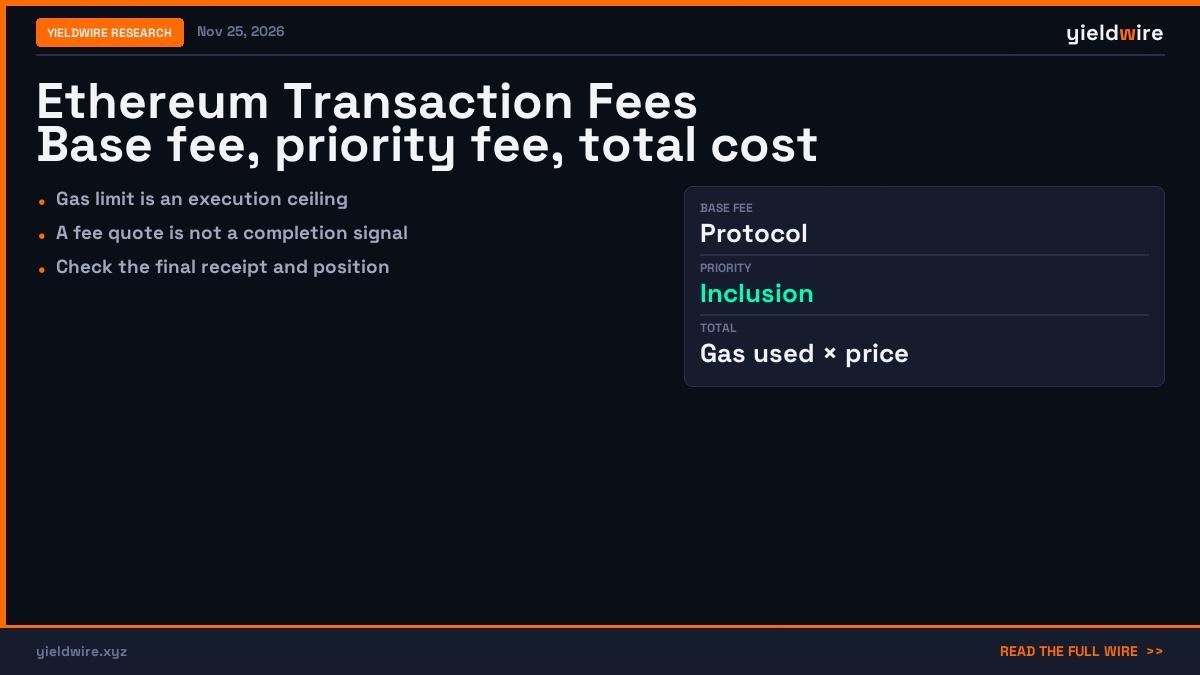
Ethereum.org's gas documentation describes gas as the unit used to measure computational work on the network. Under the EIP-1559 fee model, the total price per unit of gas has two main components: a protocol-set base fee and a priority fee chosen by the sender. The wallet then combines that price with the amount of gas the transaction actually uses.
That framing is more useful than treating a fee quote as a toll. It is a calculation with inputs, limits, and uncertainty.
The values to read before signing
Most EIP-1559 wallet prompts expose some variation of these fields.
| Field | What it represents | What it does not prove |
|---|---|---|
| Gas limit | The maximum gas units the transaction may consume | That the call needs every unit, or that it will succeed |
| Base fee | The protocol-set price per unit of gas for the block | That a transaction will be included at a specific time |
| Priority fee | The amount intended to reward the validator for inclusion | That a validator must select the transaction |
| Max fee per gas | The sender's cap for base fee plus priority fee | The final amount paid or a guarantee of execution |
The basic accounting identity is straightforward:
transaction fee = gas used × effective gas price
The important detail is that gas used can be lower than the gas limit. The gas limit is a ceiling on execution work. If the call finishes after using less gas, the unused portion is not charged as completed work. If a call exhausts the supplied gas, the transaction can run out of gas and its state changes revert, while the gas spent on the attempted execution is still consumed.
Ethereum.org also explains that the base fee changes from block to block according to block demand. A block above its target pushes the next base fee higher; a block below target pushes it lower. The base fee is burned. The priority fee is the part that goes to the validator. Those mechanics explain why a wallet's number can move while a transaction is waiting.
A hypothetical calculation
Use labeled examples instead of importing a live fee quote into a decision. Suppose a simple transaction uses 21,000 gas. Suppose the base fee for the relevant block is 20 gwei and the priority fee is 2 gwei. The effective gas price would be 22 gwei.
21,000 gas × 22 gwei = 462,000 gwei
462,000 gwei = 0.000462 ETH
That is an example of the calculation, not a current network estimate. A contract interaction can use much more gas than a basic ETH transfer because it executes code and may write storage. An approval, a swap, and a vault deposit can each have different gas use even when they are initiated from the same wallet.
Now add a maximum fee setting. A wallet might set a max fee per gas that is high enough to cover a possible base-fee increase, plus a priority fee. This setting is a cap. It is not an instruction to pay the maximum in every case. The effective price remains constrained by the base fee available at inclusion and the priority fee paid to compete for that inclusion.
The distinction is worth keeping in view when an interface displays a large maximum. A maximum fee is part of the authorization the user is signing. It helps a wallet tolerate changes in the base fee. It does not describe a guaranteed final bill.
Gas limit is not the same as total cost
Gas limit and gas price are easy to mix up because they appear together. They answer different questions.
The gas limit answers: how much computational work may this transaction consume before execution stops? The effective gas price answers: how much ETH is paid for each unit of work that is actually consumed? Multiplying them gives an upper-bound style estimate, but the final fee depends on gas used and the effective price at inclusion.
This matters for smart-contract actions. A contract call can take different branches depending on the state it sees when it executes. A route that was valid while a user prepared a swap may have changed by the time it enters a block. A protocol may also impose its own checks, such as a deadline, a minimum output, or a collateral condition. A reasonable gas limit does not make those application-level conditions true.
For that reason, do not increase a gas limit just because a transaction is pending. First identify whether the transaction has been included, whether it reverted, or whether it has not found a block. Those are different states with different evidence.
Why a higher tip is not a safety control
The priority fee is often called a tip. It is part of the fee offer that can make a transaction more attractive for inclusion. It is not a protection against an incorrect recipient, a malicious approval, a price move, or an unfamiliar contract method.
In DeFi, this distinction has practical consequences. A user might increase a priority fee to replace a pending transaction or to compete during a busy period. That action can affect inclusion incentives. It does not change the calldata, token allowance, or protocol risk of the request already being signed.
Read a wallet prompt as a group of separate controls:
- The recipient or contract address identifies where the transaction goes.
- The calldata identifies what function is requested and with which parameters.
- The value field identifies ETH sent with the call, if any.
- The nonce puts the action into the account's transaction sequence.
- The fee fields set the transaction's execution budget and inclusion offer.
Changing one control cannot validate the others. A high priority fee can make a bad transaction happen sooner. It cannot turn it into a safe one.
Pending, included, executed, and confirmed are different states
A wallet can show a transaction as sent immediately after it broadcasts the signed payload. At that point, the network has not necessarily included it in a block. A block explorer or RPC view can help distinguish a pending record from a transaction with a block number and receipt.
After inclusion, a receipt shows whether the EVM execution succeeded or reverted. A successful receipt still does not prove that an application has indexed the position correctly. A vault interface may need to process events before a new balance appears. A lending protocol may show a position only after its own indexer updates.
Use a short evidence sequence instead of treating a wallet toast as final:
- Confirm the transaction hash and the sending account.
- Check whether the transaction has a block number and receipt.
- Read the receipt status and gas used.
- Confirm the intended onchain result, such as an allowance, token balance, or protocol position.
- Compare that result with the exact action the wallet prompt described.
This sequence helps isolate a fee problem from an execution problem. If a transaction is still pending, the fee settings and nonce may be relevant. If it has reverted, inspect the revert context and transaction parameters. If it succeeded onchain but an app looks stale, inspect the onchain state before repeatedly sending more transactions.
Fee settings in a yield workflow
Yield products can involve several transactions: an approval, a deposit, a claim, a withdrawal, or a position adjustment. Each request has its own gas use, fee settings, nonce, and execution risk. A lower quoted fee on the first step does not make the full workflow cheaper or safer if the later steps require more work or if an approval is broader than intended.
Before sending a multi-step action, identify which parts are mandatory and which are optional. Read the contract address and token amount on every prompt. If a transaction is pending, avoid turning repeated clicks into a chain of higher-nonce requests. If a replacement is needed, use the wallet's documented flow and verify the final receipt before assuming the sequence is clear.
On YieldWire's yields page, a displayed rate is only the first layer of research. The security page helps frame protocol controls and dependencies. At the transaction layer, gas settings are another boundary to read carefully: they price execution work, but they do not assess the protocol or validate the action.
A practical wallet-prompt checklist
Before confirming an Ethereum transaction, pause long enough to answer these questions.
| Check | Why it matters |
|---|---|
| Is the destination the contract or recipient you expected? | Fee settings cannot correct a wrong destination |
| Does the method and token amount match the intended action? | A transaction can be included quickly and still authorize the wrong action |
| Is the gas limit supplied by the wallet consistent with the call type? | It is an execution ceiling, not a cost quote by itself |
| Is the maximum fee an acceptable budget if conditions change? | The estimate may move before inclusion |
| Is the transaction pending, included, or reverted? | Each state needs a different response |
| Has the resulting balance or position changed onchain? | A wallet toast is not the final state |
No checklist removes market, contract, or operational risk. It does keep the fee fields in their proper place. Base fee, priority fee, and gas limit are useful technical inputs. They tell Ethereum how much execution work may be bought and how a transaction competes for inclusion. They do not guarantee a fast block, a successful call, or a sound DeFi position.
Source: Ethereum.org, Gas and fees.
This article is educational and is not financial advice. Digital assets and DeFi positions carry risk, including the risk of loss.
Track all Solana yields in real time
Compare APYs across lending, LP, and liquid staking protocols on the YieldWire dashboard.
Open Dashboard →