Ethereum Account Nonces: What They Order and What They Do Not Verify
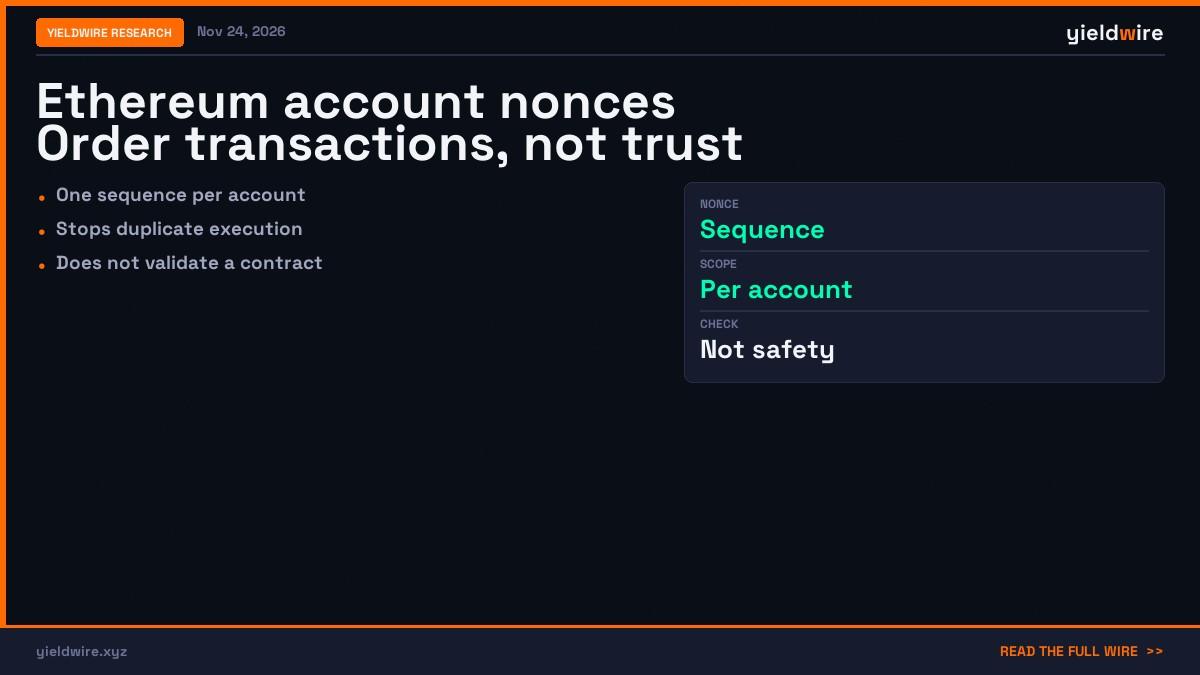
A nonce gives each transaction from an Ethereum account a sequence number. It helps prevent replay and explains pending-transaction order, but it cannot validate a destination, a contract, or a DeFi outcome.
A nonce is a sequence number, not a safety check
Every Ethereum account has a nonce. For an externally owned account, it counts the transactions that account has sent. A wallet includes the next expected nonce when it creates a transaction, and the network uses that number to establish an order for that account's state changes.
The mechanism is easy to overlook because wallets normally manage it in the background. It becomes visible when a transaction stays pending, when a user speeds up or cancels an action, or when several DeFi calls are sent in quick succession. In those moments, the nonce answers a useful operational question: which transaction from this account is supposed to be processed next?
It does not answer the questions that matter for a safe destination. A correct nonce does not prove that a recipient address belongs to the intended person, that a contract call is safe, or that a vault deposit will produce the expected position. It orders a signed request. The rest of the request still needs its own review.
Ethereum.org's account documentation describes the nonce as one of the fields in account state. For user-controlled accounts, it tracks transactions sent. That is a small piece of infrastructure with a large practical consequence: transactions from the same account cannot be treated as independent queue tickets.
What the network checks
Suppose an account's next nonce is 42. A transaction signed with nonce 42 is the next candidate to change that account's state. A transaction signed with nonce 43 may be visible to an RPC provider, but it normally cannot execute before 42 is resolved. The network needs a continuous sequence.
| Transaction | Nonce | Usual result while 42 is unresolved |
|---|---|---|
| Send A | 42 | Can be considered for inclusion |
| Send B | 43 | Waits behind Send A |
| Send C | 44 | Waits behind both earlier transactions |
This rule gives Ethereum a deterministic order for transactions sent by one account. It also prevents the same signed transaction from being executed twice. Once the network has accepted a transaction for nonce 42, another transaction from that account cannot use 42 as an additional independent action.
The rule is local to the sending account. Two unrelated accounts can submit transactions at the same time. Their nonces do not compete with each other. A wallet interface may show a busy global mempool, but the ordering constraint a user encounters most directly is the sequence attached to their own account.
Why the nonce helps stop replay
A transaction carries a signature that authorizes a particular payload. Without a sequence number, someone who saw a valid signed transaction could try to submit it again. The nonce makes that repeat unusable after the original transaction has been accepted. The account has moved to the next expected value.
That protection is specific. It prevents a duplicate execution of the same account action on the same chain context. It does not make every signature safe. A transaction can have the correct nonce and still call an unfamiliar contract, grant an allowance that is too broad, or send funds to an address typed incorrectly.
For a DeFi user, this distinction is useful because wallet warnings often group several concepts together. A prompt may display the nonce, gas settings, recipient, and calldata in one screen. The nonce tells the wallet and network how the request fits the account's sequence. The recipient and calldata determine what the request asks the network to do. Read them as separate fields with separate consequences.
Pending transactions can create a queue
A pending transaction is not necessarily broken. It may simply be waiting for inclusion. But when it uses the account's next nonce, it can hold up later actions from that account. This is why a wallet can show a later transfer or contract call as pending even when its fee settings look reasonable.
Consider a hypothetical sequence:
- A user submits a stablecoin approval with nonce 42.
- The approval remains pending because the fee settings are no longer competitive.
- The user submits a vault deposit with nonce 43.
- The deposit waits because the approval transaction has not resolved.
The deposit is not necessarily rejected. It is behind a gap. If the first transaction is included, the next transaction can move forward. If the first transaction is replaced or cancelled, the outcome for the later transaction depends on the final sequence and the contract conditions at execution time.
This is also why repeated clicks can create confusion. A wallet may create a new transaction each time an interface is asked to retry. Those requests can receive successive nonces. The safest response to an unclear pending state is to inspect the account's transactions before generating more of them, not to assume each click replaces the prior one.
Replacement is not the same as a second action
Wallets commonly offer a speed-up or cancellation flow for a pending transaction. In general, that flow creates another transaction with the same nonce and different fee settings or contents. Nodes then apply their replacement policies when deciding which version to propagate and include.
The exact interface varies by wallet and RPC provider, so a user should follow the wallet's documented flow rather than manually copying parameters from an explorer. The key concept is simpler: the new transaction is attempting to occupy the same place in the account sequence. It is not an extra action after the first one.
A cancellation request also deserves care. It can free the sequence only if the replacement is accepted and included. Until then, a wallet may show competing transactions for the same nonce. Do not interpret a local wallet label as final confirmation. Check the final receipt and the account's current transaction count in a trusted explorer or RPC view.
Ethereum.org's transaction guide explains that a transaction is a signed instruction that changes EVM state when it executes. A nonce is one field in that instruction. It is not a receipt, an execution result, or a promise that the requested contract action will succeed.
Four claims a nonce cannot support
It helps to name the boundaries explicitly.
| A nonce can help establish | A nonce cannot establish |
|---|---|
| The order of transactions sent by one account | That the recipient is correct |
| Whether a later account transaction is waiting behind an earlier one | That a contract is audited or safe |
| Whether a replacement targets the same place in the sequence | That a contract call will avoid a revert |
| Why a prior signed transaction cannot execute again after acceptance | That an application has indexed the result |
The last point matters in yield workflows. A lending interface can display an optimistic balance before a transaction is included. An indexer can also take time to display an included transaction. Neither interface delay changes the nonce rule, but neither can be resolved by looking at the nonce alone.
For an approval or deposit, review the contract address, the method being called, the token amount, and the final receipt. Then confirm the resulting allowance, balance, or protocol position. That sequence avoids giving a single metadata field more authority than it has.
A practical check when an action is stuck
When a wallet shows several pending actions, work from evidence rather than color labels.
- Open the oldest pending transaction from the account in a reputable explorer.
- Note whether it has a block number, a receipt, or only a pending record.
- Compare its nonce with the nonce on the later transactions.
- If later actions have higher nonces, expect them to wait until the earlier sequence position resolves.
- Use the wallet's own replacement flow if action is needed, then wait for an included receipt before treating the sequence as clear.
- Recheck the intended balance, allowance, or DeFi position after the relevant transaction executes.
This is a diagnostic workflow, not a recommendation to change fees or cancel a transaction. Network conditions, wallet behavior, and protocol deadlines differ. The aim is to identify whether the problem is ordering, inclusion, execution, or an application display delay.
Where this fits in a yield-risk review
Yield comparison starts with return, liquidity, and protocol controls. The route into a position is another layer of operational risk. A user can select a strong protocol and still make a poor decision by confusing a pending approval with a completed deposit, or by replacing the wrong transaction without reading the sequence.
On YieldWire's yields page, treat a displayed rate as the start of due diligence rather than the whole position. The security page provides a protocol-level view of controls and dependencies. At transaction level, the equivalent habit is to distinguish authorization, ordering, inclusion, execution, and the final state a protocol interface displays.
The nonce is valuable precisely because it is narrow. It tells Ethereum how to order an account's requests and blocks duplicate execution of the same sequence position. It does not validate the request's destination or economics. Keeping that boundary clear makes a pending wallet state easier to diagnose and a DeFi action easier to verify.
Source: Ethereum.org, Accounts and Ethereum.org, Transactions.
This article is educational and is not financial advice. Digital assets and DeFi positions carry risk, including the risk of loss.
Track all Solana yields in real time
Compare APYs across lending, LP, and liquid staking protocols on the YieldWire dashboard.
Open Dashboard →