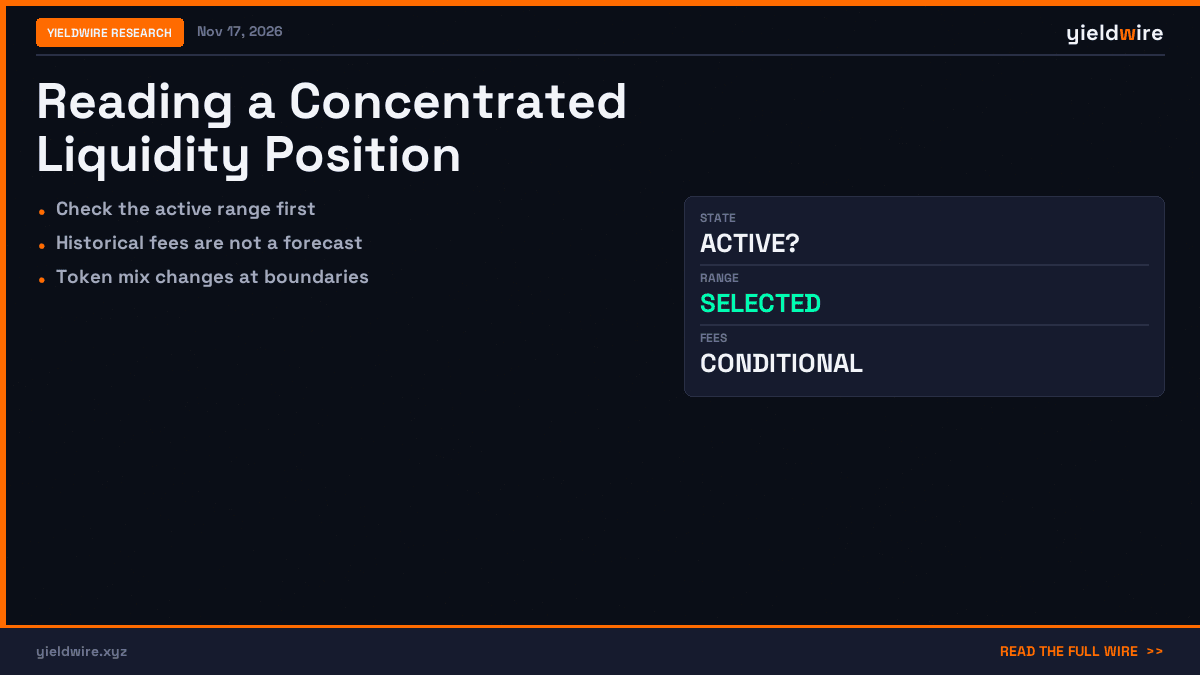
Reading a Concentrated Liquidity Position Beyond Historical Fees
A concentrated liquidity position only earns swap fees while its selected price range is active. Learn how to read the range, the token mix, and fee history without turning a dashboard number into a forecast.
Historical fees are a record, not a position status
A concentrated liquidity dashboard can show a large fee total beside a position that is currently doing nothing. That is not a contradiction. Fees are earned only when the pool price trades inside the range chosen for that position. The fee number records what happened while liquidity was active. It does not confirm that the position is active now, and it does not predict what it will earn next.
That distinction is easy to miss because a position normally displays one compact card: deposited tokens, a price range, uncollected fees, and a return figure. Each field answers a different question. Reading them as one yield number turns a trading position into something it is not.
Uniswap describes concentrated liquidity as liquidity assigned to a chosen price interval instead of being distributed across all possible prices. Within that interval, a position provides liquidity and can earn fees from swaps. Outside it, the position is inactive and no longer earns swap fees until price returns to the selected range.
The first task is therefore simple: locate the current pool price and compare it with the lower and upper prices on the position. Do that before looking at annualized fee estimates or a historical return.
The active-range test
Every concentrated position has three relevant prices:
| Field | What it means | What to check |
|---|---|---|
| Lower price | The bottom of the selected range | Is the current price above it? |
| Current price | The pool price at the time you read the position | Is it between both boundaries? |
| Upper price | The top of the selected range | Is the current price below it? |
If the current price sits between the lower and upper prices, the position is active. It is supplying liquidity at the current trading price and is eligible to collect its share of swap fees. Eligibility is not the same as a guaranteed amount. Actual fees still depend on trading volume, the fee tier, and how much competing liquidity is active at the same prices.
If the price is below the lower boundary or above the upper boundary, the position is inactive. It remains on-chain and can still be closed or adjusted, but it is not earning new swap fees from the pool at that moment. A fee counter can keep the fees accumulated earlier, which is why a high historical total should never be used as evidence of present activity.
Consider a labeled example, not a market quote. A position in an ETH/USDC pool could select a range from $2,000 to $2,400. At a current pool price of $2,200, it is active. At $2,500, it is outside its range. The position has not disappeared, but it has stopped participating in swaps until price returns below $2,400 or the owner creates a new range.
The same test applies to any concentrated liquidity implementation, including Solana CLMMs. Interfaces differ, and some display ticks instead of a human-readable price, but the economic question is unchanged: does the pool price sit inside the interval that this capital covers?
Why token balances change near the boundaries
A second source of confusion is the token mix. A two-token deposit does not stay a fixed 50/50 portfolio while the price moves through a concentrated range. As the pool price approaches one boundary, the position is gradually exchanged into more of one asset and less of the other.
For a pair quoted as token0 per token1, the direction matters, so check the interface's quote convention before drawing conclusions. Conceptually, though, the pattern is consistent. At one end of a range, the position becomes almost entirely one token. At the other end, it becomes almost entirely the other. Once price moves beyond a boundary, it is effectively held in the corresponding single asset and is inactive for fees.
This is why an out-of-range position is not just a paused income stream. Its exposure may be materially different from the deposit you remember making. A SOL/stablecoin position that ends above its range, for example, may have converted toward the stablecoin side. A move below the range can concentrate it toward SOL. The exact direction depends on the quoted price and token order, so the interface and on-chain position data are the final reference.
Do not treat that conversion as a bug. It is part of the automated market maker mechanism. The more useful question is whether the resulting asset exposure still matches your risk plan.
Range width is a trade-off, not a yield setting
A narrow range places the same capital across fewer prices. If trading remains inside that range, the position can have more liquidity near the current price than a wide-range position with the same deposit. That can increase its share of fees while it is active.
The cost is less room for price movement. A narrow range can become inactive after a relatively small move. It may also shift into a one-sided token balance quickly. A wide range has more room to remain active, but spreads capital over more prices and may collect a smaller share of fees at any one price.
Neither choice is automatically better. A range is an expression of a view about volatility, time horizon, and how often the owner can monitor or adjust the position. It should not be chosen from the highest displayed annualized rate alone.
| Range choice | Potential benefit | Main trade-off |
|---|---|---|
| Narrow | More capital is concentrated near the current price | Can become inactive quickly |
| Wide | More room for price movement before leaving the range | Less concentration at the current price |
| Full range | Minimal range-management burden | Less capital concentration than a selected interval |
For a passive holder, the management burden matters as much as the visualized APY. Repositioning requires a transaction, a new range choice, and a decision about the now-changed token mix. On chains or periods with meaningful transaction costs, those actions can also reduce realized returns.
Read fee figures in the right order
A position page may show collected fees, uncollected fees, daily fees, and an annualized estimate. These should not be interpreted as interchangeable.
Start with the position state. If it is out of range, a trailing daily or weekly fee chart describes a past interval, not a current rate. Then inspect the period used by the interface. A seven-day figure annualized into a headline APY assumes that the same volume, price location, and liquidity competition continue. Those inputs often change.
Next, separate gross fees from your economic result. Gross fees are the swap fees attributed to the position. They do not account for changes in the value of the tokens held, price impact from rebalancing, transaction costs, protocol fees, or any incentive program that may expire. The difference matters most in volatile pairs, where a position can earn fees while its asset exposure moves away from a simple hold strategy.
Finally, check whether the fee amount is collected or merely accrued. Accrued fees are owed by the pool mechanics but may still require a transaction to collect. Collection is an operational step, not proof that the position remains active.
A position review that takes two minutes
Use this sequence before relying on a concentrated-liquidity yield figure:
- Confirm the pool and fee tier. Similar token pairs can have different tiers and separate liquidity.
- Read the lower price, current price, and upper price using the same quote convention.
- Label the position active or inactive before considering fee history.
- Inspect the current token balances. Compare them with the assets you are willing to hold if price keeps moving.
- Check the period behind any displayed fee estimate and whether the amount is gross, accrued, or collected.
- Decide whether a new range would be a deliberate allocation change, not an automatic response to a red status label.
This is a review framework, not a trading instruction. Moving a range can lock in a changed token mix and creates new exposure. Leaving it unchanged can mean no fee income for an unknown period. The relevant choice depends on the asset pair, the owner's liquidity needs, and the risk they are prepared to carry.
What concentrated liquidity does not solve
Concentrated liquidity can make capital more efficient when it is active. It does not remove smart-contract risk, token risk, depegs, manipulation risk in thin pools, or the possibility of losses relative to holding the assets. It also does not turn a historical fee chart into a stable yield product.
For yield research, that is the central takeaway. A useful position review connects the range state, token composition, fee history, and risk exposure. Looking at only one of them produces a number that feels precise but leaves out the mechanism that generated it.
Before depositing, compare the position's mechanics with alternatives such as lending or staking on YieldWire's yields page, and review the relevant protocol controls on the security page. The higher displayed rate is not automatically the better risk-adjusted option.
Source: Uniswap developer documentation on concentrated liquidity.
This article is educational and is not financial advice. Digital assets and DeFi positions carry risk, including the risk of loss.
Track all Solana yields in real time
Compare APYs across lending, LP, and liquid staking protocols on the YieldWire dashboard.
Open Dashboard →