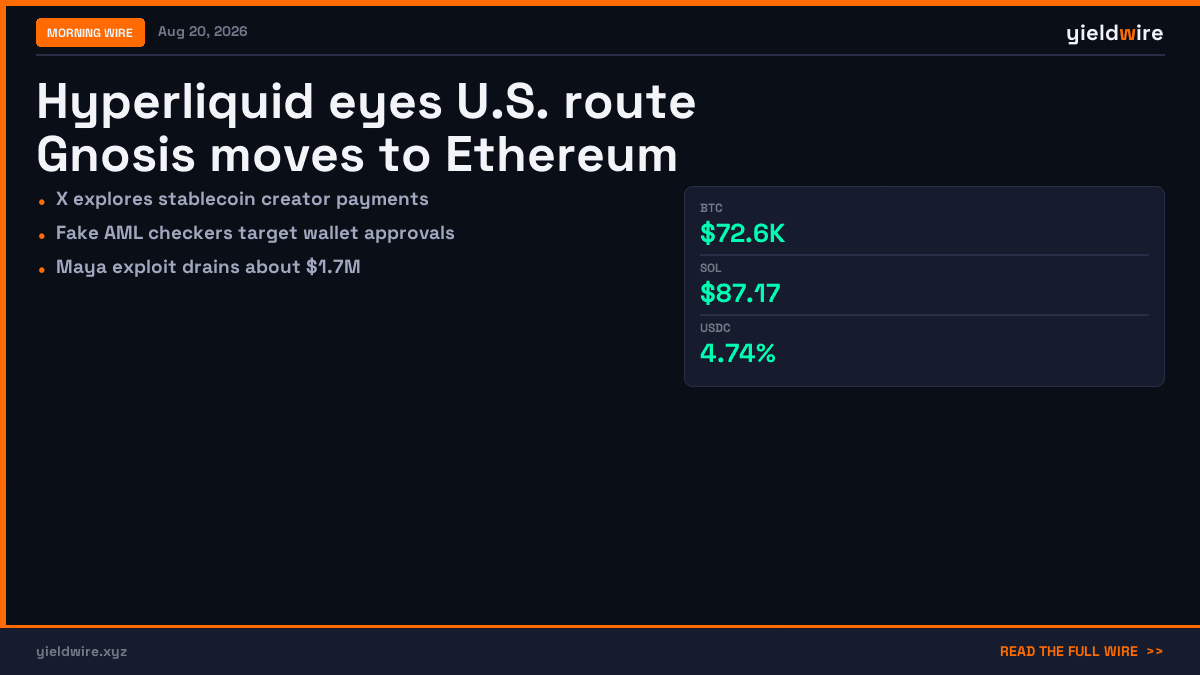
The Wire: August 20, 2026
U.S. regulators discussed a compliant route for Hyperliquid as stablecoin payments, security threats and Ethereum consolidation moved forward.
The Wire: August 20, 2026
U.S. regulators are discussing a compliant route for Hyperliquid
President Donald Trump said CFTC Chair Michael Selig is working on bringing Hyperliquid into the United States in a compliant legal structure. HYPE rose as much as 25% over 24 hours after the comment, while three U.S.-listed Hyperliquid products gained close to 20%. No CFTC approval exists and Trump did not describe the structure. A regulated route could widen institutional access to onchain perpetuals, but it would not remove liquidation, oracle or venue-concentration risk. Regulation changes market access; it does not make leverage safer. Source: Unchained, published August 20 at 10:17 UTC. Compare market and operational factors in yieldwire risk scores.
X is exploring stablecoins for creator and content payments
X is considering stablecoins as a way to pay influencers and content providers. A platform with global users has a clear reason to test tokenized dollars: settlement can run continuously and recipients do not need the same banking setup in every market. Discussions are ongoing, and no final issuer or payment rail has been announced. The open questions are how redemptions would work and whether balances would remain custodial inside X. Distribution could expand stablecoin usage, but payment volume alone does not make the underlying reserve structure safer. Source: Cointime, published August 20. Compare live opportunities on the yield dashboard.
The OCC aims to finalize U.S. stablecoin rules by November
Office of the Comptroller of the Currency head Jonathan Gould said the agency expects to publish final rules for payment stablecoins by November. The framework will implement the GENIUS Act and cover reserves, redemption at par, liquidity, audits, custody, supervision and the wind-down of failed issuers. The law takes effect in January 2027, when only permitted issuers will be able to offer payment stablecoins to Americans. Clear rules can reduce legal uncertainty, but compliance does not erase reserve, custody or smart-contract risk. Source: Decrypt, published August 20 at 09:31 UTC. Compare operational factors in yieldwire risk scores.
Fake AML checkers are trying to turn compliance anxiety into wallet approvals
Malwarebytes identified websites impersonating crypto compliance services and asking users to connect wallets for supposed anti-money-laundering checks. A legitimate basic check only needs a public address. It should not require a wallet connection, token approval or signed transaction. The fake sites simulate a scan, show reassuring results and then create an opportunity for the victim to approve a malicious action. The pattern matters for DeFi users because a professional-looking risk screen can become the attack surface itself. Source: Decrypt, published August 20 at 13:31 UTC. Review the pre-deposit checklist before signing.
GnosisDAO approved a move from its own validator set to Ethereum settlement
GnosisDAO voted to turn Gnosis Chain into a zero-knowledge Ethereum Economic Zone rollup. The proposal received 123,158 GNO in support, with 115 against and 151 abstaining, and targets a launch in late 2026 or early 2027 if the required technology is ready. The change would retire the chain's independent validator set and use Ethereum for settlement. That could improve access to Ethereum liquidity and reduce bridge dependence, but it also changes the trust, fee and liveness assumptions for every protocol deployed on Gnosis. Source: Cointelegraph, published August 20 at 08:59 UTC. Use the risk dashboard to compare infrastructure dependencies.
Maya Protocol halted after an exploit drained about $1.7 million
Maya Protocol stopped its cross-chain network after an attacker used six software flaws to drain about 20 BTC and another $300,000 in assets. The post-mortem said the attacker inflated a liquidity pool by 49.45 million CACAO, gained 99.93% control and withdrew 48.87 million CACAO. Halting the network contained further losses, but it also showed the operational risk behind cross-chain liquidity: one accounting failure can affect several assets and interrupt exits. High swap fees or liquidity rewards do not compensate for a pool whose solvency assumptions can be manipulated. Source: Decrypt, published August 19 at 18:20 UTC. Review the pre-deposit checklist.
Numbers (Updated)
- BTC: $72,566 (+6.6%)
- SOL: $87.17 (+6.6%)
- ETH: $2,315 (+12.1%)
- Solana DeFi TVL: $5.29 billion
- Established Solana USDC yield: Jupiter Lend at 4.74% APY on $444.2 million TVL
Explore all Solana yields · Risk scores · Follow @yieldwirexyz
Track all Solana yields in real time
Compare APYs across lending, LP, and liquid staking protocols on the YieldWire dashboard.
Open Dashboard →