The Wire — July 27, 2026
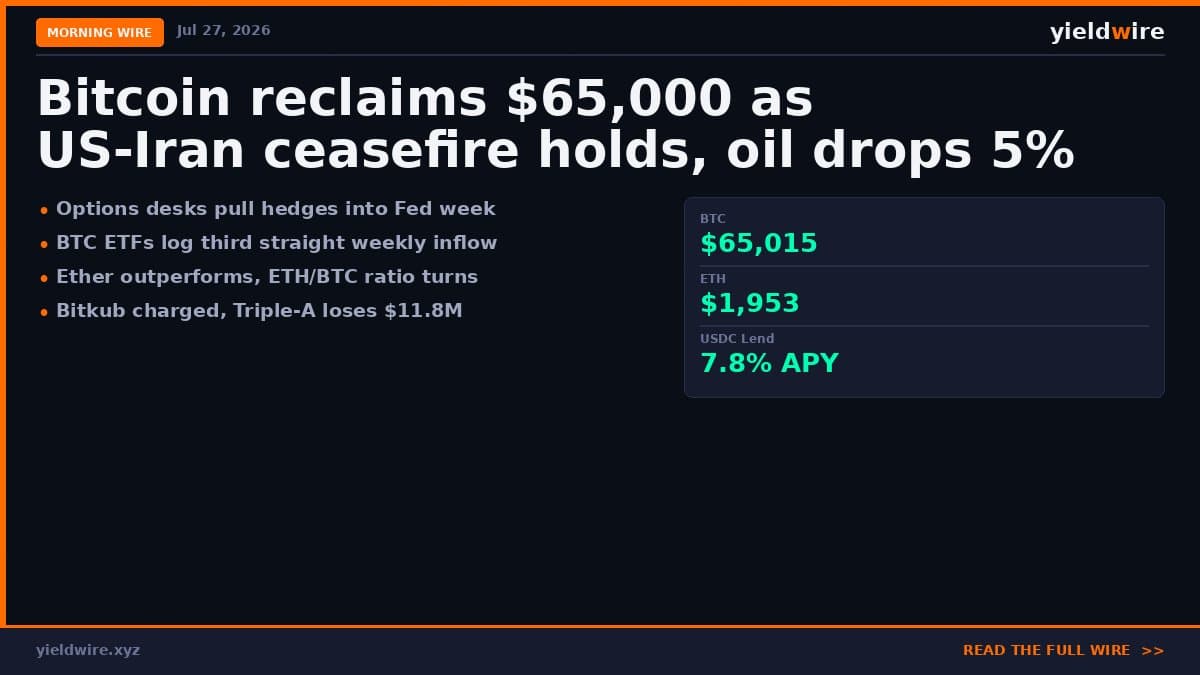
Bitcoin reclaims $65,000 as a US-Iran ceasefire holds and oil drops 5%, while ether outperforms the majors and two custody failures land in the same week.
The Wire — July 27, 2026
Bitcoin reclaims $65,000 as a US-Iran ceasefire holds and oil drops 5% Bitcoin traded back above $65,000, near $65,015 on the day, after the United States and Iran held their fire and crude fell about 5% on the cooldown. Cheaper oil eases one of the inflation inputs the Fed watches, and a step down in geopolitical risk pulled capital back toward risk assets over the weekend. The read for onchain lenders is straightforward. A firmer bitcoin steadies the collateral that backs borrowing across major markets, and that supports the supply-side APYs stablecoin lenders earn rather than the borrow-driven rates that spike and fade. Source: CoinDesk, published July 27. How we score lending risk
Options desks pull their hedges going into this week's Fed meeting Bitcoin options traders have been cutting downside protection ahead of the Federal Reserve's rate decision this week, a positioning shift that says desks are leaning into the meeting rather than bracing for it. Fewer hedges means less pressure from forced selling if the market wobbles, but it also leaves positioning thinner if the Fed surprises. The setup matters for anyone earning yield on borrowed capital. When hedges come off into an event, funding and perp rates can swing hard on the outcome, which is exactly the kind of reward-yield volatility that looks generous on a screen and disappears within a session. Source: CoinDesk, published July 27. See how base yield differs from reward yield
Bitcoin ETFs post a third straight weekly inflow despite $465 million in late-week losses US spot bitcoin ETFs recorded net inflows for a third consecutive week even after roughly $465 million left the funds over the final two sessions, with BlackRock's IBIT leading the late outflows. The weekly net stayed positive, so the flow trend holds, but the back-end reversal shows how quickly institutional appetite can turn inside a single week. Sustained ETF demand is part of what has kept bitcoin's bid firm through the recent macro noise, and a steady spot bid is the quiet support under the collateral values that lending markets price against. Source: CoinDesk, published July 27.
Strategy extends its bitcoin-buying pause to five weeks and sells $544.5 million in MSTR Strategy bought no bitcoin for a fifth straight week while raising its US-dollar reserve to $3.75 billion and selling $544.5 million in MSTR stock. The company that turned aggressive bitcoin accumulation into a corporate template is now sitting on cash and trimming equity instead of adding to its stack. Michael Saylor has teased "another color," hinting at a new instrument, but for five weeks the largest corporate holder has been a spectator rather than a buyer. When the marginal buyer that markets leaned on goes quiet, spot demand has to come from somewhere else, which is why this week's ETF and ceasefire bids matter more. Source: The Block, published July 27.
Ether outperforms the majors, up nearly 4% as the ETH/BTC ratio turns Ether led the majors higher, climbing about 3.7% to near $1,953 while bitcoin added under 1%, pushing the ETH/BTC ratio up in a move Fundstrat's Tom Lee reads as a signal of stronger crypto prices ahead. BitMine kept adding to its ether treasury on the same thesis. A rising ratio has historically marked periods when capital rotates down the risk curve from bitcoin into ether and the assets that trade off it, including staked ETH and the restaking markets built on top. For yield, that rotation tends to lift borrowing demand for ETH first, which feeds base lending rates rather than incentives. Source: CoinDesk, published July 27. Compare ETH yields
Two custody failures land in the same week: Thailand charges Bitkub, Triple-A loses $11.8 million Thailand's SEC filed a criminal complaint against exchange Bitkub and two former directors, alleging they left a roughly $47 million theft out of the firm's 2021 disclosures. Separately, stablecoin payments company Triple-A confirmed a treasury-wallet breach with losses climbing to $11.8 million as attackers kept sweeping new deposits, though it says client funds are unaffected and the hit will be absorbed through reserves. Different failures, one lesson. Neither loss came from a broken smart contract. One was a disclosure and custody failure at a centralized venue, the other an operational key compromise, and off-core infrastructure like this is exactly what our risk scores weight most heavily. Source: Decrypt and CoinDesk on Bitkub, The Block and Cointelegraph on Triple-A, published July 27. How we score protocol risk
Solana yields hold as SOL climbs to $76 Solana DeFi total value locked sits near $4.9 billion while SOL rose about 2.5% to $76.53 on the day. Stablecoin lending stays the base layer. On live pricing, Kamino's USDC market shows a headline near 7.8% on a thin pool close to $2.3 million, while the deepest book, Jupiter Lend, quotes about 5.5% on roughly $415 million in USDC. The gap is the point we make on every market. A large APY on a small pool is a different product from a modest APY on a deep one, and depth is part of the risk you are underwriting. When the token rises but the base USDC rate barely moves, the yield is coming from real borrowing demand rather than from price. Source: DeFiLlama live data, July 27. Explore all Solana yields
Numbers
- BTC: $65,015 (+0.8%)
- SOL: $76.53 (+2.5%)
- ETH: $1,953 (+3.7%)
- Solana DeFi TVL: $4.9B
- Top USDC yield (Solana): Kamino Lend at 7.8%, Jupiter Lend at 5.5% on deeper liquidity
Explore all Solana yields . Risk scores . Follow @yieldwirexyz
Track all Solana yields in real time
Compare APYs across lending, LP, and liquid staking protocols on the YieldWire dashboard.
Open Dashboard →