The Wire — July 26, 2026
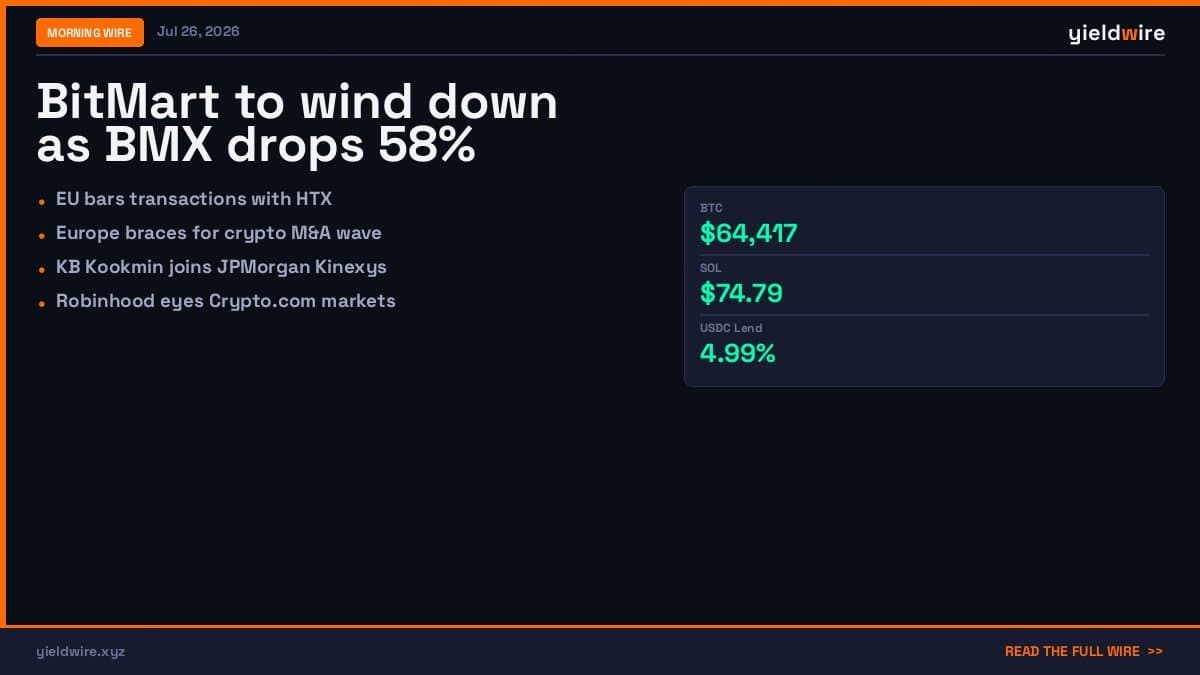
BitMart becomes the second major exchange in a week to announce a shutdown as its BMX token drops 58%, while the EU bars transactions with HTX and Europe braces for a wave of crypto M&A.
The Wire — July 26, 2026
BitMart to wind down after nine years as BMX drops 58% BitMart said it will shut down, the second centralized exchange in a single week to announce a closure. The platform stopped new registrations, deposits, and trading orders at 01:30 UTC Sunday, will end all spot and derivatives trading on August 26, and will formally cease operations on January 31, 2027. Users have one month to close positions and six months to withdraw. Its BMX token fell about 58 percent in 24 hours to roughly 8 cents, cutting its market value to near $27 million, and some traders reported USDT withdrawals stuck pending for hours. It follows BitMEX, which said days earlier it would close after 11 years. For anyone parking assets on a centralized venue to earn yield, the week is a blunt reminder that counterparty risk is the first risk, and it sits above every advertised rate. Source: CoinDesk, published July 26. How we score risk →
EU bars transactions with HTX in its largest sanctions batch in four years The European Union added HTX to its list of platforms accused of helping Russia move funds around sanctions, with a transaction ban taking effect August 23. The measure is part of the bloc's 21st sanctions package, adopted July 23, which designated 218 individuals and entities, the largest batch in four years. It stops short of a full asset freeze, and eligible EU, EEA, and Swiss residents can apply to withdraw funds or close accounts within three months of the ban. Platforms including EXMO, Rapira, and BitPapa were named alongside HTX. Compliance exposure keeps widening for any venue that touches sanctioned flows, and that risk sits upstream of whatever yield a user finally sees. Source: The Block, published July 25.
Europe's compliance costs set up a crypto M&A wave With the race for MiCA licenses largely over, Europe's rulebook is entering a phase defined by the ongoing cost of staying compliant, and analysts expect that to drive mergers between crypto-native firms and established banks. Lenders already carry the compliance infrastructure that smaller shops struggle to fund, and fewer than 20 percent of European banks currently offer any crypto service, leaving the market underserved. Kraken is pursuing a banking license in Europe, which would make it the only crypto exchange with that designation. Consolidation tends to concentrate custody and lending flows into fewer, larger balance sheets, which matters for where onchain and offchain yield ultimately gets sourced. Source: CoinDesk, published July 26.
South Korea's largest bank puts cross-border payments on JPMorgan's Kinexys KB Kookmin Bank, South Korea's biggest lender with $552 billion in assets, will launch a blockchain-based cross-border payment service on JPMorgan's Kinexys platform for US dollar settlement across 10 countries, starting in August. Kinexys, formerly Onyx, has processed more than $4 trillion to date and settles using JPM Coin, a bank-issued deposit token that moves around the clock. The steady march of tokenized bank money is the quiet backbone of onchain settlement, and deeper institutional dollar rails are what eventually let regulated yield products scale. Source: Cointelegraph, published July 26.
Robinhood weighs Crypto.com event contracts as prediction markets heat up Robinhood is in talks with Crypto.com to offer the exchange's yes-or-no event contracts to its users, according to the Wall Street Journal, a move that would put it in more direct competition with its current partner Kalshi. Robinhood launched its prediction markets hub in 2025 through Kalshi to meet CFTC requirements, and Bernstein now projects the segment could bring in $1.7 billion in revenue by 2028. The talks may not lead to a deal. Prediction markets are becoming a core venue for onchain-adjacent speculation, and the capital they pull in competes for the same dollars that fund lending and liquidity. Source: Cointelegraph and The Block, published July 26.
Solana lending yields hold steady as DeFi TVL sits near $4.85 billion Solana DeFi TVL stood at about $4.85 billion this morning with SOL near $75. On the lending side, USDC supply rates are compressed and stable. Jupiter Lend is paying about 4.99 percent on roughly $415 million of deposits, the deepest USDC market on the chain, while Kamino's main USDC reserve prints near 6.68 percent on thinner liquidity. Smaller venues like Loopscale quote higher, above 7 percent, but on TVL under $2 million, where a single large withdrawal can move the rate sharply. When the base rate holds while the token barely moves, the yield is being paid by real borrowing demand, not by price. Source: DeFiLlama yields, live data. Compare Solana lending yields →
Numbers
- BTC: $64,417 (+0.6%)
- SOL: $74.79 (+1.2%)
- ETH: $1,884 (+1.2%)
- Solana DeFi TVL: $4.85B
- Top USDC yield (Solana): Jupiter Lend at 4.99%
Explore all Solana yields → · Risk scores → · Follow @yieldwirexyz
Track all Solana yields in real time
Compare APYs across lending, LP, and liquid staking protocols on the YieldWire dashboard.
Open Dashboard →