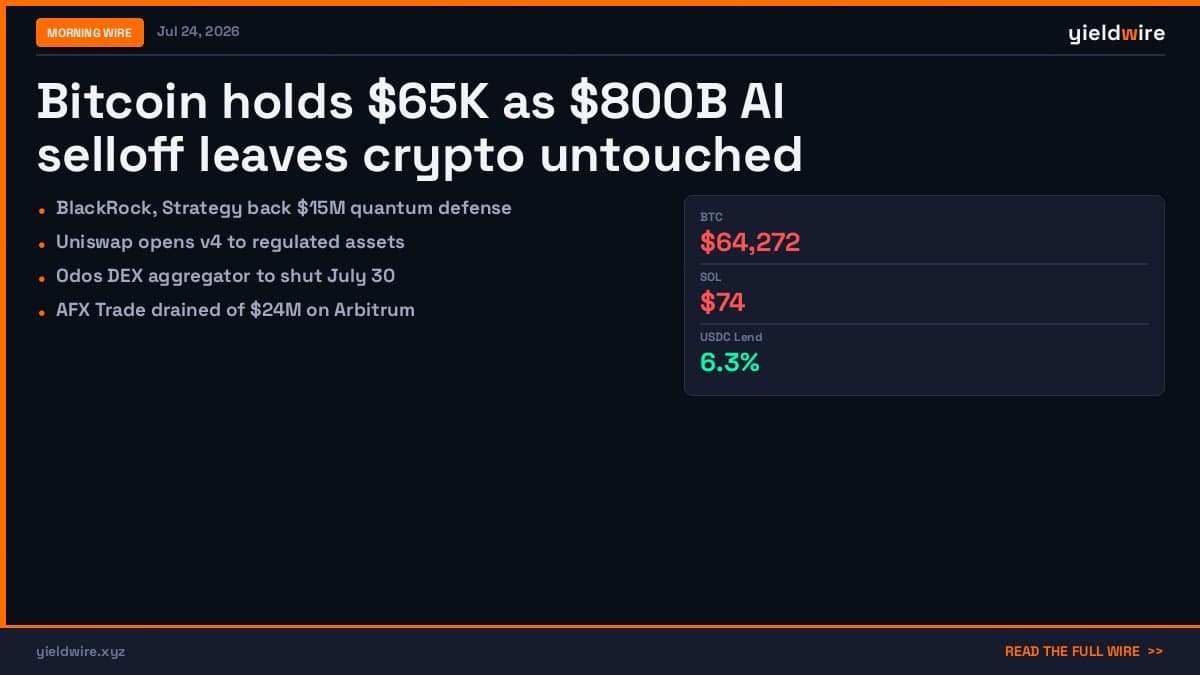
The Wire — July 24, 2026
Bitcoin holds near $65,000 while an $800 billion selloff in AI stocks leaves crypto largely untouched, as institutions fund quantum defense and Uniswap opens v4 to regulated assets.
The Wire — July 24, 2026
Bitcoin holds near $65,000 as an $800 billion AI selloff leaves crypto largely untouched Bitcoin traded just above $64,000, holding the $65,000 area it has defended all week, even as roughly $800 billion was wiped from AI-linked equities in a single session. The divergence is the story. For most of the past two years crypto has moved as a high-beta version of tech stocks, so a drawdown that size would normally drag BTC lower with it. This time the correlation broke. A steadier bid under bitcoin during an equity rout tends to firm up collateral values across lending markets, which supports the supply-side APYs that stablecoin lenders earn rather than the leverage-driven rates that spike and fade. Source: CoinDesk, published July 24. How we score lending risk →
BlackRock, Coinbase and Strategy back a $15 million Bitcoin Security Consortium Nine firms, including BlackRock, Coinbase, Strategy, Fidelity Digital Assets, Galaxy, Block, Blockstream, Anchorage Digital and ARK Invest, pledged $15 million over three years to fund bitcoin's open-source security work, with a focus on post-quantum cryptography. Brink's Mike Schmidt will coordinate the effort day to day. The money will not sit with the consortium. Members choose which developers and researchers to fund, and the group says it will not direct protocol development or take sides on proposed changes. Quantum machines cannot break bitcoin's signatures today, but a migration to quantum-resistant cryptography is widely seen as the hardest upgrade the network could face, and this is the first coordinated institutional effort to pay for that work in advance. Source: The Block and CoinDesk, published July 23.
Solana yields hold steady as SOL slips below $75 Solana DeFi total value locked sits near $8.08 billion even as SOL fell about 3.6% to $74.40 on the day. Stablecoin lending remains the base layer. On live pricing, Kamino's USDC market pays about 6.32% on supplied capital, while the deepest book, Jupiter Lend, quotes near 4.95% on roughly $419 million in USDC. Loopscale shows a higher 7.18% headline but on a far thinner pool close to $1.5 million. The spread is the point we make on every market. A large APY on a small pool is a different product from a modest APY on a deep one, and depth is part of the risk. When the token drops but the base USDC rate barely moves, it is a clean read that the yield is coming from real borrowing demand rather than from price. Source: DeFiLlama live data, July 24. Explore all Solana yields →
Uniswap brings permissioned pools to v4 for regulated assets Uniswap introduced Permissioned Pools, a hook standard for v4 that enforces investor eligibility onchain rather than through a frontend gate. The pool itself checks whether a wallet sits on the issuer's allowlist before any swap or liquidity action clears, and the check applies to both trading and providing liquidity. Launch partners include Superstate, Securitize and Dowgo. The design lets tokenized funds, securities and equities trade on an automated market maker while staying inside their compliance rules, which is the piece institutions have said was missing. For onchain yield, permissioned RWA pools are where regulated capital and DeFi rails finally meet, and the tokenized-asset market is projected to reach $11 trillion by 2030. Source: The Defiant and CoinDesk, published July 23. See RWA yields →
Odos Protocol will shut down on July 30 DEX aggregator Odos said it will end operations on July 30 and switch its app to read-only mode on July 27, giving users a short window to withdraw funds or export private keys from social and email-login wallets. The token and DAO will keep running on-chain, but there will be no further development, support or maintenance. The numbers explain the decision. Odos routed about $7.8 billion in monthly volume at its December 2024 peak and roughly $169 million in July 2026, a drop of more than 97%. Aggregators live and die on flow, and a venue that thin cannot fund its own upkeep. For users the takeaway is operational: check any Odos-linked positions and move assets before the cutoff. Source: Cointelegraph, published July 24.
Arbitrum perp DEX AFX Trade drained of $24 million through a compromised bridge AFX Trade lost about $24.15 million in USDC after an attacker compromised the validator signing keys on the platform's third-party bridge, then moved the funds to Ethereum and swapped them for roughly 12,467 ETH at around $1,937 each. Arbitrum's own bridge was not touched. AFX offered the attacker a 30% white-hat bounty, close to $7.2 million, to return the other 70%. It is the second hit on an Arbitrum perp venue in a week, after Ostium lost $18 million to a compromised oracle key. The pattern is the warning. The trading contracts held, but the bridge and oracle keys around them did not, and that off-core infrastructure is exactly what our risk scores weight most heavily. Source: Decrypt and CoinDesk, published July 23. How we score protocol risk →
Numbers
- BTC: $64,272 (-1.2%)
- SOL: $74.40 (-3.6%)
- ETH: $1,864 (-2.8%)
- Solana DeFi TVL: $8.08B
- Top USDC yield (Solana): Kamino at 6.32%
Explore all Solana yields → · Risk scores → · Follow @yieldwirexyz
Track all Solana yields in real time
Compare APYs across lending, LP, and liquid staking protocols on the YieldWire dashboard.
Open Dashboard →