The Wire — July 18, 2026
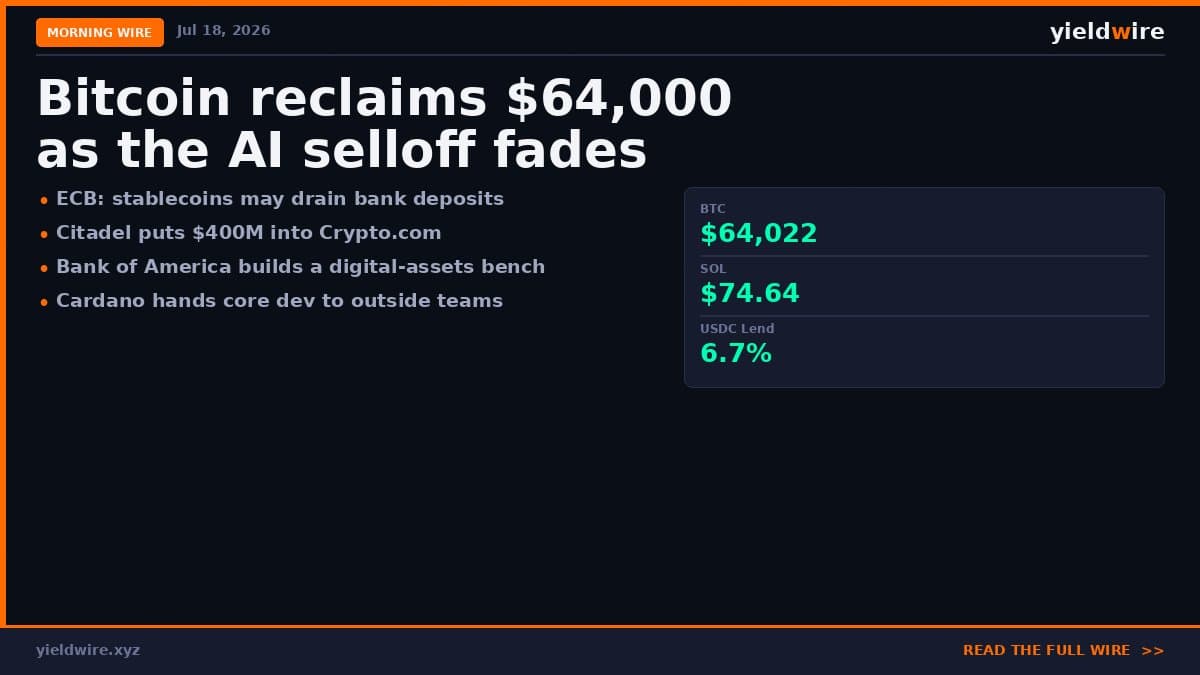
Bitcoin claws back to $64,000 as the AI-driven selloff triggered by China's Kimi K3 model starts to fade.
The Wire — July 18, 2026
Bitcoin reclaims $64,000 as the AI selloff that hit it Friday starts to fade Bitcoin trades at ≈$64,022 this morning, up about 2% on the day, after a rough Friday session that pushed it under $63,000. The trigger was not crypto. Beijing-based Moonshot AI released Kimi K3, a 2.8 trillion parameter mixture-of-experts model that topped both Anthropic and OpenAI on Arena's Frontend Code leaderboard, scoring 1,679 against 1,631 for Claude Fable 5 and 1,618 for GPT-5.6. A Chinese open-weight model beating the US frontier spooked AI equities, the selloff spread from semiconductors to risk assets, and bitcoin went with them. That is the story worth sitting with. Bitcoin is increasingly trading as a leveraged bet on the AI capital cycle, moving with chip sentiment rather than anything on-chain. The full Kimi K3 release lands July 27, so the AI tape stays the thing to watch. (Source: CoinDesk, July 17.) Track BTC yields →
The ECB says stablecoins could pull retail deposits out of European banks An ECB study laid out a "deposit-substitution mechanism": as households and firms move money from bank accounts into stablecoins, banks lean harder on wholesale funding and their capacity to lend narrows. Board member Piero Cipollone put it plainly at a Rome banking conference, "if the use of stablecoins increases in the future, banks will also lose retail deposits," and pitched a digital euro as the counter. This is the same tension US community banks have been raising, now stated by a central bank in a formal paper. With the global stablecoin market cap near $300 billion, a yield-bearing dollar token is a deposit competitor, and regulators have started modelling it as one. (Source: Decrypt, July 17.) Compare stablecoin yields →
Citadel Securities put $400M into Crypto.com at a $20B valuation It is Crypto.com's first institutional raise since it was founded in 2016, and the exchange says the capital funds an expansion into tokenized securities, derivatives and other asset classes. The shape mirrors Citadel's $200M strategic investment in Kraken at the same $20B mark last November. Read the two deals together and the pattern is clear: the largest market maker in US equities is buying positions across crypto's exchange layer as trading in tokenized assets and traditional assets converges onto the same rails. Wall Street is no longer testing the water. (Source: CoinDesk and Decrypt, July 16.)
Bank of America built out a dedicated digital-assets and AI bench The bank named Sonali Theisen head of its global digital assets platform, with a remit spanning stablecoins, tokenized deposits, custody and crypto trade settlement, and tapped Kevin Milsom to run AI transformation across its global markets business. Personnel moves rarely move a price, but they signal where an institution is putting its weight. A bank of this size creating a named seat for tokenized deposits and settlement is the operational version of the ECB warning above: the deposit base is going on-chain, and the incumbents intend to be there when it does. (Source: The Block, July 17.)
Cardano is handing its core software to outside teams Developer Input Output will begin transferring control of key components, the Haskell node, the Plutus platform and the Daedalus wallet, to independent specialist firms such as Se7en Labs and Teragone, starting in August and running into 2027. At least three node implementations in Haskell, Rust and Go will be maintained under community oversight. Founder Charles Hoskinson framed it as "the last stage of the Voltaire era," full decentralization of node development. It is also a live test of whether a chain can spread core maintenance across several companies without slowing shipping or creating coordination gridlock. Worth watching for any network that leans on a single core team. (Source: CoinDesk, July 17.)
Trezor pushed back on ZachXBT calling hardware wallets "complete garbage" The investigator argued that all hardware wallets are unfit for signing transactions or storing serious funds, recommending a dedicated iPhone instead. Trezor commercial chief Danny Sanders half agreed, conceding that "we have clunky solutions out there," especially when firmware updates interrupt high-value transactions, but said ZachXBT was generalizing from a sophisticated-user edge case. ZachXBT singled out Ledger as the worst offender for update-driven UI breakage. The debate matters for anyone self-custodying yield positions: the signing device is part of your risk surface, and the people who audit exploits for a living are not sold on the current tools. (Source: The Block, July 17.) See our risk scores →
On Solana, lending is still paying real yield on stables Away from the macro tape, Solana DeFi TVL sits at ≈$4.81B. Kamino's top USDC lending market prints 6.74% and Loopscale 6.53%, while Jupiter Lend's deep $417M Earn pool pays 4.68%. The compression that ran through Q2 has held, not deepened, and the stable-lending venues are still clearing above 4% at size. For a USDC holder, that remains the simplest on-chain call, provided you weigh the risk score of the venue against the headline number. (Source: DeFiLlama, live.) Browse all Solana yields →
Numbers
- BTC: $64,022 (+1.98%)
- SOL: $74.64 (+1.13%)
- ETH: $1,840 (+1.51%)
- Solana DeFi TVL: $4.81B
- Top USDC yield (Solana): Kamino Lend at 6.74%
Explore all Solana yields → · Risk scores → · Follow @yieldwirexyz
Track all Solana yields in real time
Compare APYs across lending, LP, and liquid staking protocols on the YieldWire dashboard.
Open Dashboard →