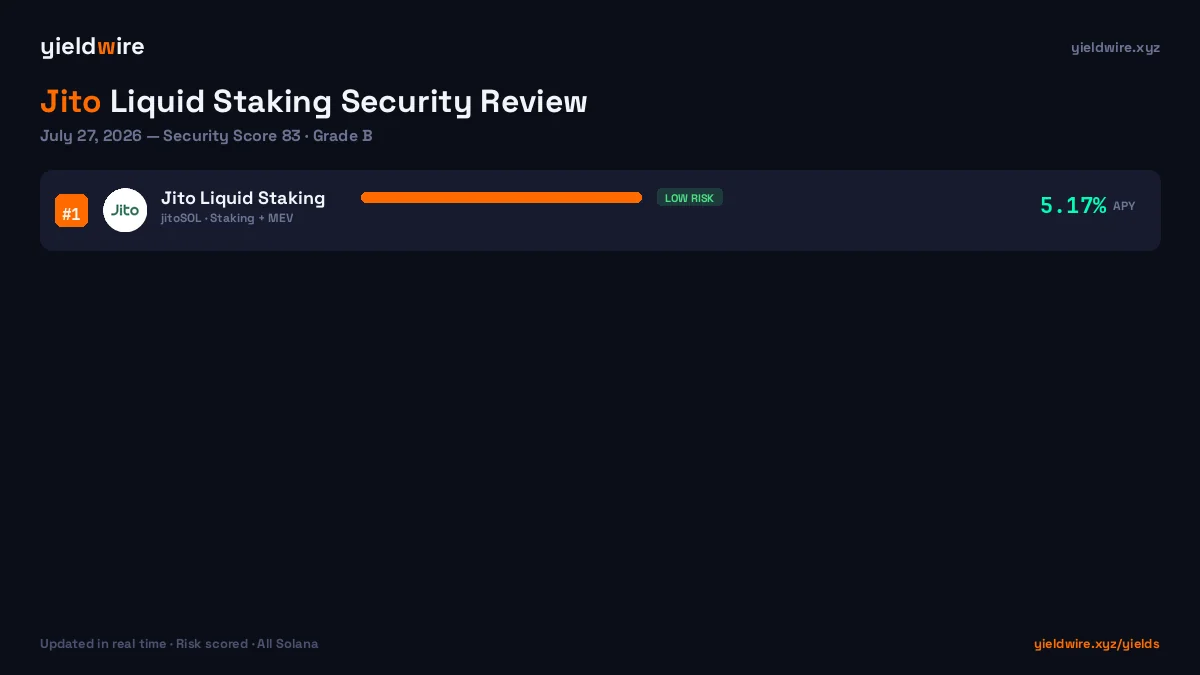
Jito Liquid Staking Security Review: MEV, Validators, and Smart Contract Risk
Jito Liquid Staking holds about $759M in jitoSOL and pays roughly 5.2% by folding MEV into a plain SOL stake. This is the full security read: the SPL stake pool it runs on, the nine plus three audits, how StakeNet picks 400 validators, where TipRouter sends the MEV, and how withdrawals actually clear. yieldwire scores it 83, Grade B.
The Short Version
Jito Liquid Staking is the largest liquid staking token on Solana by a wide margin. jitoSOL holds about $759M as of July 27, 2026, and pays roughly 5.2% APY. The pitch is simple: you get a normal SOL staking yield plus a share of the MEV that Jito's validator network captures, in a token you can move, lend, or trade without waiting out an unstake.
The extra yield comes from an extra layer of code. Native SOL staking talks straight to the validator. jitoSOL wraps that in a stake pool contract, an automated validator selection system, and an MEV distribution pipeline. Each layer adds return and each layer adds surface area.
yieldwire scores Jito Liquid Staking at 83, Grade B, with HIGH confidence. It sits near the top of the liquid staking set, one notch under Marinade at 84. The score reflects a deep audit trail and clean track record, held back from an A by validator concentration at the network level and the reality that a stake pool this large is a single large target. Here is the full breakdown.
What You Are Actually Holding
jitoSOL is a receipt token on Solana Labs' SPL Stake Pool program. You deposit SOL, the pool mints jitoSOL, and the pool delegates your SOL across a set of validators. You are not holding a claim that pays out coupons. You are holding a share of a growing pool.
The token does not keep a fixed peg to SOL. It appreciates. The exchange rate is total pool lamports divided by jitoSOL supply. As staking rewards and MEV tips land in the pool each epoch, the pool grows while the token supply stays flat, so one jitoSOL buys slightly more SOL over time. On July 27, 2026, one jitoSOL is worth well over one SOL, and that gap only widens.
This matters for how you read risk. There is no peg to defend and no depeg event to fear in the usual sense. The number that can move against you is the exchange rate itself, and under current Solana rules that rate only falls in two cases: a critical bug in the stake pool program, or validator slashing. Slashing does not really exist on Solana yet, which removes the most common down-leg that hits liquid staking tokens on other chains. That leaves smart contract risk as the primary threat to the rate.
| Asset | APY | TVL | What drives it |
|---|---|---|---|
| jitoSOL | 5.17% | $759M | SOL staking yield plus MEV share |
| Native SOL stake | ≈5.0% | n/a | Inflation rewards only, no MEV |
| jitoSOL as collateral | near 0% | varies | Yield lives in the token, not the lending pool |
Rates pulled on July 27, 2026 and float every epoch. Treat them as a snapshot.
The Audit History
This is where Jito earns most of its safety score. The foundation runs on the SPL Stake Pool program, which is one of the most reviewed pieces of code on Solana. It has been audited by multiple firms, is used by many staking protocols at once, and has years of live history moving billions in stake with no exploit of the pool logic.
yieldwire counts nine audits on the shared stake pool base plus three reviews on Jito's own infrastructure, the MEV client and the TipRouter distribution layer. That split is the honest way to read it. Most of jitoSOL's contract safety is inherited from battle-tested SPL code that many protocols rely on. The Jito-specific parts, StakeNet's Steward program and the TipRouter merkle machinery, are newer and carry more of the residual risk.
The caveat is the same one that applies to every audited protocol. Audits shrink the odds of a logic bug, they do not prove economic safety. The MEV pipeline in particular is where the novel code lives, and novel code is where surprises come from. A clean history on the stake pool base is necessary. It is not the whole story.
How Validators Get Picked
Delegation is where a liquid staking token can quietly concentrate risk, so it is worth reading closely. Jito does not hand-pick validators. It runs StakeNet, an on-chain selection system built from two programs: a Validator History program that records performance data, and a Steward program that runs the selection logic. Both are public and verifiable, which is a genuine strength versus a manager deciding delegation off-chain.
Validators must clear a hard gate before they are eligible at all. They have to run Jito's MEV client, keep MEV commission at or under 10%, keep validator commission at or under 5%, vote on at least 97% of expected slots across the last 30 epochs, hold at least 5,000 SOL, and stay out of the network superminority, the top third of total stake. Fail any one and the score goes to zero.
Validators that pass are ranked on a four-tier system: inflation commission first, then MEV commission, then validator age, then vote performance. The top 400 by score share the pool, each targeted at one four-hundredth of the total. Rebalancing runs every 10 epochs, roughly every 20 to 30 days, and no more than 7.5% of the pool can move per cycle. If a validator goes delinquent or games its commission, instant unstaking can pull up to 10% of the pool in a single epoch.
The result is real diversification at the pool level. Your stake is spread across hundreds of operators, not parked with a handful. The risk that does not disappear sits one level up: Jito-client validators run a large share of Solana block production overall, so the network's MEV economy leans heavily on one client. That is a Solana-level concentration question, not a jitoSOL smart contract flaw, and it is the main reason the decentralization sub-score lands at 85 rather than higher.
Where the MEV Goes
The MEV share is the whole reason to hold jitoSOL over a plain stake pool token, so the distribution mechanics deserve scrutiny. Tips from block builders and searchers accumulate through the epoch. At the epoch boundary, TipRouter operators snapshot validator and stake accounts, build a merkle tree of who is owed what, and vote on the root. Once more than two thirds agree, the root is set and rewards become claimable.
The split on MEV is 97% to validators and their stakers, 3% protocol fee. For jitoSOL holders the distribution is automatic through the rising exchange rate, so there is nothing to claim by hand. The design is transparent and the numbers are on-chain, which is the right way to run a reward pipeline that decides real money every two days.
The honest risk read: TipRouter is consensus software that a third of operators could stall, and merkle distribution is only as good as the operators computing it. Quorum protects against a single bad actor. It does not make the pipeline free. This is the newest machinery in the stack and it is where a staker should expect the next class of bugs to appear, if any do.
Getting Out
Liquidity is the feature liquid staking sells, so the exit paths matter as much as the entry. There are two.
Direct unstaking burns jitoSOL for SOL at the exact on-chain rate, with a 0.1% fee, and clears within one epoch, so up to about two to three days. No slippage, no spread, the rate is what it is. This is the backstop that keeps jitoSOL honest: whatever a DEX quotes, you can always redeem at the true rate.
The instant path is selling jitoSOL on Jupiter or another venue for immediate SOL. That is one transaction with no wait, but you pay the market spread and eat slippage on large size. In calm markets the spread is thin because liquidity is deep. In a stress event, deep liquidity is exactly what thins out, and the gap between the market price and the redemption rate can widen right when people most want to exit. The direct unstake still clears at the real rate, so the downside is a delay and a temporary discount, not a loss of principal.
One detail worth knowing: depositing an existing stake account routes through the Jito Interceptor, which holds the minted jitoSOL for a 10 hour cooldown with an early-claim fee that decays to zero. It is an anti-abuse measure, not a lockup on normal SOL deposits, but it can surprise anyone migrating a stake account expecting instant jitoSOL.
jitoSOL vs Native Staking
The clean way to frame the trade is against staking SOL yourself. Native staking has no smart contract layer at all, so it carries the least code risk you can get on Solana. The cost is that native stake earns inflation rewards only, with no MEV boost, and it is illiquid: you wait a full epoch to unstake and you cannot use the position as collateral in the meantime.
jitoSOL adds the MEV share, full liquidity, and DeFi composability. It buys those with three extra layers of code: the stake pool program, StakeNet, and TipRouter. For most holders the pool's audit depth and clean record make that trade reasonable, which is why it scores an 83. If your only goal is minimum smart contract exposure and you do not need liquidity, native staking is the more conservative call. Everyone else is paying a small, well-audited amount of contract risk for meaningfully more utility.
You can compare jitoSOL against every other Solana liquid staking token on the liquid staking category page, see the full methodology behind the 83 on the security page, and model the yield on your own position with the staking calculator.
The Verdict
Jito Liquid Staking scores 83, Grade B, HIGH confidence. It is the deepest liquid staking market on Solana, running on the most reviewed stake pool code on the chain, with an MEV pipeline that pays real extra yield and distributes it transparently. The marks against it are network-level validator concentration around the Jito client and the plain fact that any pool this size is a large target holding a lot behind one set of contracts.
For a SOL holder who wants staking yield plus MEV and the ability to use the position across DeFi, jitoSOL is one of the strongest options on Solana on a risk-adjusted basis. Size it against your own comfort with smart contract exposure, and keep the direct unstake path in mind as the exit that always clears at the real rate.
This is a security review, not investment advice. APYs and TVL move every epoch. Do your own research before staking.
Track all Solana yields in real time
Compare APYs across lending, LP, and liquid staking protocols on the YieldWire dashboard.
Open Dashboard →