Reading Ethereum Transaction Status Without Treating a Broadcast as Final
A transaction hash is useful evidence, but it is not the same as inclusion, execution, or finality. Learn which Ethereum status signals answer each question before you act on a transfer or contract call.
A transaction hash is a reference, not a result
After a wallet submits an Ethereum transaction, it usually presents a hash and a success-like status immediately. That is useful, but it answers a narrow question: the wallet created a signed payload and handed it to a node or service for broadcast. It does not yet prove that a validator included the transaction in a block, that the EVM call completed as intended, or that a DeFi position has reached the state an interface expects.
This distinction matters most when the transaction changes a position with a deadline. A token transfer may still be pending while a user waits for collateral to arrive. A swap can be included but revert. A lending deposit can be visible in a wallet before the application has refreshed its own indexer. Treating every early status as final can lead to a second submission, a mistaken support ticket, or a decision based on a balance that is not yet spendable in the intended protocol.
Ethereum.org's transaction documentation describes a transaction as a signed instruction that changes EVM state once it is executed. The practical reading order is therefore simple: identify whether the transaction was broadcast, included, executed, and then confirmed to the level appropriate for the action.
Four states that should not be collapsed
Wallets, block explorers, RPC providers, and apps use slightly different labels. The underlying questions are more stable than the labels.
| Status signal | What it establishes | What it does not establish |
|---|---|---|
| Signed | The account authorized a specific transaction payload | That any node accepted or relayed it |
| Broadcast or submitted | At least one provider received the signed payload | That it entered a block or changed state |
| Pending | The transaction is known to a provider but is not yet in a canonical block | That it will be included, or included at the quoted fee |
| Included with a receipt | A block contains the transaction and execution produced a receipt | That a downstream app has indexed the result, or that more confirmations are unnecessary |
The signed transaction contains more than the destination address and value. Ethereum documentation lists fields such as the sender, recipient, signature, nonce, gas limit, and fee parameters. These fields determine what the network is being asked to do. They do not guarantee that the requested action will complete successfully once it reaches the EVM.
For a direct transfer to an externally owned account, inclusion normally means the balance transition described by the transaction took place. A contract call needs another check: the receipt status and the relevant emitted events or state update. A transaction can consume gas and still revert because a contract condition was not met. An explorer page that shows a transaction in a block is not enough to conclude that a swap, approval, or vault deposit succeeded as intended.
Broadcast is the start of the delivery path
A wallet signs locally, then sends the signed payload to an RPC endpoint, relay, or wallet service. The provider may broadcast it to peers. At this point, the hash is a stable identifier for the requested transaction, not a certificate that the network accepted it for execution.
Several ordinary outcomes can follow a broadcast:
- The transaction reaches validators and waits in their transaction pools.
- It is included in a block and executes.
- It remains pending because its fee settings are not competitive for current demand.
- It is replaced by another transaction from the same account and nonce.
- A provider does not relay it widely enough, or the provider cannot see it after a restart.
That is why a wallet message such as "transaction submitted" should be read as a delivery milestone. Do not resend the same action merely because a few seconds have passed. First inspect the hash in an independent explorer or RPC view, then check the account nonce and whether a replacement transaction was created.
The nonce is especially useful for this diagnosis. Ethereum accounts use a sequential transaction count. A later transaction with the same nonce can replace an earlier pending transaction, subject to the receiving nodes' replacement rules. A later nonce cannot normally execute ahead of an earlier missing nonce from the same account. This is one reason a single stuck transaction can make a wallet appear to have several unrelated pending actions.
Inclusion and execution answer different questions
Once a validator includes the transaction in a validated block, an explorer can show a block number and a transaction receipt. The receipt is the most useful shift in evidence. It tells the reader that execution was attempted as part of a block. For a contract interaction, inspect the receipt status before treating the application action as complete.
Consider a hypothetical vault deposit. A user approves a token, then sends a deposit call. The first transaction may be included successfully but only grants an allowance. The second may be pending, included and successful, or included and reverted because the vault has a cap or its input changed. A dashboard that only sees the approval cannot claim that the deposit happened. A dashboard that sees the deposit hash but has not checked the receipt cannot claim that the contract call succeeded.
Use the transaction details to separate these cases:
| Check | Why it matters for a contract call |
|---|---|
| Block number | Shows inclusion in a block rather than provider-only visibility |
| Receipt status | Distinguishes successful execution from a reverted call |
| Logs and decoded events | Help confirm which contract action the call emitted |
| To address and input data | Identify the contract and method the wallet actually called |
| Token balances or protocol position | Confirm the state change the user expected, after the app has indexed it |
The last row is not redundant. DeFi apps often combine on-chain reads, indexers, and cached APIs. A transaction can be final enough on-chain while the dashboard is briefly behind. Conversely, a dashboard optimistic update can appear before the transaction is included. For a time-sensitive decision, use an explorer or a direct contract read as the stronger source of truth.
Confirmations reduce uncertainty, not every kind of risk
An included transaction has one confirmation when its block is part of the chain a provider is following. Additional blocks built after it add confirmations. More confirmations reduce the chance that a recent block is displaced in a reorganization, but there is no universal confirmation count that fits every action.
The right threshold depends on what is at stake and what the connected application requires. A small self-transfer and a collateral movement that could affect a liquidation buffer do not carry the same operational consequence. Some bridges, exchanges, and protocols publish their own confirmation requirements. Those requirements are part of the route, not a general statement that an Ethereum transaction is either final or not final.
Confirmation also does not repair a reverted call, an approval sent to the wrong contract, or a price movement that changes the economics of a position. It only adds confidence that the included transaction remains in the canonical history. Keep that distinction clear when assessing yield positions: transaction finality is one layer of operational risk, separate from smart-contract, oracle, liquidity, and market risk.
A compact workflow for pending transactions
When a wallet or protocol page shows an unfamiliar status, avoid guessing from color alone. Work through the evidence in order.
- Copy the hash from the wallet and open it in a reputable explorer.
- Check whether the explorer shows a block number or only a pending record.
- If included, read the receipt status before assuming the contract action worked.
- Compare the destination contract and action with the one you meant to sign.
- Check the resulting token balance, allowance, or protocol position after the application has refreshed.
- If it is still pending, inspect the nonce before submitting any replacement or cancellation action.
This workflow is deliberately conservative. It does not tell a user to wait for a fixed number of blocks or to change fee settings. Those decisions depend on network conditions, the wallet's replacement flow, and the protocol's own rules. It gives the user a way to identify which question remains unanswered.
What YieldWire can surface beside a yield
Yield comparisons often focus on APY and TVL because they are visible and easy to rank. Execution status belongs in the same practical view when a reader moves funds between a wallet and a position. A rate cannot compensate for a transaction the user misunderstood, a contract call that reverted, or collateral that has not arrived where the user expects it.
On YieldWire's yields page, compare the asset route and protocol controls before treating a displayed rate as the whole position. The security page frames the same principle at protocol level: a risk review should make dependencies visible rather than turn a green label into a verdict. For a transaction, the dependency chain includes the wallet, RPC path, included block, contract execution, and application indexing.
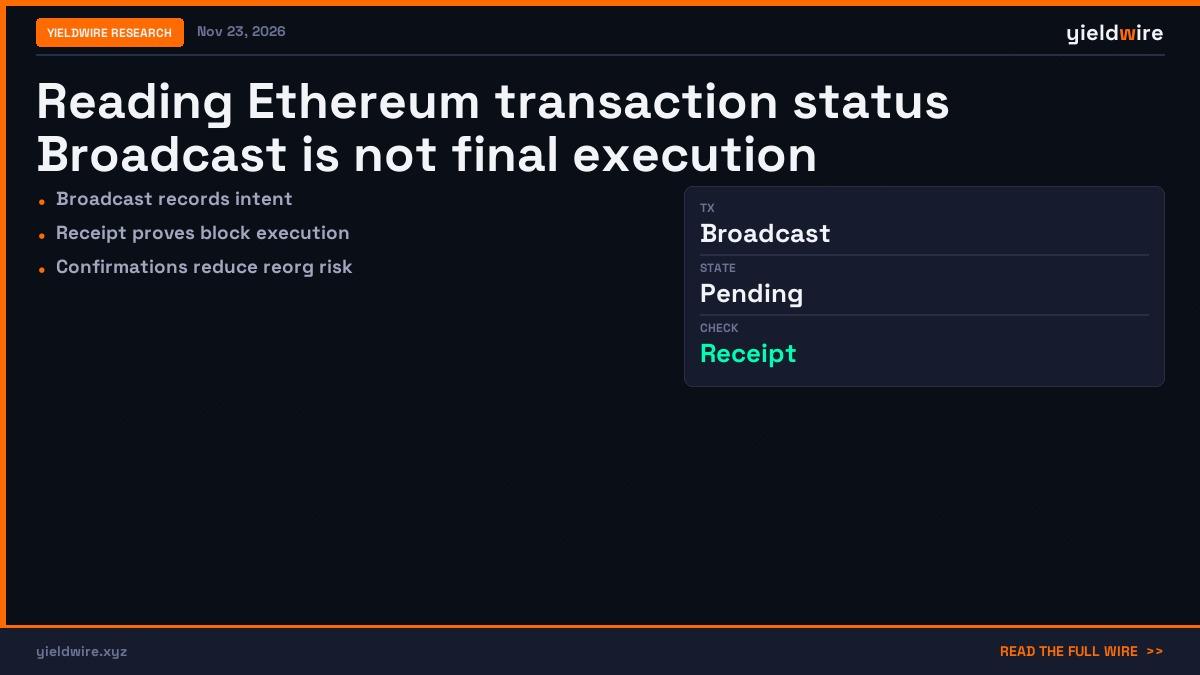
The useful habit is modest: a broadcast is evidence of intent, a receipt is evidence of execution, and confirmations add confidence in inclusion. Read each status for the claim it can support. That makes it easier to catch an incomplete transaction before it becomes a more expensive position-management error.
Source: Ethereum.org, Transactions.
This article is educational and is not financial advice. Digital assets and DeFi positions carry risk, including the risk of loss.
Track all Solana yields in real time
Compare APYs across lending, LP, and liquid staking protocols on the YieldWire dashboard.
Open Dashboard →