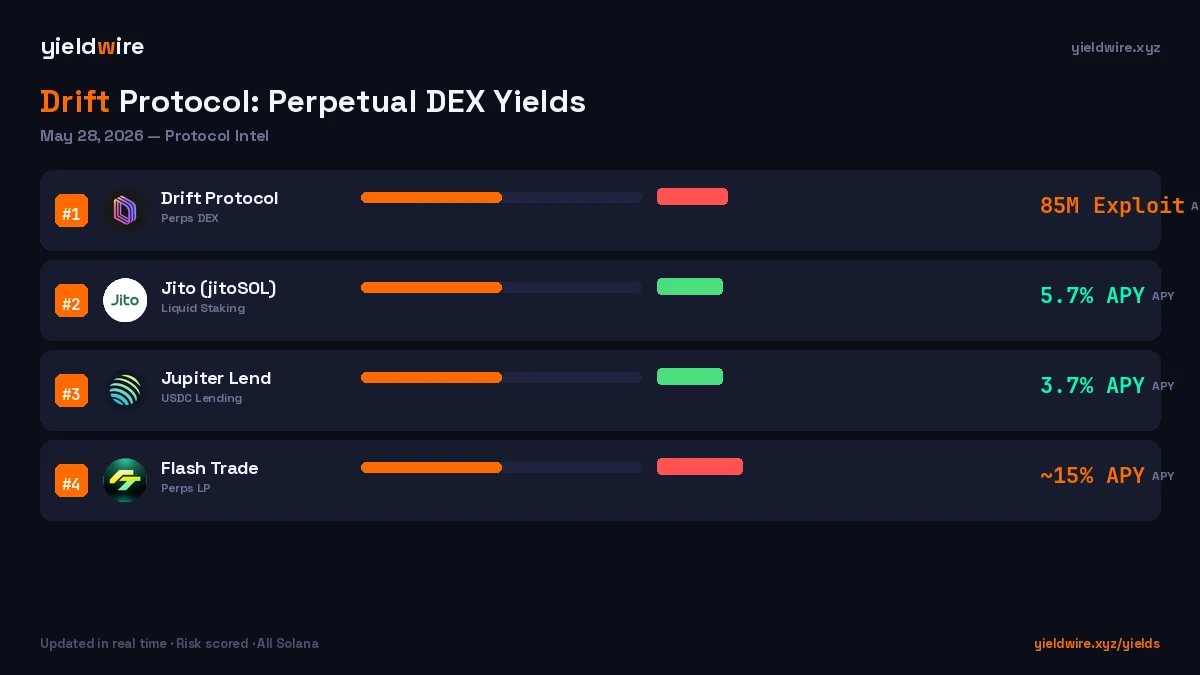
Drift Protocol: Perpetual DEX Yields on Solana
Drift was Solana's largest perpetual futures DEX with $550M in TVL. Then a $285M exploit hit on April 1. Here is what the yield landscape looked like, what went wrong, and where the protocol stands now.
What Drift Built
Drift started as a perpetual futures exchange on Solana in 2021 and grew into something broader: a hybrid trading platform combining perps, spot markets, and lending under one set of smart contracts. By Q1 2026 it held $550M in TVL, making it the largest orderbook-style perpetuals DEX on the chain.
The architecture is worth understanding because it explains where yields come from. Drift runs a JIT (just-in-time) auction system for order execution. When a taker submits a market order, makers have a short window to fill it at a better price than the protocol's vAMM would offer. If no maker steps in, the vAMM catches the order as a backstop. The result: CEX-style execution speed with on-chain settlement.
Trading covered BTC-PERP, ETH-PERP, SOL-PERP at up to 20x leverage, plus 30+ smaller markets (JUP, JTO, PYTH, DOGE, memecoins) at up to 10x. Spot markets and a borrow-lend facility rounded out the product.
Where the Yields Came From
Drift generated yield through three main channels. Each carried different risk profiles.
Insurance Fund Staking. Users could deposit USDC, SOL, BTC, or ETH into separate Insurance Fund vaults. These vaults collected a share of trading fees, liquidation fees, and borrowing fees from the exchange. The USDC vault earned the most because it backstopped perpetual trading, the protocol's core volume driver. Historical APYs on the USDC vault ranged from 8% to 15% depending on trading volume, with the other asset vaults running lower.
The catch: insurance fund stakers are first in line to absorb bad debt. If a large liquidation cascade creates a deficit the protocol cannot cover, the insurance fund takes the hit before any other backstop kicks in. This is not theoretical. It is the design.
DAMM Vault LPing. Drift's dynamic AMM (DAMM) vaults allowed liquidity providers to earn trading fees, funding payments, and base yield from participating as the protocol's baseline liquidity layer. Returns varied widely depending on market conditions. In high-volatility weeks, DAMM vault LPs could see 20%+ annualized. In quiet periods, single digits.
Borrow-Lend. The integrated lending market paid variable interest on deposits. Rates tracked utilization: USDC lending yields sat between 3% and 8%, similar to standalone lending protocols like Kamino or Jupiter Lend.
The April 1 Exploit
On April 1, 2026, an attacker drained $285M from Drift in under 12 minutes. It was the largest DeFi exploit of 2026 and one of the largest in Solana's history.
The attack did not exploit a smart contract bug. It exploited governance.
Drift's Security Council operated on a Squads V4 multisig with a 2-out-of-5 signing threshold. On March 26, five days before the attack, the protocol had migrated to a new multisig configuration with zero timelock. That meant any transaction approved by two signers executed instantly, with no delay window for detection or intervention.
The attacker social-engineered two of the five signers into pre-signing malicious transactions. They used Solana's durable nonce feature to keep those signatures valid indefinitely (normal Solana transactions expire after roughly 60 seconds). When the attacker was ready, they submitted both pre-signed transactions, gained admin control, and drained the vaults in a single atomic operation.
Three details stand out.
First, the 2/5 threshold was low for a protocol holding $550M. Most comparably sized protocols on Solana use 3/5 or higher. Jupiter Lend operates with a 12-hour timelock on top of its multisig, which means even a compromised signer set would give users half a day to exit before any change takes effect.
Second, the zero-timelock migration happened five days before the exploit. Whether this was coincidence or part of the attack preparation is still under investigation. The timing is notable.
Third, two prior audits (Trail of Bits in 2022, ClawSecure in February 2026) did not flag the governance configuration as a risk. Audits check code, not operational security posture. This is why yieldwire's security scoring weights governance controls separately from audit count.
Recovery and Current Status
Drift is not dead. The team secured a $148M rescue package led by Tether, which will replace USDC with USDT as the protocol's settlement asset.
The recovery plan:
- Recovery tokens pegged 1:1 to verified user losses. The recovery pool starts at roughly $3.8M and could grow to $151M over time through protocol revenue, partner capital, and Tether's matched deployment of up to $127.5M.
- Relaunch targeted for Q2 2026 as a "security-first" exchange. New multisig controls, time-locked operations, key rotation, and a reduced product scope focused on perpetuals trading.
- Insurance Fund deposits were not directly impacted by the exploit. Stakers can withdraw once the protocol goes live again.
- Independent audits by OtterSec and Asymmetric Research required before relaunch.
As of late May 2026, TVL sits around $242M, down from $550M pre-exploit. Trading has not resumed. The relaunch date remains tentative.
What This Means for Yield Seekers
Drift's exploit is a case study in why yield numbers alone are insufficient.
Before April 1, a user looking at Drift's Insurance Fund would have seen an 8-15% APY on USDC with the largest perps DEX on Solana. The protocol had two audits. It was generating real revenue. The yields were organic, not subsidized by token emissions.
None of that mattered when the governance layer failed.
| Factor | Pre-exploit Drift | Post-exploit Drift |
|---|---|---|
| TVL | $550M | ~$242M (frozen) |
| Insurance Fund APY (USDC) | 8-15% | Trading paused |
| Multisig config | 2/5, zero timelock | TBD (relaunch) |
| Audit count | 2 (Trail of Bits, ClawSecure) | OtterSec + Asymmetric pending |
| Trading status | Live, 30+ markets | Paused |
| Settlement asset | USDC | USDT (post-relaunch) |
For context, Flash Trade's FLP vault pays roughly 15% APY on $10M TVL with a simpler product scope. Raydium's CLMM pools pay 18-25% APY with $1B TVL but carry their own governance gaps. Each of these protocols sits on a different point of the risk curve, and none of them had a $285M incident in their recent history.
yieldwire's Take
We will score Drift's security posture once the relaunch is complete and the new governance configuration is public. Scoring a protocol in mid-recovery would produce a misleading number.
What we can say now: Drift's pre-exploit security score would have been in the C range (similar to Raydium's 63). A 2/5 multisig with zero timelock on $550M of user funds was always a structural weakness, and the market priced it at zero until it wasn't zero anymore.
When Drift relaunches, watch for three things. The new multisig threshold (3/5 minimum to be competitive). The timelock duration (12 hours is the current benchmark set by Jupiter). And the audit scope (governance configuration, not just smart contract logic).
We will publish an updated profile on yieldwire.xyz/protocol/drift once trading resumes.
Methodology
TVL figures sourced from DeFiLlama as of May 28, 2026. Pre-exploit data from DeFiLlama historical records and Drift's public documentation. Exploit details sourced from incident reports by BlockSec, Chainalysis, Quill Audits, and Drift's own recovery updates. Insurance Fund yield ranges are historical estimates from Q4 2025 through Q1 2026 trading activity. Recovery plan details from Drift's April 16, 2026 incident recovery update and CoinDesk reporting.
See the live Drift profile when available: yieldwire.xyz/protocol/drift.
This is not financial advice. Drift Protocol is currently in recovery mode following a major exploit. Trading is paused. Past yields are not indicative of future returns. Users should conduct their own due diligence before depositing funds into any DeFi protocol.
Track all Solana yields in real time
Compare APYs across lending, LP, and liquid staking protocols on the YieldWire dashboard.
Open Dashboard →